The Economics of SpaceX, Blue Origin and the Space Industry
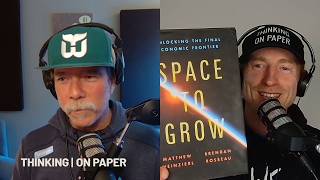
Harvard Business School economist Matt Weinzierl and Brendan Rosseau wrote Space to Grow. Weinzierl thinks the laws of economics are universal, and that nothing in them requires gravity.
The rebellion against the 5-minute AI book summary.
Book-club episodes that turn major technology books into a slow, connective layer for the show.
Harvard Business School economist Matt Weinzierl and Brendan Rosseau wrote Space to Grow. Weinzierl thinks the laws of economics are universal, and that nothing in them requires gravity.
Anders Sandberg is driven by curiosity, and the thing he is most curious about is the future. This conversation goes almost everywhere.
Who owns the riches of the solar system? The closing chapters of Space to Grow ask whether we can stop our power games, conflict and corruption from following us into space.
What happens when low Earth orbit fills with junk faster than it clears? Donald Kessler warned in 1978 that collisions could accumulate faster than atmospheric drag removes the debris.
What happened when space startups went public through SPACs? Space to Grow follows the boom, including Astra, which went public before any of its rockets had reached orbit.
Why would anyone pay to go to space? Chapter four of Space to Grow answers with Planet, the company behind a constellation of small Earth-imaging satellites called doves.
Was SpaceX inevitable? The authors of Space to Grow put its success down to iteration, vertical integration, economies of scale and reusability, and culture.
Can a fusion startup really turn mercury into gold? For our last show of the year, we pick favourites from someone else's list of 52 things he learned.
Philosopher Pia Lauritzen has collected and analysed more than 30,000 questions from people around the world. Most start with what or how. Very few ask why.
Who pays the human cost of AI? Part two of Karen Hao's Empire of AI ends with the data annotation workers in Kenya, Venezuela and Colombia who labelled disturbing content for AI models.
Federico Faggin thinks it's absurd that molecules assembled themselves into something that knows it exists. The last chapter of Irreducible is where he says what follows from that.
Does probability mean anything without consciousness? In chapter twelve of Irreducible, Federico Faggin argues that probability has relevance only if consciousness exists.
Are we digital and finite? In chapter ten of Irreducible, Federico Faggin says we are vastness, potentially beyond all limits.
Is materialism enough to explain us? Federico Faggin argues that consciousness, free will and life existed from the very beginning as properties of the whole, which he calls the One.
Can quantum entanglement prove we have free will? Federico Faggin thinks so, and chapter eight of Irreducible is where he makes the case.
Is the scent of a rose a signal? Federico Faggin says it isn't. It's a quale, something completely different from the electrical signals generated by the brain's neural networks.
What separates a living cell from a computer? In chapter six of Irreducible, Federico Faggin argues that a cell has all the classical characteristics of a machine, plus quantum characteristics that come from live information.
Can a machine ever be curious? Federico Faggin, who designed the Intel 4004, argues that comprehension and curiosity can't come from an algorithm.
Has the universe always been conscious? Federico Faggin, who made the first microprocessor, puts forward the hypothesis that it has, and that it has always had free will.
Can a computer experience anything? Federico Faggin argues that computers are completely deterministic and predictable, while living organisms process information using every phenomenon available to them.
Is AI the problem, or are we? Yuval Noah Harari writes that computers aren't yet powerful enough to escape our control by themselves, and that as long as humanity stands united, we can build institutions to control AI.
Is creativity unique to humans? In chapter nine of Nexus, Yuval Noah Harari calls that a common but mistaken assumption, one of three he identifies in how we think about automation.
Could AI weaken dictators as much as it serves them? Yuval Noah Harari argues that the weakest spot in the AI shield is with dictators.
Who stops clapping first? Chapter eight of Nexus opens with Solzhenitsyn's account of a Stalin-era party conference where the applause ran for eleven minutes, until a paper factory director sat down and was arrested that night.
Who pays for the surveillance of modern life? Yuval Noah Harari points out that we pay for the digital agents ourselves, and carry them with us wherever we go.
Has the AI takeover already begun? Yuval Noah Harari argues that computers able to pursue goals and make decisions by themselves change the fundamental structure of our information networks.
Why can democracies correct their mistakes when totalitarian regimes can't? In chapter five of Nexus, Yuval Noah Harari treats both as ways of moving information.
What gives religion its authority? Yuval Noah Harari argues that its most important function is to provide superhuman legitimacy for social order.
Why are stories more powerful than truth? Yuval Noah Harari argues that humans rule the world because we cooperate in large numbers, and we cooperate in large numbers because we tell stories.
Does more information make us wiser? Yuval Noah Harari opens Nexus by arguing that power isn't wisdom, and that the naive view of information gets it wrong.