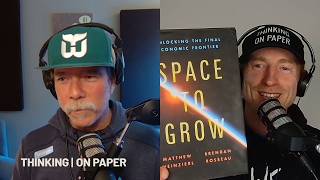
Who Owns Space? Space to Grow Book Club
Mark asks whether national security, the subject of the book's final chapter, already answers the question of who owns space. There would be no space industry without national security.



In this episode · 20 chapters
- The hard part is coordination
- Property rights have always been part of space
- What is actually in an asteroid
- The man who wanted to be an asteroid miner
- Is asteroid mining legal?
- The Outer Space Treaty
- Licking the cookie
- Planetary Resources and the plan
- The 2015 US space resources act
- Utilize, and what lawyers mean by it
- How other countries took it
- Locke, Hume and Kant in the room
- The global south, and who is not in the room
- Whoever mines first sets the precedent
- Licensing, franchising and a consortium
- What happens if China is left out
- National security, DARPA and who funds it
- The weaponization of space
- The prisoner's dilemma
- How the book ends
As we just weave through this whole book, the only thing that keeps ringing in the back of my head is what can we do as a society to not bring our terrestrial baggage into space?
Mark and Jeremy finish Space to Grow by Matthew Weinzierl and Brendan Rousseau. They start with Planetary Resources and Peter Diamandis, then trace the law from the 1967 Outer Space Treaty to the 2015 US act that let American companies own and sell space resources.
Jeremy convenes Locke, Kant, Hume and Rousseau to write the rules, and floats licensing asteroids for five years. Mark asks what happens when China is left out. The closing chapter on the weaponisation of space and the prisoner's dilemma brings the argument down to Earth.
Space to Grow by Matthew Weinzierl and Brendan Rosseau ends, in chapters 11 and 12, with two questions: who owns the resources of the solar system, and how national security is shaping the space industry. Read on the Thinking On Paper podcast book club, the chapters cover the 1967 Outer Space Treaty, a 2015 US law on space resources, asteroid mining and the Space Force.
What did the 1967 Outer Space Treaty say about space resources?
The 1967 Outer Space Treaty, agreed by both the US and the Soviet Union, made outer space “the province of all mankind”, but left unclear whether anyone could claim resources from an asteroid.
Why did Planetary Resources lobby for a space mining law?
Peter Diamandis wanted to be an asteroid miner from childhood. His company, Planetary Resources, needed a legal basis to mine asteroids, so it lobbied for one.
What did the 2015 US space resources law allow?
A 2015 US law allowed American companies to “possess, own, transport, use and sell” resources they obtain in space. Other countries objected that one nation should not write the rules alone.
How will space mining affect the global south?
Countries of the global south will not be extracting space resources in the early phases, said Olavo Bittencourt of the Hague space resources working group. “But they will suffer the consequences.”
What military milestones does Space to Grow trace?
The book traces the military side: the 1999 Rumsfeld Commission’s warning of a “space pearl harbour”, a 2018 US strategy designating space a theatre of war, the Space Force, and the Wolf Amendment barring NASA from working with China after China’s anti-satellite test.
Where Mark and Jeremy disagree
Mark argues that whoever mines an asteroid first will set the precedent, whatever the rules say. Jeremy proposes time-limited mining licences, with part of the profits paid into a fund for the global south.
Links from this episode
Questions
Who owns space?
The 1967 Outer Space Treaty, agreed by both the US and the Soviet Union, made outer space “the province of all mankind”, but left unclear whether anyone could claim resources from an asteroid.
What do the last chapters of Space to Grow cover?
Space to Grow by Matthew Weinzierl and Brendan Rosseau ends, in chapters 11 and 12, with two questions: who owns the resources of the solar system, and how national security is shaping the space industry. Read on the Thinking On Paper podcast book club, the chapters cover the 1967 Outer Space Treaty, a 2015 US law on space resources, asteroid mining and the Space Force.
Who founded Planetary Resources?
Peter Diamandis wanted to be an asteroid miner from childhood. His company, Planetary Resources, needed a legal basis to mine asteroids, so it lobbied for one.
How long would Jeremy license asteroids for?
Jeremy convenes Locke, Kant, Hume and Rousseau to write the rules, and floats licensing asteroids for five years.
Transcript
Mark Fielding Disruptors and curious minds. global conflict has reached its highest level since World War II. 59 active conflicts, including major wars in the Middle Eastern Ukraine, as reported by the 2025 Global Peace Index. Other reports indicate over 120 armed conflicts with over 60 nations involved. Power.
resources, energy, religion. The natural state of this planet is disagreement, division and war. And if SpaceX are going to build a civilization at the south pole of the moon, what are the US going to do if they rock up and China have planted a flag in the sea of storms? Who owns the riches and resources of the solar system? Who owns the precious metals buried on the surface of asteroids? Who has the right to mine them?
From the Outer Space Treaty of 1967 to the Moon Treaty of 1979 to NASA, human politicians and companies like Deep Space Industries and Astroforge have been trying to create a way to avoid taking the power games, subterfuge, blame and political rampant chaos and corruption to put it nicely.
to space. Will it work? Should it work? Can it work? We're reading Space to Grow by Matthew Weinzierl and Brendan Rousseau. Thinking on Paper is the USS Enterprise of the tech podcast and Jeremy is Spock. So Jeremy, can you find some balance between cold logic and human emotion? Please.
The hard part is coordination
Jeremy Gilbertson Whew, what a kickstart, man. I love that, dude. Got me fired up. As we just weave through this whole book, the only thing that keeps ringing in the back of my head is what can we do as a society to not bring our terrestrial baggage into space? Like, that's the mission, that's the mission.
should you choose to accept it, space industry.
Jeremy Gilbertson But is it easy? No, it's easy to state. it's hard to solve. we talk humans allegedly being pretty good at coordinating, cooperating, collaborating. That's how we succeeded our evolution. as things become appealing to grab and control, better of us is taken.
rather than the more altruistic version of us.
Property rights have always been part of space
Mark Fielding What is reassuring though, so since the birth of the space industry, property rights and the politics of ownership and sovereignty in space has been at the front of the agenda. So they are thinking about it. They have been thinking about it. They've been actively working on it to a certain degree since the beginning. I mean, even though the whole space industry was born out of a Cold War, essentially.
Jeremy Gilbertson Right. And a proof that one nation could do something over another. The first to this, it was a signal. It was a power signal ⁓ in a lot of ways, even though it was a beautiful scientific...
achievement to be able to pull this, this stuff off. But again, it was a signal in this power struggle too. yeah, we're going to, we're going to dive in and out of this, but planetary resources is where we're starting. six degrees of Peter Diamandis, you know, we've had some X prize folks on the show before Peter, we would love to have you on the show. at some point think on paper with us, planetary resources was started out.
Mark Fielding Come on Peter, come and think on paper with us.
What is actually in an asteroid
Jeremy Gilbertson with the idea these jewels, are flying about our solar system. And they actually have so much resource potential consolidated in them to the tune of like, if you think about it, think one was stated to 10,000, the value of 10,000 quadrillion dollars, which is 100,000 times the global GDP of Earth in 2023. So what happens when that? Well, yeah, just that just drops down, boom. And we have flood platinum and all of these other rare earth metals landing in the market. But again, that could do one of two things. Yeah, sure. freaks the market out. But also it makes things that we make out of platinum.
Mark Fielding That would crash the market.
Jeremy Gilbertson easier to make and lower the cost for people that need a medical devices and all of that kind of stuff. So really interesting to think about it from a bigger picture. This is the societal viewpoint, right? Not just, holy crap, we figured out how to generate enough exit velocity to get off earth. We've landed on the moon once we're doing a bunch of stuff in orbit, really cool, really cool stuff. But then how do we become good stewards of making all this stuff work for our advantage?
The man who wanted to be an asteroid miner
Mark Fielding as Peter Diamandis, who, since his childhood, he wanted to do one thing. Be an asteroid miner. ⁓
Jeremy Gilbertson That's bonkers to me, right? I originally, as
I was reading that sentence, I was like, I wanted to be an astronaut and I made sure I had to read it twice. I'm like, no, he said asteroid minor. when you're a kid, yeah, wow, I wonder.
Mark Fielding yeah, well, we'll have to ask him when he's on thinking on paper. So Planetary Resources Inc. He almost got his wish.
Is asteroid mining legal?
Mark Fielding Was it legal? Is the idea of mining asteroids for platinum and rare minerals resources, is it legal? Was it legal back then? What was the year? we're talking in the early.
Jeremy Gilbertson It wasn't initially, but what does every good company do involves certain aspect of corralling resources or getting permission is they lobby. create, they attempt to present legislation that makes what they're doing a little bit So that's exactly what they
The Outer Space Treaty
Mark Fielding Their company had a framework in place that they could think about, at least think on, the Outer Space Treaty, a binding set of rules forming the basis of international space law passed in the United Nations in 1967. Remarkable that both the US and the Soviet Union were signed on.
They agreed that outer space was the province of all mankind.
But did that include claiming resources on an asteroid? Wasn't really clear, I don't think, was it?
Licking the cookie
Jeremy Gilbertson Yeah. Well then we get into this whole like lick the cookie reference just so no one else would eat it. Um, I don't know. I'm thinking of like dogs peeing on their, you know, peeing in their backyard to mark their territory. yeah. So, so the root of all this was this outer space treaty. There was some framework they go, they, they go to try to present a concept, a bill for new legislation to allow them to mine.
the asteroids that they somehow can get to because there's there's value, right? Number one, how the hell do I get to the asteroid? Okay, that's going to require some money. How the hell do I make sure the asteroid has stuff worth mining that takes some money that takes some science. And then how do I my how do I land on the asteroid mine the stuff and bring it back? That takes some money, right? So so there's an idea of like, hey, if I'm if I'm putting energy into something, this is a Locke This is a John Locke ism, I think. And it was cool to see these old philosophies woven in of how people deal with property rights, ownership rights. But John Locke said that if you put your labor to something, and it generates an output, that output is yours. Again, like very, very high level. But conceptually, you know, it sounds pretty fair, right? Like, Mark, if you spend $5 billion, figuring out how to mine asteroids, you land up there, you mine you, you're able to do it, you pull it off, you come back, you don't kill yourself. You bring back a pile of money. There's value in what you did and you deserve to reap the rewards. Do you not?
Mark Fielding gold industry, the diamond industry, the oil industry, every new frontier since the dawn of humanity would say that that's kind of how things work, isn't it?
Jeremy Gilbertson I've spent some time in the writing of specifications. So specifications for systems, And there was one point I was on a working group that ⁓ was trying to decide the system specifications for ⁓ structure cabling, the type of cable you use, the performance you get, you know, the performance you get when you connect the cable or something, there are all these rules and regs.
And I was working for a distributor at the time. So I had no, you know, specific affiliation to any one manufacturer. I sold them all, but each of the manufacturers would participate in that working group as well. So when it gets written with the people on the working group, the products tend to get approved in the specification for the people that were on the working group. It's like, it doesn't always work out that way, but it, their reasoning for being on the working group is to try to figure out if their products can fit that bill, they'd like their products to fit that bill. So similarly, long-winded analogy, but similarly, there's this first in time principle that is kind of written into this language of the bill. planetary res...
Mark Fielding know, sorry, I'm going have stop you there because I can't get Sam Altman out of my head as you're talking about this and the Empire of AI and our book club with Karen Hao and how OpenAI essentially did what you're explaining that you did or the companies that you that your suppliers did and planetary resources and the mining companies did. If you're there sitting with the politicians telling them what the law should be, then yeah, they're going to bend to your will and your
Jeremy Gilbertson Well, so in the case of the politicians, they're largely non-technical and potentially uninformed. So they're trusting this oracle, very charismatic, right or wrong, or just allowing that oracle's language to proceed through because of something behind the scenes. Who knows, right? But this first in principle thing, pushed back a little bit. So DSI was the planetary resource competitor. They pushed back, you know, like, hey, this first in principle thing is a little funky.
Planetary Resources and the plan
Jeremy Gilbertson because planetary resources, your step one is to put satellites into orbit and do some imaging similar to what planet is doing now, I think was their first, hey, we'll try to get some revenue by imaging the earth or doing some kind of space to earth information grab consolidation and sell. the idea that DSI was like, well, hey, first in time could mean you saw an asteroid that you think has potential. Of course you're gonna see asteroids, you got constellations of satellites written about. So there was that initial pushback, but fast forward 2015, talk to us about what was actually approved.
The 2015 US space resources act
Mark Fielding titled Space Resource Exploration and Utilization Act became law granting American citizens the right to engage in and commercial recovery of space resources free from harmful interference.
US companies were now entitled to any asteroid resource or space resources obtained and were allowed to "possess, own, transport, use and sell" any resources from space. Water harvested from the moon. Asteroids could contain. Well, I won't go to that. Yeah, they got. Yeah.
Utilize, and what lawyers mean by it
Jeremy Gilbertson so you have this statement and before we go into the international repercussions of said legislation, how do you feel about the word utilize? Just in general, how do you feel about the word utilize?
Mark Fielding it's lawyer speak for Use
Jeremy Gilbertson I hate the word utilize. Like I freaking hate it with a passion. Say use. Say use. You're just.
Mark Fielding are going to decide and that's how lawyers speak.
How other countries took it
Jeremy Gilbertson Are you trying to sound fancier by saying utilize? No, it's anyway, it's personal pet peeve could be right or wrong, but okay, so this comes out 2015. What does the world say Mark? How do they feel about it?
Mark Fielding I think it depends on where you're from. I think some countries and some companies were probably a little bit pissed off, angry, jealous, envious, probably angry.
Jeremy Gilbertson Well, it basically pushes out, ⁓ forget about that whole outer space treaty thing, We're, you're now granting, granting mining rights or granting resource monetization rights to something that was supposed to be a collective commons. but managing said resource as collective commons is a whole nother thing in and of itself, isn't it?
Mark Fielding Unfortunately or fortunately or the collective commons aren't going to mine asteroids. very very few people are going to mine asteroids even when it becomes commercially and economically feasible, it's still going to be a handful of companies, at least until our population has reached the trillions and we are living all over the galaxy.
Locke, Hume and Kant in the room
Mark Fielding At beginning of this conversation, I said that we are the USS Enterprise of the technology podcast and you are Spock
Is this just logically the best solution that there is to a unanswerable
Jeremy Gilbertson think you can go full-spock on this man. I don't think it can be logic. It's ⁓ empathy is not logic, there has to be empathy to this piece of the equation when you're writing when you're writing these rules. Let me flip it on its head. I had this we're famous for our thought experiments on thinking on paper. Here's one for you, Mark. Okay, we are convening the most important working group in the history of humanity. We, you and I, are really trying to figure out one thing. Write the rules for who owns space. Bam, done. Most important working group we could ever put together. Let's say we could just knock on some coffins and say, you know, hey, Emmanuel Kant, hey, wake up for a bit. Rousseau, wake up for a bit. Mr. Hume.
Wake up, we got some work for you. John Locke, come together. Let's figure this thing out. Exhumed the Hume, that is a thinking on paper hat or t-shirt, just like massage the Hamiltonian. ⁓ So, I was thinking about how these folks would interact in a room. Of course they would all disagree because they're all, their points are very counter to one another.
Mark Fielding Yes, I exhumed the Hume.
Jeremy Gilbertson I know we're not gonna do like a full deep dive into like Locke's philosophy and Kant's philosophy, but in the context of the chapter, how would you envision that discussion might go?
Mark Fielding I'd love to see them walk into a room with Donald Trump and Emmanuel Macron and Keir Starmer and then try to bang out a solution to this problem.
I don't know the answer to that thought experiment. I do know that they probably say that one country should not write the rule book for all the other countries. who was it, the Brazil delicate? domestic legislation, however well-meaning, will often provide us with a poor substitute that falls short of achieving what can only be realized by means of a multilateral instrument that can take into account the interests of the international community.
The global south, and who is not in the room
Mark Fielding These nations, I love this quote, these nations that make up the global south, i.e. the people not involved in the decision making, will not be engaged in the extraction of resources in space in the early phases of exploration and exploitation, said Olavo Bittencourt, a lead of the Hague's space resources working group, the one that we have now taken over, Jeremy, and we are running. But they will suffer the consequences.
Jeremy Gilbertson Kant says that any rule that is made should universally apply to all the players in so the US is able to launch stuff into space. There are very small countries that aren't even going to probably never be able to launch stuff into space, right? So how do you create a rule that serves the US and small country at the same time? Here's the debate, right? And then lastly, Rousseau, and again, this is just me in the context of the chapter.
He almost questions like the how the rules are made and who they serve. If the rules are made by powerful people, do they serve everybody or do they serve the people in power? Easy question to answer, but.
that's open to the YouTube comments if you want to answer that for us. I think we could probably what you'll say.
hammered out with this kind of stuff, with those different philosophies coming together and they're charged with who owns space?
Whoever mines first sets the precedent
Mark Fielding We always talk about human nature, Jeremy, this isn't very, very simple. There's a very simple...
outcome to all of this and we all know what the outcome will be for all of the grand standing. The first country or company to land on an asteroid and mine it will set the precedent and make sure that the riches like it's like with AI the riches were promised to truly like it's going to transform the GDP of the world but and it's going to create all of this value and all this production - and these asteroids are going to create all of this value how do we make sure that that value is fairly distributed to the global south which will to to everybody and maybe maybe we're asking the wrong question
Licensing, franchising and a consortium
Jeremy Gilbertson things that I thought about as I was as I was poking around with this, you you said nobody can own space. So maybe it becomes like this licensing structure, where you know, you're a mining company. know, you want to go to set what was it Psyche-16, which is that gigantic one worth 10,000 quadrillion dollars, whatever. you say, Hey, I'm gonna give this a rip for five years. So you have a five year license.
to jump on the asteroid, yank as much out as you can and see what you see what you can come up with. maybe, maybe licensing is, is a way to keep it reasonable.
Jeremy Gilbertson Great question. It's a great question. Maybe so another piece of it is like, there may be a global consortium, right, which therein lies.
Mark Fielding franchising out the asteroid? We're gonna you to an asteroid franchise.
Jeremy Gilbertson That's right. That's exactly right. No, but the idea of that is like, you're not giving someone something forever. You're allowing them to have a run at it for a moment in time under a set of rules, maybe. Maybe some of the profit that they make goes into a fund to help the global south and help other companies.
What happens if China is left out
Mark Fielding It's still the same question who decides and if we're blocking China out of that what we have this really nice international agreement but China's not involved and India's not involved and Russia is both involved and not involved and they get there first and then okay our really nice international agreement about licensing asteroids for five years falls out of the window doesn't it because they're again who decides that that's just the same problem but further along.
Jeremy Gilbertson are gonna bring our shitty baggage to orbit then. This is basically where we're at. The likelihood.
Mark Fielding I think that that's basically what Chapter 11 is afraid to say. I think Chapter 11 merges very nicely with Chapter 12 and how we started the show National Security. And if National Security, the military celestial complex, that also answers the question to Chapter 11, doesn't it? Isn't Chapter 12 the answer to Chapter 11?
Jeremy Gilbertson kind of who runs the show.
National security, DARPA and who funds it
Mark Fielding Isn't the answer to chapter 12
Jeremy Gilbertson Well, does the military own the internet right now?
Mark Fielding The governments can turn it off.
But no, there was an excerpt in that chapter, I don't remember, and I ended up writing down DARPA question a lot of things are funded by government, kickstarted by government because the expectations of, or funded by defense rather, funded by defense because the expectations for immediate return are not there, but the desire to find the next thing that could blow something else up and it's fear and security. Fear and security powers that machine a little bit, right? But DARPA funded the development of what eventually became the does that land today? It'd be an interesting case study that we need longer time to unpack.
Mark Fielding Without national security, where would the space industry be? Probably it would still be on planet Earth. would be no space industry. There would be no space industry without national security. A few weeks ago, we spoke to Mark Boggart, the CEO of Seraphine, a space investment company. And he said 80 % of all space investment at the moment is defence.
Jeremy Gilbertson There wouldn't be a space industry, be a Earth industry.
Mark Fielding based. Not only is the space industry built on national security, the immediate future of the space industry is built on national security. The long term future of the space industry is a tool for national security.
Hotels on the moon are awesome. Orbitals anywhere, awesome.
But before that, you've to blow other people's satellites up.
The weaponization of space
Jeremy Gilbertson Well, look at this. mean, there's just some of these quotes as I'm running through this thing. The weaponization of space is forthcoming. The era of multipolarity with this fuzzy quote, fuzzy mixture of peaceful and military significance. ⁓ Space is no longer a sanctuary. The ⁓ acting Secretary of Defense in 2019, Patrick Shanahan said.
This is not a future or theoretical threat. This is today's In 2018, Trump unveiled, this quote, Trump unveiled a new national security strategy in early 2018, designating space as a theater of war. Among the other amazing things that said gentleman has accomplished.
to 1999 and the Rumsfeld Commission concluded that the country was vulnerable to what it called a space pearl harbour. with so few satellites of their own adversaries can focus on playing offense. Congressman Jim Cooper later wrote, no one today finds US space assets too daunting to think of attacking.
mission recommended creating a new military organisation that would be responsible for the space domain just as the army, navy and air force oversee land, sea and air and eventually you get the wonderfully titled space force.
The prisoner's dilemma
Jeremy Gilbertson So we get into another game theory, economic theory device that is woven in here, the famous prisoner's dilemma, right? you trust that the other prisoner is going to say something that benefits cooperation or is it? Yeah. Yeah. mean, so, all right. it obviously didn't work between U.S.
Mark Fielding Excuse me for my cynical laugh.
Jeremy Gilbertson the US and China, didn't agree in the prisoner's dilemma exercise. There was a anti-satellite missile that China threw up, shattering us, let's see, 2007, I think. Three years later, Congress passes something called the Wolf Amendment, which forbids NASA to collaborate with China.
any Chinese owned company, they get kicked out of the space station. China says, F you, I'm building my own. does it bode well guys, like all of all the good stuff we talk about of all the grand potential that can be harnessed in space. Helium-3 to power quantum mass drivers on the moon to basically create these data center factories in space, we can get all the data centers off the earth, like
That we're in our we're going to be in our own way again, Mark. We're to be in our own way.
Mark Fielding just hope we let's hope we win we got to win the space race if we space to go
How the book ends
Mark Fielding The ending, that's the ending of the book, people. The last chapter ends on that note, that warning, that warning of humanity's weakness for power. And...
Unlike the other technologies we speak about, which can all be used for good or for ill.
If we're not careful, space just becomes a weapon, a theater of war, as Donald Trump put it.
But he says over and over and over again that his mission is for the good of humanity. And all of the companies and all of the people that we've met on thinking on paper, that we've seen in this book.
follow the same moral compass. We ask it every week on Thinking on Paper, like what do we want humans to be and how does technology help us get there? We ask it every single guest and they all say the same things. They all have the same love and passion for our crazy, stupid, amazing civilization.
Those are the people that make the decisions about who owns space. Such is that. That question is so ridiculous. But who owns the resources and not the politicians?
Jeremy Gilbertson Another Neil deGrasse Tyson quote to maybe land the plane of space to grow. Quote, every time a nation or a company plants a flag in space and says, this is mine, I think about the fact that the atoms in the flag were forged in the cores of dying stars billions of years before earth existed. You didn't make the atoms. You didn't make the asteroid. You didn't make the laws of physics that let you get there. You assembled some human ingenuity on top of four billion years of cosmic evolution and called it ownership. The universe has heard this argument before. It is not impressed.
Mark Fielding And until next time disruptors and curious minds, be disruptive, stay curious.
Jeremy Gilbertson Keep thinking on paper.