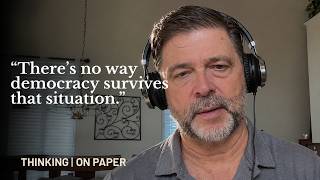
Why Put Data Centers in Space?
Philip Johnston does not expect to bring Starcloud's compute modules back from orbit. The problem is the chips need to be replaced every four years anyway.



In this episode · 19 chapters
- Why put data centers in space?
- How a data center in space works
- Latency and laser links
- Power in orbit
- Launch costs and the economics
- Railguns and space elevators
- Manufacturing in space and lunar resources
- The space gold rush
- Solar flares and radiation
- Cooling: the biggest challenge
- Ion thrusters and krypton
- Chip lifespan and reusability
- The first demonstration mission
- Quickfire questions
- A hundred billion humanoid robots?
- Everything depends on launch cost
- Quantum computing in space?
- Uploading consciousness and the Fermi paradox
- Backstage breakdown
I like to think we’re digging for gold. I know it’s very popular in Silicon Valley to be super keen on selling shovels. There are times when you just want to dig for gold.
Philip Johnston co-founded Starcloud to put AI data centres in orbit, powered by the Sun. He explains how a dawn-dusk sun-synchronous orbit keeps a satellite always in sunlight, and why the whole plan depends on launch costs falling under $500 a kilo.
Cooling is his biggest engineering problem, because in a vacuum heat can only leave as infrared radiation. On the space gold rush, he says: “I like to think we're digging for gold.” We also get into ion thrusters, space elevators and humanoid robots.
Philip Johnston, co-founder of Starcloud, argues on the Thinking On Paper podcast that AI data centres will move into orbit once launch costs fall far enough, running on constant sunlight and cooled by large radiators. He ties the economics to SpaceX's Starship and launch prices below about $500 a kilo: “all other data centers will inevitably move to space once the launch cost hits the same point”.
Why put data centres in space?
Philip Johnston argues orbit offers constant sunlight for power and large radiators for cooling. He says the economics work once launch prices fall below about $500 a kilo.
Is a data centre in orbit slower than one on the ground?
A data centre in low Earth orbit has latency similar to one on the ground, Johnston says, because at 400 kilometres up it is no further away than a site in Alaska or Seattle. Starcloud plans to send data through a mega constellation such as Starlink using laser links, and he says only workloads needing under 20 milliseconds of latency must stay on Earth.
How big a data centre fits in one Starship launch?
The largest single compute block that fits in one Starship payload bay is about a 40 megawatt data centre, roughly a hundred tonnes of compute, solar panels and radiators, according to Johnston. He says Starcloud will launch these 40 megawatt units first, and that only training very large models needs them clustered on a shared spine.
What launch price does Starcloud need to make its plan work?
Starcloud's economics depend on launch prices falling below about $500 a kilo, Johnston says. He puts the shuttle era at about $60,000 a kilo and today's rideshare price at $6,000 a kilo, and says Starship's marginal launch cost is projected at $10 a kilo.
What is the hardest engineering problem for data centres in space?
Cooling, not cold, is the hardest engineering problem in space, Johnston says: with no air, heat can only leave as infrared radiation, so Starcloud must build very large, low-cost, low-mass deployable radiators. “Cooling is by far the biggest challenge we are solving.”
What will Starcloud's first demonstration satellite do?
Starcloud's first demonstration satellite aims to run about 100 times more powerful GPU compute than has operated in space before, using data centre grade terrestrial chips, and to prove its radiation shielding and thermal management work. Johnston does not plan to bring compute modules back, saying “the chips need to be replaced every four years anyway”.
Where Mark and Johnston disagree
Mark puts the tech-pessimist case that grand space ambitions are frivolous when Earth has problems. Johnston replies that “what we're doing is actually solving the Earth problem”, and concedes Earth will need new data centres for at least another five to ten years.
Links from this episode
Questions
Why put data centres in space?
Philip Johnston argues orbit offers constant sunlight for power and large radiators for cooling. He says the economics work once launch prices fall below about $500 a kilo.
Who is Philip Johnston?
Philip Johnston co-founded Starcloud to put AI data centres in orbit, powered by the Sun.
How does Starcloud keep its satellites in sunlight?
He explains how a dawn-dusk sun-synchronous orbit keeps a satellite always in sunlight, and why the whole plan depends on launch costs falling under $500 a kilo.
Will AI data centres move into space?
Philip Johnston, co-founder of Starcloud, argues on the Thinking On Paper podcast that AI data centres will move into orbit once launch costs fall far enough, running on constant sunlight and cooled by large radiators. He ties the economics to SpaceX's Starship and launch prices below about $500 a kilo: “all other data centers will inevitably move to space once the launch cost hits the same point”.
Transcript
Jeremy Gilbertson Disruptors and curious minds welcome to another episode of thinking on paper where we take you the curious individual behind the scenes of the latest emerging tech and We unpack it together. Why do we do it? Well, we all want to understand why this technology is gonna be important how the world's gonna change what it's gonna mean to our families our jobs our own curiosity and That's what we're here doing. Listen
All of these episodes won't be extremely easy to listen to, but I tell you what, they're going to be informative, they're going to be fun, and they're going to get you using this thing in your head, this jelly that's sitting in your skull. You're going to be thinking a little bit differently, hopefully, about this. So Mark, I'm stoked. I'm stoked today because we're talking about something that I spent a lot of time in, traditionally, not the future look of it, but the past version of it. So I'm excited. What did we learn about, Mark?
Why put data centers in space?
Mark Fielding Drum roll, data centers in space, five gigawatt data clusters with solar arrays four kilometers across, 400 miles up in the sun synchronous orbit. Now listeners might be wondering why? Why not just build them here on earth? And before we get into the how, I wanna explain the why with a few quotes from the Star Cloud white paper. So that's a clue to our guest today, Star Cloud.
Couple of quotes to explain why. OK, the first is a quote from our good friend of the show, Elon Musk. We have silicon shortage today, a voltage step down transformer shortage probably in about a year, and then just electricity shortage in general in about two years. And then there's another quote from Tom Muller, employee number one at SpaceX. The amount of power to run compute by 2045 will be the base power of the planet right now.
not sure what that means. The drain on resources is so high, you need to put that compute in space and use the power of the sun. That's a really good use of space to help save the planet. And that's why data centers in space. Now, Jeremy, I know this is your specialized subject and Philip, it's his specialized subject as well. So I've bought a bell. if you two get too deep in the weeds about data center tech, I'm going to ring this.
Mark Fielding just to reel you in, okay?
Jeremy Gilbertson Love that. I love that and before we before we get into this episode want to remind everybody that we have our hot buttons Section that mark runs. It's gonna be really fun. We had our thinking on paper news We have our carryover question and we also unpack everything backstage at the very end So stick around lastly before we introduce the guest mark. I'm gonna tee up a quote from one of my favorite books of all time I'm not gonna nerd out on this too much, but there's a guy named Gerardo Neil that wrote a book in 1976 called The High Frontier. It was about building colonies and manufacturing lower Earth orbit. Someone who you know who we referenced last show, Carl Sagan, was quoted in 1976 as he was talking to the US House of Representatives on Gerard O'Neill's work. The engineering aspects of it are perfectly worked out by O'Neill's study group. It is practical. This was in 1976. We all know it's 2025 today. Without further ado, let's bring on our guest,
Mark Fielding Philip Johnson, co-founder of Star Cloud. Welcome to Thinking on Paper.
How a data center in space works
Philip Johnston Great to be here. Thanks so much for having me, Jeremy and Mark. I like the reference to O'Neill. Do you guys know what an O'Neill ring is? It's like the, it's the best example of, or the best design for a orbital colony. Anybody that's interested should Wikipedia the O'Neill ring concept.
Jeremy Gilbertson I actually have-
Philip Johnston So basically it spins so you have artificial gravity, but it's designed in a way that would reflect sunlight. Yes, it looks a bit like that's a bit like what I'm thinking. The thing I'm thinking is more. Yeah, It's basically a long tube which has the sides opened out to reflect sunlight and generate power.
Jeremy Gilbertson There's a bunch of different drawings in here, yeah.
Philip Johnston So the whole thing is either permanently in sunlight or permanently in dark, but you have artificial gravity and it's better than just having a ring spinning basically.
Jeremy Gilbertson So this is a timely topic. AI is getting thrown at us left, right, top, and bottom. And I think some of us who are not in the data center know or even starting to figure out, well, something's got to power all of this AI stuff. Data center demand is up. We know we're limited on power in the US, in the world. There's a finite amount of that. So.
you come up with this idea along with your team or kind of synthesize this idea together to actually put data centers in space. So let's simplify it. In your definition, what is a data center?
Philip Johnston A data center, I mean, actually in really the simplest terms, we can be thought of as a low cost energy provider. So you can run data centers on us, but you can run other things too. But in the simplest terms, a data center is a bunch of chips processing or storing data. I don't know if you have a better definition than that, but.
Jeremy Gilbertson keep it simple. I spent about 10 years as a data center consultant, basically helping people design and put their IT equipment into these big facilities, whether they were leased or we build them or whatever, you know, that sort of thing. So it's more on the mechanical electrical side that supports it. having this capability in space, let's talk through it. Okay, so let's say I'm a company, right? And I've got an IT compute load that powers my business. And I'm trying to figure out where to put it and why and cost benefits and that sort of thing. When you have a conversation or when you envision, I know you're still building this and you have the test, the pilot is happening in like 2025, but how do you envision talking with somebody to figure out, hey, Jeremy, what's your IT load? And then what's your redundancy requirements? And then how do we configure that?
put it on a rocket and let it spin around in lower Earth orbit. How does that process look to you?
Philip Johnston Yeah, so I'll try and distinguish between the sort of...
quite near term and the medium to longer term. So the first few iterations of the satellite, you mentioned the first one was going up in a few months in summer this year. These are designed to offer edge compute workloads for mainly other satellites and also to some degree terrestrial customers who care about data sovereignty and would like to run a workload in space. So for those guys, the design of that satellite is quite similar to the design of most satellites in that critical systems have to be redundancy on critical systems and then over provisioning on systems which will degrade over time, particularly solar panels and chips. So yeah for those conversations is basically if we can provide you this amount of compute on orbit you know how valuable is that to you and can we provide that at a price point that makes sense. In the longer term the ambition is that you can think of us a bit like a core weave or lamb
So, Amar, these guys, essentially, we will be renting out GPU time and whoever the buyer of that GPU time is shouldn't really care whether it's in space or on Earth. We'll be able to say basically, you we can provide you H100 time for 150 an hour or $2 an hour, whatever it's going to be. And we do the connectivity, we do the calling, we do the power, and they don't have to think about that really.
Latency and laser links
Jeremy Gilbertson So one of the things I kind of think about too is, we'll talk about how things get up there and where they land and what Lego blocks they end up plugging into. when you think about, the one thing I tend to think about is if you're doing processing there and it's way far away, we know we have latency between here in Chicago, between here in London, between Atlanta and London.
how does the latency thing work and how does the things you process in that module come back to earth and how is that being optimized to make sure it doesn't take too long?
Philip Johnston Yeah, so this was basically not solved problem until about two years ago when the mega constellation started allowing access directly from other satellite customers. So we're going to plug into one of the mega constellations, be that Starlink, Kapler, Kepler, one of the others, directly with an optical terminal, so with a space laser. Which, I mean, the data rates on these lasers is extremely high.
potentially hundreds of gigabits per second per laser. And you can have multiple lasers if you want. Which is about what a current terrestrial data center. There are definitely terrestrial data centers that have an in and out pipe of about 100 gigabit a second. So it's not too different. In terms of the latency, flying in low Earth orbit is no different really from having a data center terrestrially. If you're 400 kilometers up, that's not that different from having a data center in Alaska or in Seattle or wherever.
So yeah, anything that requires sub-20 millisecond latency will need to remain on Earth. But my view is that all other data centers will inevitably move to space once the launch cost hits the same point.
Mark Fielding What might need sub 20 to remain on earth? kind of use case is that?
Philip Johnston Very few use cases to be honest. So nothing that is like an internet-based use case needs that. So any kind of, you know, like this call we're having now could easily be a hundred millisecond latency. And even things which are very latency sensitive, like for example, if you want to, for example, arbitrage two exchanges between London and New York.
It's very latency sensitive, but it's actually quicker to do it through space than it is to do it through fiber. It will be very soon if it isn't already much quicker to do it through space. I mean, for one thing, the speed of light is about 50 % faster in a vacuum than it is through fiber. So really we're talking about, I mean, very few situations come to mind that require sub 20 milliseconds. I literally...
Jeremy Gilbertson I'll give you a nerdy one just because it's a project that I worked on with some buddies. It's a real-time music performance. So if you have, all of us are playing musical instruments from different spots, it requires about 10 milliseconds of latency just to keep us all in time and rhythm. I didn't get the...
Mark Fielding Is that why those Zoom experiments during Covid were so bad?
Jeremy Gilbertson Yeah. Well, they weren't using the stuff that we were using, but I digress. Let's stay focused on data centers. All right. So Phillip, we get this, so let's let, we get this box, right? That we put on and I'm totally simplifying cause the technology that you're building is actually quite brilliant. You put it on, the back of rocket. We send it up to space. There's some kind of station up there, right? That it will connect into like talk me through the Lego blocks and if we can keep it kind of high level.
Philip Johnston The modular design that we have in the white paper and that's in the concept video, I would say that's about a 10 year time frame. And the reason you might want to modularize is if you want to, the largest compute cluster you can launch individually is about a 40 megawatt data center. So that's about a hundred tons worth of compute solar panels and radiators. It's what you can fit on one full Starship payload bay, for example. So if you want to build a data center that's internally networked, that's larger than that. And so for example, for training, to be extremely highly internally networked, you can't have just an obstacle terminal between them, then you would need to have them all hooked up on the same spine basically somewhere in space. That's what that concept is. I think probably in more immediate term we're going to just be launching these individual 40 megawatt blocks and they'll have their own solar panels and radiators attached. So you're talking about 10 football fields of solar panels and radiators for one of those 40 megawatt blocks versus like a 4 kilometer by 4 kilometer for the 5 gigawatt block.
So yeah, I would say that's probably the thing to focus on in the slightly more immediate term is these units of 40 megawatts. And you can use that for all kinds of inference workloads and everything else. It's only really training very large models that you need to cluster these things together.
Power in orbit
Jeremy Gilbertson So 40 megawatts, friends and neighbors, is quite a bit of compute load, just to let everybody know. 40 megawatt data centers terrestrially are massive, like massive, acres upon acres upon acres. When you consider 40 megawatts, is that pure IT load, or does that include kind of the backup power stuff as well?
Philip Johnston That includes backup power. I mean, well, actually, one of the nice things about being in a dawn-dusk sun-synchronous orbit is that we're always in the sun. And so we'll need less backup power than... We'll still have some redundancy, but we'll need less than a terrestrial day's end would.
Mark Fielding Is this the Terminator line?
Philip Johnston Yes, the Terminator line. Exactly. It's really waiting to say that.
Mark Fielding Yes, I've it in there. I've been waiting to say that. so, because the Sun synchronous orbit, I've heard of lower Earth orbit, but I've never heard of Sun synchronous orbit. And is that to keep it on the terminator line? So it's always on that line between darkness and daylight. the solar energy is always there.
Philip Johnston Yes, exactly. It's a bit, it's not super easy to explain without oranges and apples next to me, but as the Earth processes around, you're in an orbit that maintains the same, they call it L-TAM, like the same position relative to the sun, as the Earth moves around the sun, unless you, unless you're unless you have this sun synchronous property which you get by having, because basically the oblateness of the Earth, like it's slightly fatter on the Northern Hemisphere than it is on the bottom hemisphere, means if you're at a certain angle, about seven degrees off, then as the Earth moves around the sun, your whole orbit moves by 1.365th of an orbit every day. And so that means that you stay on the terminator as the terminator goes, as the Earth rotates around the sun. That's what that means.
Mark Fielding Can I just do a shout out for a book I know about the Terminator line because not because I'm a T1000 because I read Orbital by Samantha Harvey recently and for anyone who's listening who wants to try to imagine what it's like in orbit check this book out because it's beautiful.
Philip Johnston I've not seen that, I might have to buy that myself.
Mark Fielding It's a very short one about being on the space station for six months.
Philip Johnston Awesome, sounds amazing.
Jeremy Gilbertson I just bought it too, Philip. I haven't gotten into it yet. So, check this out. I know you're probably of thinking, all right, putting stuff in space, that seems pretty cool, pretty interesting, but doesn't it cost a pile of money to send stuff up there, right? And where we're at, like launch costs right now is what, about eight million bucks-ish to kind of put some stuff in space just for round numbers?
Launch costs and the economics
Philip Johnston If you want to book your own launch, about eight million dollars. The beautiful thing very recently and in the last three, four years is these rideshare missions. our first satellite is a 50 kilo small satellite, it's about the size of a fridge. That cost us 300 grand. It's amazing, it's honestly amazing. Yeah, because we're hitching a ride. those Falcon 9 rideshare missions will launch about 20 missions at once.
Jeremy Gilbertson Nice. Cause you're hitching a ride. Yeah.
Philip Johnston each of which is paying about $6,000 a kilo. And you can put pretty small stuff on there. If you want to go down even smaller than us, can pay like 50 grand and put a CubeSat on there if you want.
Jeremy Gilbertson I love that. And on the other side of that, we talk about the cost to get up in space, but like based on your white paper and some stuff that we've looked at, mean, significant cost reduction as far as electricity expenses and that sort of thing from the hundreds of millions to the tens of millions. I mean, when you start talking in orders of magnitude like that, things start to seem really, really, really compelling.
Philip Johnston Yeah, I would say it is all highly contingent on the launch cost continuing to fall. So it used to be with the shuttle about 15, 20 years ago, it about $60,000 a kilo. Now it's come down to $6,000 a kilo. That's what we're paying for the first launch. We need the launch cost definitely under $500 a kilo. The marginal launch cost with Starship is projected to be $10 a kilo. So that gives you some sense of where we're heading. Yeah, anything under about $500 a kilo and we're...
good to go but if it gets down to ten dollars a kilo or even if it's fifty dollars a kilo which is what they say they're going to charge customers we will be an absurdly profitable company.
Railguns and space elevators
Jeremy Gilbertson Sounds good. Mark, I'm gonna try and get this in before you ring the bell on me. But going back to O'Neill's book in High Frontier, he talks about actually setting up manufacturing in space and using these, what do you call them, mass loaders? Like this magnetic rail system from the moon that fires things out. Is that something that is being entertained as we look down the road as an alternative to trying to get exit velocity from Earth?
Philip Johnston Yes, I mean, actually people are doing these rail guns on Earth as a company called like, it's not slingshot, there's a company called something which is doing this rail gun from Earth. Certainly from the moon it's like, that is almost certainly the way you would do it from the moon in the end state. You can also actually quite feasibly have space elevators hanging off the moon.
So yeah, that's one way to do it. And you can have a space elevator on a track that rotates around so that the space elevator, so that it's, I don't know, anyway.
Mark Fielding That's a callback to quantum supremacy book club where we talk about space elevators and material science and the possibilities of what quantum can do. Sounds like a total recall, a mix of all of our science fiction, science fiction becoming reality, becoming science fiction becoming reality.
Philip Johnston I mean, I'm of the view you could build a space elevator on Earth for about $10 billion. The problem with space elevators terrestrially is they're just going to get pummeled with stuff in LEO. So even if you have these avoidance maneuvers, stuff is going to be colliding with them at about 27,000 kilometers an hour all the time. So yeah, it just doesn't really work as well. Whereas in...
Jeremy Gilbertson Little more disruptive than gnats on a windshield on the highway, right? Like we're talking, yeah. And Leo, lower earth orbit, yeah.
Mark Fielding If they're strong enough to be there, are they not strong enough to withstand almost all impact?
Philip Johnston No, I mean they're strong enough basically to they have to have an anchor out beyond geo so they have to be about 30 000 kilometers long so they're strong enough tension wise like this but if you shoot a gun at it it's like shooting a gun at a taut rope you know like it can hold this way but if you shoot a bullet it's just going to rip the whole thing apart. But just back to your point on the moon and manufacturing in space
Manufacturing in space and lunar resources
Philip Johnston Yeah, I'm very convinced manufacturing space is going to be a thing as well. As I say, the whole thing is contingent on low-cost launch. Once you have low-cost launch, it makes no sense to do lots of things on Earth, manufacturing, data processing, lots of things. The moon is interesting because the...
Lunar regolith is mainly silicon, which is useful for manufacturing solar panels. And it would take about 20 times less energy to get the silicon cells from the lunar surface to LEO than it does to get silicon cells from Earth to LEO. So it does make a lot more sense to manufacture them on the lunar surface and then transport them to LEO if you want to have low latency. If you want to build big solar farms in LEO, then you probably want to manufacture them on the moon.
Jeremy Gilbertson It's gotta be pretty fun to think this big, Philip, and also start to execute on this.
Philip Johnston It's very fun. I do like it.
Mark Fielding It's incredible. How many people are thinking as big as you? You mentioned manufacturing on the moon. Some people might think that these are flights of fancy, but they're not. They're happening. You said these things are happening. Is it a very small group of you doing this or is there much more happening than we know?
Philip Johnston There's a... I mean it's growing as Starship becomes... looks like it's going to work more and more basically. There's a whole bunch of people looking at Luna, both mining of...
various lunar resources, guess you guys have seen the interlune guys, Rob Meyerson, they're trying to mine helium-3 on the moon. It's still relatively small now, it's gonna be like, the capacity for Earth to put stuff in orbit is gonna go up by about 100,000 X in the next five to 10 years. So we're talking about the very early days of an industry, it's a bit like, it's like the first people to arrive in California back in the 1850s or whatever.
Jeremy Gilbertson Well, keep us in mind as you run across these folks, because space is definitely, space technology is one of our threads that we explore along with quantum, along with AI, along with blockchain, a lot of different areas.
The space gold rush
Mark Fielding I just had a question on that analogy to the gold rush. Then are you selling the chevilles or are you digging for the gold? Because you mentioned that Star Cloud isn't just data centers, but we kind of prepped for this that it was just data centers. So maybe you're...
Philip Johnston Good question.
Philip Johnston Well, is, I mean, it is, we've got enough to bite off with data centers to be honest. And data centers is definitely the first thing you would do. And it's also the biggest market. Like data centers in the end state is, mean, in my view, data centers in the end state is like 99 % of the economy. So like the end state of any intelligent star system is to build a...
Philip Johnston Dyson Sphere hooked up to as much computers as you can physically support which is like a matrioshka brain is what they call it. That takes a few million years but that is nice. Star Cloud is the first company ever that is on a path to building a Dyson Sphere slash matrioshka brain.
Jeremy Gilbertson So for those of you guys just listening and you're not seeing us, half of my face just melted in a couple of those thoughts and words. But no, it's awesome. All right, Philip, one quick question.
Philip Johnston There was a point there I wanted to touch on. What was the start of your question?
Mark Fielding Are you... are you... the analogy to the goldfish, are you selling the shovels or are you digging for gold?
Philip Johnston sorry. I like to think we're digging for gold. I know it's very popular in Silicon Valley to be super keen on selling shovels. There are times when you just want to dig for gold. I like to think we're digging for gold.
Solar flares and radiation
Jeremy Gilbertson Go big or go home. So all right, here's one question, and I wanna actually unpack this pilot that you're getting ready to put up in the next few months, but I remember about 10 years ago when I was knee deep in data center world, solar flares was this big thing, and it was like, we gotta prepare for solar flare, because when they happen, it's gonna wreak havoc on all of our systems and all of this, and there were some effects for some big ones, but that being...
a little bit more applicable when you have these assets in space. Have you guys thought about the solar flare thing and what does that mean for you?
Philip Johnston So there was a huge solar flare in mid last year. I if you guys saw the Northern Lights around April last year. Even Seattle, it was crazy. I think it was the biggest one in maybe 20 years at least. Not a single Starlink satellite went down and they had 5,000 in all of it. yeah, so I mean, it's not as big of a problem as people I think think. If there's like a Carrington event in the 1850s that had this big blackout, if there's that scale, then yes, we're a bit fucked, but so.
Jeremy Gilbertson Everything on Earth is too, right? Yeah, the data centers on Earth are gonna have trouble with a Carrington event too, right?
Mark Fielding So solar flares aren't, unless there is another Carrington event, a major concern. Space junk, maintenance, cooling, this kind of matrix of challenges.
Cooling: the biggest challenge
Philip Johnston Cooling is by far the biggest challenge we are solving. I mean people think space is cold and so cooling is easy.
Because there's no atmosphere, you don't have convection or conduction, so everything needs to be dissipated with infrared, like black body radiation. So that means having very large, low cost, low mass deployable radiators. basically two sheets of metal that you're pumping coolant through. It doesn't need to be expensive, but right now they are very expensive. So that's our biggest engineering challenge is making these large, low cost, low mass deployable radiators. I would say that's actually like core technology for energy, for any high energy use case in space also.
space manufacturing and everything else. The others are solvable. Space debris is not as big of a problem as people think.
So the way, either you fly very low or you fly very high. So we're at around, we're flying in Ville for the first two satellites, 350 kilometers. It's like a self-cleaning orbit because everything naturally deorbits within a month because of the low levels of drag in the upper atmosphere. Or when the satellite's larger you can fly higher. So we have the problem with flying low is you need thrusters to maintain your orbit and the problem with flying high is you're in the banana and radiation belt. But luckily as the satellite gets larger shielding is naturally taken up.
that structure itself is naturally more shielding.
Jeremy Gilbertson So let's unpack that a little bit. As you get higher, you have to deal with more radiation. As you get lower, you require thrust and propulsion to get you to maintain the spot there. And what happens if you don't have that? Does it just kind of back to earth?
Philip Johnston Yeah, if you're at 350km it'll take you about a month before you burn up in the upper atmosphere.
Jeremy Gilbertson So how do you have enough fuel to maintain that? Like how does that work?
Ion thrusters and krypton
Philip Johnston You use iron thrusters so we have these two gridded iron iodine thrusters. It's basically like a mini particle accelerator that shoots stuff out the back at 20 kilometers a second and that means that you need very little fuel so it keeps us up there for about five years.
Jeremy Gilbertson Philip, I love that you referred to a mini particle accelerator like a little Pez dispenser in your pocket. It's just a little mini particle accelerator, it's all good.
Philip Johnston It's size of a Rubik's Cube and it shoots stuff out of the bag at 20km per second.
Jeremy Gilbertson man, this could be the coolest episode I think I've ever been a part of.
Philip Johnston if you want it even cooler, it shoots Krypton out the back at 20km to the second. Krypton or Xenon, of the two.
Mark Fielding Krypton's real? Last week, the handover question was from him, but we had Eubotica on and their AI-powered satellites. And we were speaking about this low Earth orbit where they run out of energy and essentially drop from the sky and burn up. And he was speaking about this kind of new mindset of recycling these satellites somehow. Is that something that you're looking at, interested and aware of, or do you think that at the moment that's maybe a secondary thing to solve further down the line?
Chip lifespan and reusability
Philip Johnston The problem is the chips need to be replaced every four years anyway. So we might look to reuse some of the structure and in the white paper in the video that's what you see is this spine that stays up for longer which has the solar panels and radiators. But the actual compute module it's unlikely we would bring it back to do anything with because after five years those chips are not going to generate cash for us anyway.
So no, we haven't really baked in reusability for now. Re-entering a satellite is just expensive and time consuming and annoying. So I'm not sure exactly how they're meant to do it. If they're meant to re-enter, then that's very, very, very annoying to do.
Jeremy Gilbertson Little harder coming down than going up, right?
Philip Johnston Yeah, yeah. Well.
Jeremy Gilbertson What, let's unpack this. Is it a pilot, is it a test? What are you calling this?
The first demonstration mission
Philip Johnston Demonstrate emission, yeah. So that's going to have about 100 times more powerful GPU compute than has ever been operated in space before. And the purpose of that is just to prove that our radiation shielding thermal management solutions allow us to operate terrestrial GPUs in space.
Jeremy Gilbertson So, all right, so talk to me about this mission, right? So what would success look like based on, after you're done with it, what boxes do you want to have checked to move on to the next experiment?
Philip Johnston We want to run at least 100 times more powerful GPU compute in nspace. That will be some demonstrated workloads. We want to do some kind of gimmicky things like training the first model in space. We're really talking about data center grade terrestrial hardware, like the top of the line. I won't say the name because we're keeping it under wraps, but you can almost certainly guess the chip we're flying.
So yeah, we want to do some things like training and modeling space. The icing on the cake would be if we can run a customer workload. So we're speaking with a few satellites now where they will send us raw imagery. We will then.
workload on that and we'll downlink in real time the insight from that. So it might be for example they send us all this imagery of California and we identify if there's a wildfire somewhere and we just downlink that location data which is you less than a kilobyte so they send us five gigabytes of data we send down one kilobyte which is the insight they actually care about. That would be the icing on the
Jeremy Gilbertson You and Fenton should go bowling one day. Yeah.
Mark Fielding Yeah, we were speaking about this last week as well with Fintan.
Philip Johnston Yeah, edge compute is the popular one because it's the main use case initially.
Jeremy Gilbertson The most important question I have for you for the day, has Red Bull approached you for the rights to operating and maintaining these satellites in space?
Philip Johnston Red Bull for branding. If they want to pay us to put a Red Bull sticker on the satellite, we have a camera on the outside we can get a nice shot of the earth in the background.
Jeremy Gilbertson I'm just thinking of the, I'm just thinking of the guy in the spacesuit, right? That, yeah.
Jeremy Gilbertson I it. love it. I think it's a great time, Mr. Fielding, to transition to hot buttons. Philip, are you feeling ready? You want to stretch it out a little bit, see if we can get through these hot buttons?
Mark Fielding Can we pay to put a thinking on paper sticker on the satellite?
Jeremy Gilbertson I'd love that.
Philip Johnston There's a price for everything.
Quickfire questions
Mark Fielding Hot buttons, 30 seconds, five yes or no, or one word answers. It's the Daniel Kahneman thinking fast, thinking slow. You're thinking fast. You've got the clock, Jeremy, can I see a clock?
Jeremy Gilbertson forget, a clock is coming. Off you go.
Mark Fielding Question number one, the most underrated technology breakthrough of the past decade.
Mark Fielding What's the best science fiction movie?
Philip Johnston I don't have a good one. I don't have good answer. I don't even think of a science fiction movie. I don't know any Star Wars.
Mark Fielding Name one science fiction movie.
Jeremy Gilbertson So much pressure, so much pressure.
Mark Fielding Terminator and just the other one was the other two. What was the what's the most used app on your phone right now?
Mark Fielding And what's your favourite country that you have lived in?
Philip Johnston Singapore or US
Jeremy Gilbertson Hot buttons, there you have it.
Philip Johnston It's too slow on the hot bands.
Jeremy Gilbertson It's all good. We actually told you they would be this or that questions, but you had to come up with the answer yourself. So I'll give you I'll give you some extra credit.
A hundred billion humanoid robots?
Mark Fielding Underrated? I started with the wrong one. What's the most underrated technology of the past decade? That's a thinker.
Philip Johnston Yeah, so maybe people, might think humanoids are actually overrated right now. I think they're like mega underrated.
Mark Fielding any particular reasoning behind.
Philip Johnston I'm a believer that there'll be like a hundred billion humanoid robots within 15 years, 10, 15 years.
Jeremy Gilbertson Have you talked to the folks at Figure yet?
Philip Johnston No, but I've just backed this incredible YC company called Proception with Jay Lee. People should Google him. There's a team that just left Optimus. They were doing the dexterity in the hand. I've put a very small angel check in those guys. They're going through Y Combinator now. They'll do a race in a month or in a week or two. you guys. my god, you guys. should get this guy on Jay Lee. He's freaking amazing. Yeah.
Jeremy Gilbertson Sounds like someone we should talk to, Mark.
Jeremy Gilbertson Let's do it.
Mark Fielding anybody who's the the ideas 100 did you say a hundred billion humanoids within 15 years I just love that that idea is just a lot of people would think it was bonkers I think it's amazing and
Philip Johnston 15 years might be ambitious just on the manufacturing side but that's where we're headed. 100 billion humanides, okay give it 20 years.
Jeremy Gilbertson Hey, food delivery robots, self-driving cars, I mean, it's all adjacent, right? We just gotta figure out how to do this, do this thing, right?
Philip Johnston Well, that's literally the optimist team that was doing that has left to do their own startup. It's called Proception. is J. Lee. It's unbelievably good.
Jeremy Gilbertson All right, Jay Lee, let's put him on the list. Mark, you have... Yeah, exactly. Mark, do you have any more questions? I've been thrown a lot at Philip from a data center from kind of what he's technology-wise. Any thoughts before we kind of move into the news?
Mark Fielding So I'm gonna just be top of the list.
Everything depends on launch cost
Mark Fielding Well, I like the Mark Zuckerberg quote in the white paper, we would build out bigger clusters than we currently can if we could get the energy to do it. And in my non data center brain, listening to you two talk about it, it just feels that we're just wasting our time on earth. We should just get up there and do it.
Philip Johnston The whole thing is contingent on launch cost. I do need to emphasize that. We need to be building enormous numbers of Starships, which they are building factories to do. That's why I'm British on it. For the next five years, we're certainly going to need to continue building data centers on Earth, like five, 10 years at least.
Mark Fielding I do have one question and it's a lot of people who listening to this, maybe they're like us, they've all been reading Nexus and they've all been reading too much tech pessimism and the moment that people start talking about grandiose ambition like this, people get scared, people get nervous, you don't need to go into space, like you don't need to be doing this, we've got too many problems on earth. Like what do you say to that argument that this is...
maybe frivolous or not necessarily or like what's the benefit to humanity?
Philip Johnston I mean, I can see the argument for things like building cities on Mars, although personally I'm hugely in favour of building cities on Mars. But what we're doing is actually solving the Earth problem.
Like we're providing energy for at least a tenth, cheaper than a tenth the cost and you don't have to consume enormous amounts of fresh water to keep the data centers cool and you don't have to burn fossil fuels and it's just in all dimensions it makes life on Earth better. So what we're doing in particular is it doesn't fall under that bucket. Certainly I can see why people might think that about building a city on Mars though yeah as I say I'm very much not in that camp.
Jeremy Gilbertson Awesome, we're on to the news.
Quantum computing in space?
Jeremy Gilbertson Alright Mark, I'm gonna buck the system and ask the question that you didn't want me to ask because I'm too compelled to it's been on my brain. this week Oxford University, I'm ignoring your bell, Oxford University Department of Physics demonstrated distributed quantum computing together. Meaning they've successfully linked two quantum processors together to work together, right? Are you at all thinking about like what quantum computing could look like?
Philip Johnston I've been approached by a few quantum people who say that space is a good place to do quantum stuff because it's a vacuum and because it's very cold. But it's not something we've put too much time into thinking about, to be honest. Maybe we will, but...
Jeremy Gilbertson Plenty on your plate, Philip, plenty on your plate.
Jeremy Gilbertson Good stuff, well stay tuned for more quantum stuff. We got another quantum show coming up very soon. Carryover question, Mark, let's fire away.
Mark Fielding So the carryover question was from Fintan who will organise a drink with you and him. His question was what technology do you think will be the next to have as big an impact on society and civilisation as the mobile phone has?
Philip Johnston easily got to be AI I presume. If AI counts as a technology in the same way that mobile phones do, if not then humanoids, let's call it humanoids. think humanoids are like a platform in the same way that an iPhone is like a platform. I think you'll be able to download like apps for your humanoid for niche applications. Like for example, if you want your humanoid to like do tango lessons with the elderly, like that's probably not a use case that Tesla is going to build for, but somebody will build it and you'll be able to download that and instead of paying 30 bucks an hour per person, you can pay two bucks an hour for your humanoid to teach the elderly tango lessons.
Mark Fielding I'm going to raise my silly question for my audience because I know that you're out there. What's the difference between a humanoid and a robot? Why do you refer to them as humanoid, not robots?
Philip Johnston Well, humanoid is a robot in humanoid form. For a long time I think people have presumed that robots will be just optimized for their specific tasks, but it seems to be getting clearer and clearer that actually general purpose robots that fit into the way that the world is built are going to be much more useful and that is a robot in human form. So yeah, I'm very British on...
Jeremy Gilbertson Well, here's another tie-in mark to Michio Kaku and quantum supremacy. if, if we have, if these humanoids get developed, we can just dump them on the surface of the moon, on the surface of Mars, and we can actually could beam our consciousness there according to Michio Kaku. Theoretically, we can, don't even need spaceships anymore. We can just.
Philip Johnston I'll build it up soon.
Philip Johnston Well, yeah, I we might. I think it's presumptive to say that our consciousness will be the most advanced in 20 years time. It could be that humanoids are much more conscious than us in 20 years time, however you define consciousness, in which case, you just send them out to far-flung reaches of the galaxy.
Jeremy Gilbertson your network of brain stops. love it. Philip, this...
Uploading consciousness and the Fermi paradox
Mark Fielding How are we uploading our consciousness? Is this faster than the speed of light transfer of our consciousness if the humanoids are out in the far reaches of interstellar space? Are we using wormholes?
Philip Johnston I'm not lost in the speed of light,
Mark Fielding Yeah, that's what I mean. So how are we getting at beaming our consciousness into the far reaches of the universe?
Philip Johnston No, in far reaches of galaxy it would only take about, you know, it takes a few million years to colonise galaxy. Even if you're going at the speed of push bike, it takes about 10,000 years to get to the nearest star. So it really would not take that long to colonise the galaxy in terms of galactic timeframes, which is honestly a scary thought. That's what the Fermi paradox is. It's where is everybody? If there was intelligent life at any other star, it would only take them a couple of million years to colonise galaxy. So we should see them everywhere, but...
Jeremy Gilbertson But technically, Philip, if my consciousness was in superposition with my humanoid robot somewhere, it could be instantaneous, right?
Philip Johnston Sorry Mark, I apologise. That was very rude of me. I didn't realise you quantum superposition.
Mark Fielding Is it too late to ask him to ask Philip why where is everybody?
Jeremy Gilbertson Oh man, too much fun, too much fun.
Philip Johnston Where is everybody? I mean, think it's, it seems like there isn't anybody. I don't know. I watched this incredible YouTube video yesterday explaining probabilities of extraterrestrial life and the conclusion was basically we are as rare as we seem and that's a scary thought.
Jeremy Gilbertson no, pregnant pause, we have a lag. He'll come back.
Mark Fielding who is about to drop the secrets of the universe.
Mark Fielding I hope that the NSA haven't suddenly got involved.
Jeremy Gilbertson my goodness, we might be in trouble.
Mark Fielding Okay, we'll have to finish that question for ourselves, Jeremy, in the after show VIP backstage area.
Jeremy Gilbertson sounds like a plan. Philip, we'll hang out for another second see if we can get you refreshing. If not, was a blast having a conversation with you today and we will continue the dialogue for sure. Thanks for joining us.
Backstage breakdown
Jeremy Gilbertson friends and neighbors were backstage. We're backstage. We went all over the place today. We talked about a little bit of quantum. We talked about putting data centers in space and lower Earth orbit. We dispelled some myths related to all this stuff. Mark, I'm kind of a nerd on everything we talked about today. What landed for you and why?
Mark Fielding The sheer brazen ambition, the sheer will, the sheer determination to do bonkers, crazy, what might appear to many science fiction.
and making it real. His timelines were short, the ideas were incredible. And in researching the show, we need to have more efficient, quicker data centers. We need more GPUs and there needs to be a solution. And listening to Philip speak, the solution is space.
Jeremy Gilbertson You gotta you gotta get it I mean you can't help but get excited about like you said the ambition of what he's trying to accomplish and what he's actually taken tangible steps to Accomplish and I think I would love to have him back on the show after this test coming up in a few months Where they're actually gonna put the largest amount of you know GPUs At work in space and they've got some fun ways that they're gonna do that. So we'll definitely stay in touch
Mark Fielding But yeah, I've got, I know you have to jump, but global data center capacity is growing at 19 to 22 % annually driven by AI. By 2027, Nvidia's AI servers could consume up to 134 terawatts per hour per year, over three times the electricity used by London. We've got to, we need to be pretty quick. We don't really, because if we're going to keep...
We've almost signed our own future away, haven't we, to AI, so we need to have these data centers and... Philip's back!
Jeremy Gilbertson outstanding, we were just doing our backstage breakdown, but Philip, you left us with a pregnant pause. Let's have you finish that thought that you had.
Philip Johnston I cannot remember what it was now.
Mark Fielding We'll have to remind you after the show because we thought the NSA might have taken you out because you were about to unleash the secrets of the universe.
Philip Johnston reveal. We really enjoy talking to people who are excited about talking about larger, lots of people just look at me like I'm insane.
Jeremy Gilbertson We'll fill up the, go ahead.
Mark Fielding This is what we do this every week, Philip. If you want to come again, if you want to invite your friends, we'll listen to you and have your grandiose ideas. We love it.
Philip Johnston Amazing. I'll get some people to come on.
Jeremy Gilbertson Let's catch up after this first demonstration and see how it went and check in. And would love to talk to some of the folks that you had mentioned on the show. But thanks for joining. We'll post a bunch of notes and links and make sure everyone can follow the journey, man. Keep up the great work.
Philip Johnston Thanks a lot.
Mark Fielding Yes, definitely. Thank you. see you next week, Jeremy. Be curious. Stay this week live. Bye bye. See you in space.
Philip Johnston Should I drop now?
Jeremy Gilbertson Stay, keep thinking on paper.
Jeremy Gilbertson See you guys.
Jeremy Gilbertson All right, good day.
Jeremy Gilbertson we could do some quick callbacks. Hey, www.thinkingonpaper.xyz. Come check out what we're doing. Tell us how we're doing. Is this stuff resonating? Are you guys enjoying hearing about space data centers and quantum computing and learning why the hell all of this stuff matters? I do. I Mark does. We hope you do tell us how we're doing.
Mark Fielding That's the sign of a successful podcast, Jeremy, is if the hosts would do it, if nobody's listening, then it means that it's good, at least working for them. We've got Ion Q coming on. have David Bianchi, Hollywood actor working in Film 3. We have World ID coming on, which is very exciting. The Orb. We have Kevin Kelly, go to thinkingonpaper.xyz to learn all of those things. Winner signed copy of his book.
Mark Fielding Join our book club, we're going to be announcing a new book very soon. We've got two more chapters of Nexus, the most depressing book you'll ever read on artificial intelligence. We've nearly finished it and maybe he's going to end with a big twist. And you know what? Ooh, flowers and roses and AI is our friend. Probably not. We'll see.
Jeremy Gilbertson Butterflies.