‹ Back

Space Technology

The space tech podcast episodes from Thinking On Paper: interviews with the founders building the space economy, and our book club reading of Space to Grow.

What Is the 2026 National Space Transportation Policy?

Mark and Jeremy read the National Space Transportation Policy, a presidential memorandum dated 20 August 2026 that replaces the 2013 directive. They ask what 1,000 launches a year would demand in launch sites, propellant, workforce and places to land.

Is Asteroid Mining Possible?

Matt Gialich

AstroForge wants to mine platinum group metals from asteroids. Matt Gialich explains why the heavy elements sank to Earth's core as the planet formed, why the United States has one platinum mine, and why he sees a market far larger than rare earths.

How Will NASA Build a Moon Base?

NASA's moon base user's guide sets out three phases towards a continuous crew presence at the lunar south pole. Mark weighs 25, 27 and 29 launches against that ambition, and notes that it says little about price or timelines.

Is Space-Based Solar Power Becoming a Market?

Sanjay Vijendran

Sanjay Vijendran left the European Space Agency to co-found TerraSpark, which raised 5.4 million euros in its pre-seed round. He sets out the plan: a ground demonstration in Portugal, a first payload in orbit, and eventually power beamed from space to Earth.

The Economics of SpaceX, Blue Origin and the Space Industry

Matt Weinzierl and Brendan Rosseau

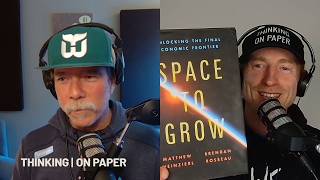
Matt Weinzierl and Brendan Rosseau, authors of Space to Grow, join the book club they have been listening to. Weinzierl, an economist, thinks the laws of economics are universal, and that space policy should play to the strengths of both government and the market.

Who Owns Space? Space to Grow Book Club

Mark and Jeremy finish Space to Grow by Matthew Weinzierl and Brendan Rousseau. They start with Planetary Resources and Peter Diamandis, then trace the law from the 1967 Outer Space Treaty to the 2015 US act that let American companies own and sell space resources.

The Biggest Space Tech Funding Rounds of 2026

Mark and Jeremy count down the ten largest space tech raises of 2026 so far, ranked by money raised rather than valuation. The list runs from Starcloud's $170 million to Sierra Space's $550 million and a Chinese rocket company at number one.

What Is Kessler Syndrome? Space to Grow Book Club

Mark Fielding and Jeremy Gilbertson read a chapter on orbital debris as a tragedy of the commons. They start with Donald Kessler's 1978 paper, which warned that collisions could accumulate faster than atmospheric drag removes debris, and ask how cheaper launches got us here.

Why Did Space SPACs Crash? Space to Grow Book Club

Space to Grow follows the SPAC boom in space, and Mark sees crypto's 2021 in it. They explain how redemptions work, why forward-looking revenue projections pushed CEOs to forecast exponential growth, and how Astra was valued at $2.1 billion before any rocket reached orbit.

Can Humans Live on the Moon?

Skyler Chan

Skyler Chan, CEO and founder of GRU, argues the key problem in living on the Moon and Mars is off-world surface habitation. GRU splits it into two products: an inflatable from Earth to hold temperature and pressure, and regolith bricks against radiation.

Do Data Centers in Space Make Sense?

Mark and Jeremy watch Philip Johnston's TED talk on data centres in space, given in San Francisco in October 2025, as preparation for going live for the Artemis launch. Jeremy credits Johnston and Elon Musk for the ground swell behind space-based data centres since then.

Why Is Moon Dust Dangerous?

Philip Metzger

Philip Metzger explains why dust from one landing can travel around the Moon, how 10 launches and landings of a 40 ton lander a kilometre away could jam an antenna, and why nations must agree what counts as acceptable damage.

How Did SpaceX Cut Launch Costs? Space to Grow Book Club

Space to Grow: Unlocking the Final Economic Frontier is our new book club read. Chapters one to three trace NASA from the comedown after Apollo through the shuttle era to the fixed-price COTS contracts that opened the door to private launch.

Could Space-Based Solar Power Make Energy Free?

John Bucknell

John Bucknell, CEO and founder of Virtus Solis, argues that space-based solar power delivers energy that is basically free once the asset is paid for. He explains why NASA's studies of the late 70s didn't add up, and what falling launch, photovoltaic and automation costs changed.

How Does Radiation Affect Electronics in Space?

Danny Andreev

Danny Andreev, founder of Sunburn Schematics, designs radiation hardened electronics for space and defence. He explains isolated DC to DC conversion, which he calls the beating heart of a spacecraft, and why thermal cycling is arguably bigger than anything else.

What Is Helium-3 Used For?

Glen Martin

Glen Martin, CEO of the Extraterrestrial Mining Company, explains why helium-3 lands on the Moon from the solar wind, and why the US only gets it as a decay byproduct of tritium in nuclear weapons. Quantum computing is already driving demand.

Where Is the Smart Money Going in Space?

Mark Boggett

Seraphim invests other people's money, and its investors expect a return within about ten years. Mark Boggett explains why that keeps him close to Earth, then walks through Seraphim's map of the market, from launch bottlenecks to satellite data sold to insurers.

How Do You Build a Moon Base on a Budget?

Mark Fielding and Jeremy Gilbertson read a paper by Philip Metzger, Anthony Muscatello, Robert Mueller and James Mantovani on bootstrapping a space industry from the Moon. It climbs through generations of lunar industry, from teleoperated machines to robots that 3D print what they need.

How Does Space-Based Solar Power Work?

Martin Soltau

Martin Soltau directed the UK government study into space-based solar power. He explains how Space Solar's Cassiopeia design steers its energy beam through 360 degrees with no moving parts, and why the beam will not cook the fish.

What Is Space-Based Solar Power?

Sanjay Vijendran

Sanjay Vijendran led the European Space Agency's first dedicated research and development programme on space-based solar power. He explains why a solar farm in orbit sees the Sun all the time, and why reusable rockets have reopened an idea that is over 50 years old.

Why Put Data Centers in Space?

Philip Johnston

Philip Johnston co-founded Starcloud to put AI data centres in orbit, powered by the Sun. He explains how a dawn-dusk sun-synchronous orbit keeps a satellite always in sunlight, and why the whole plan depends on launch costs falling under $500 a kilo.

Can Satellites Watch Earth in Real Time?

Fintan Buckley

Fintan Buckley's company Ubotica runs AI on board satellites, so a satellite sends down insights where it would otherwise send raw images. “And we have demonstrated that we can go from image to insight to ground within five minutes.”