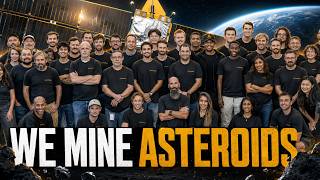
Can Humans Live on the Moon?
Skyler Chan's plan for a hotel on the Moon drew insults from strangers online. They found my high school volleyball photos.



In this episode · 10 chapters
People believe the moon landing is still fake. People think the earth is flat. Does it matter? Does it affect me? Does it affect the mission of humanity?
Skyler Chan, CEO and founder of GRU, argues the key problem in living on the Moon and Mars is off-world surface habitation. GRU splits it into two products: an inflatable from Earth to hold temperature and pressure, and regolith bricks against radiation.
He explains why the first payload, roughly 10 kilograms, aims to make humanity's first brick on the Moon, why launch cost and launch price are different things, and why a hotel is the fastest economic wedge. He also talks about the hate mail.
Skyler Chan, CEO and founder of GRU Space, tells the Thinking On Paper podcast that a hotel on the Moon is really a test of off-world surface habitation, which he calls the key problem stopping people living on the Moon and Mars. GRU plans to pair an inflatable habitat brought from Earth with radiation-shielding bricks made from lunar regolith.
Can humans live on the Moon?
Skyler Chan says the key problem is surface habitation. GRU Space plans to pair an inflatable habitat brought from Earth with radiation-shielding bricks made from lunar regolith.
What are the two parts of GRU's habitat design?
GRU splits the habitat problem into two products, Chan explains: an inflatable inner bladder from Earth to hold pressure and temperature, and bricks to protect against radiation. The bricks use a geopolymer, a chemical binder shipped from Earth and mixed with lunar regolith in an automated process.
What does Skyler Chan think of the ISRU debate?
Chan calls the debate over in-situ resource utilisation (ISRU), building with materials found on the Moon rather than shipped from Earth, a “false dichotomy” and expects a gradual shift between the two. He argues that sintering or melting regolith takes orders of magnitude more energy than GRU's mixing approach.
How much does it cost to deliver cargo to the Moon?
Delivering cargo to the lunar surface costs roughly a million dollars per kilogram today, Chan says, while SpaceX has said publicly it will offer a hundred thousand dollars per kilogram. He warns against conflating launch cost with launch price, and says the figures in GRU's white paper are internal cost modelling, not prices.
What will GRU's first payload to the Moon do?
GRU's first payload, roughly 10 kilograms in the white paper, aims to make what Chan calls “humanities first brick on the moon” and to inflate a test habitat that holds pressure and temperature. He says companies have asked to have their logos printed or stamped on the bricks.
Why did Skyler Chan choose a hotel?
Chan chose a hotel because “the fastest economic wedge to doing this happens to be the hotel” and because the idea grabs attention in a way new power or communications systems do not. The current target is a habitat that four people can visit, a figure he stresses is an estimate.
Where Mark and Chan disagree
Mark relays that people felt a Moon hotel trivialised what is possible, and Chan replies “We just prove them wrong. We just build”. Mark also asks whether becoming interplanetary absolves humanity of responsibility for Earth; Chan answers in utilitarian terms, accepting some harm on Earth for faster settlement of Mars as “Short-term pain for long-term gain”.
Links from this episode
Questions
Can humans live on the Moon?
Skyler Chan says the key problem is surface habitation. GRU Space plans to pair an inflatable habitat brought from Earth with radiation-shielding bricks made from lunar regolith.
Who is Skyler Chan?
Skyler Chan, CEO and founder of GRU Space, tells the Thinking On Paper podcast that a hotel on the Moon is really a test of off-world surface habitation, which he calls the key problem stopping people living on the Moon and Mars.
What is the key problem in living on the Moon and Mars?
Skyler Chan, CEO and founder of GRU, argues the key problem in living on the Moon and Mars is off-world surface habitation.
What does GRU Space plan to build on the Moon?
GRU plans to pair an inflatable habitat brought from Earth with radiation-shielding bricks made from lunar regolith.
Transcript
Mark Fielding Hotels on the moon, Jeremy. Do we want them? Do we need them? Hell yes. Such is the human condition. It's very unlikely. Earth will remain habitable beyond, I don't know, next Wednesday. We need to take our culture to space. Civilization beyond our home planet.
today we're speaking to Skylar Chan, CEO and founder of Gru, who plan to build a hotel on the moon, which you can go to in 2032, in theory. Chan, to Thinking on Paper. Thank you.
You are perhaps the man with the biggest ambition in space tech right now.
did you decide to dedicate your life to building a hotel on the moon?
The biggest problem
Skyler Chan the biggest problem that is stopping humans from living on the moon and Mars is not like, you know, I was inspired by Elon growing up. So it's like, it's not like the transportation of the rockets is actually like, how do we keep people alive for a long period of time on the moon and Mars? Like if you distill it down on a technical level, it's off world surface habitation. That is the key problem that we need to solve. And if that is the Promethean moment is if we solve off world surface habitation, well, you can really have millions and trillions and infinite human lives.
to be born on the moon and Mars in theory. And so that was like the obsession and that was the excitement was like, okay, like this is the thing. This is the thing I want to solve.
the way we thought about the whole time, but I'm skipping a lot of steps, but I'm just going to answer the question. So Hotel the moon is habitat on the moon, right? What are the things that will hurt you in the moon? Radiation temperature, sorry, pressure, temperature, radiation, right? And so we've just kind of divided into two products, right? To solve those problems is number one is we're bringing inflatable from earth to the moon as the inner bladder. And we want to prove that we can hold temperature and pressure in that lunar environment, which we haven't done yet. The second thing is using lunar regolith and our geopolymer process and turn it out autonomously into bricks, which can be the building blocks for the whole town and protect you against radiation. if you look at ISRU as a whole, right, the whole concept of using resources,
ISRU
Jeremy Gilbertson Yeah, just real quick to remind the audience ISRU Institute resource utilization. So using the stuff on the moon to build stuff to make civilization. Yeah.
Skyler Chan It's like if you sailed from Europe to North America, you wouldn't keep bringing stuff with you. You would just start figuring out to use stuff locally. From my viewpoint, it seems like we've got two sides of the aisle that are very polarized. In the community, you've got people who are like, no, let's only use resources on the moon and Mars. We need to do sintering and melting and not bring anything with us. You've got other people on the other side of the aisle, which like we cannot do this. This is totally stupid. This is unrealistic. Let's just bring everything from Earth to the My take is it's not actually by binary, it's false dichotomy. It's going to be a gradual progression ⁓ in terms of how humans are actually going to eventually go long term. And so what we think is the actual technology that's going to enable that is honestly the simplest solution, right? We're using geopolymers, which is basically the solution that we're bringing, a chemical solution, we're bringing from Earth to the moon and we're mixing the lunar regolith with it in our own automated process that's going to produce these bricks. Keep in mind that humans have never
The first product on the moon
Skyler Chan Built a product on the moon and I think this is just like the practical standpoint But we've got a lot of different theories on how we can do things like we should be melting and sintering and making these landing pads But the problem of that is it takes orders of magnitude like more energy than our Solution which by the way, like not only is energy probably gonna be the most like valuable commodity for us when we go to the moon ⁓ But it just does not exist right now. It's a DNA does not exist right a motorized like system is going to mix these things together is a lot more feasible and practical and realistic as a practical step than that. And I would argue that we should just focus on things that are actually going to get us to be able to have a discourse to be now like the Overton window. We're trying to increase the Overton window essentially, right? Like building stuff on the moon seems really crazy. But once you build the first brick on the moon, then it's like, like what else can we do? Right? What else can we do with this technology? we can build habitats and hotels. we can build the moon base.
and build roads, warehouses, et cetera. take on that.
window for people who might not be familiar with the term? Is what?
Skyler Chan it's essentially the idea that like, like with data centers in space, like it was crazy for a bit and then the window widened. like the sort of like acceptance of a new idea that seemed crazy, like increases. And so we're seeing in my view from what's happening, I guess the last month, it seems as though, you know, initially when we launched, it's very provocative, right? It's a one-liner, it catches people's eyes. And then, you know, we've saw some people who've sort of shifted their company focus towards focusing on the moon instead of Mars or other things. and so and like moon base and let's build mass drivers on which is like ⁓ You know, we're all trying to work . We're all in the same team and we want it for team humanity. We want to bring humans to the moon and Mars.
The idea is you have hotel habitat up there that essentially four people can go visit for a period of time, correct?
Skyler Chan That's the current estimate and the target.
Jeremy Gilbertson Yeah, I'm not, yeah, yeah, I'm
Jeremy Gilbertson not gonna come knock.
Skyler Chan of people took the white paper and said, this is exactly what it's gonna be. I remember running about our team and legal stuff and I'm like, okay, I'm making sure it's estimated, it's targeted, right? Because the whole point of the white paper is to produce a thing that people can look at and be like, hmm, this seems like a reasonable line of thinking for a case or maybe it doesn't. It's meant to be a point of discussion. It's not meant to be the crystal ball of the future,
The economics
Jeremy Gilbertson How do you deal with the economics as you're planning through all of this stuff?
Skyler Chan right now the cost per kilogram roughly to send something from Earth to the moon's surface is roughly a million dollars per kilogram. Now SpaceX on their website has said that they are going to do a hundred thousand dollars per kilogram. Those are about two main public figures that everyone in the space industry have been talking about.
Mark Fielding Just to be clear, because we've spoken a lot about launch costs to our viewers, that's to the moon. That's not to orbit, not to be confused.
Skyler Chan the moon. And those are what's publicly available in terms of listed prices that people have been talking about. So.
Yeah, that's just get to product a product like a payload basically to to to the moon. So what that means is there's there's a couple things here right to unpack is number there's the cost of launch and there's the price of launch, right? And a lot of people when they zoom out and they look at this, they look at things I'm like, oh, like launch costs are going down, you know, or something like that. And that means like my price is gonna go no, you cannot conflate like these are two separate things,
If the cost if the engineering cost can go down doesn't necessarily that your price will go down and I want to make this distinction as well because In our white paper, we've listed projection just literally Excel spreadsheet math on our cost model and we put that internal cost and a lot of news outlets have taken that and like this is how much it's gonna This is the price. This is how much it's gonna pay. You cannot complete the two. They're very different things That's just how much we predict internally will cost in those parameters that we listed which is a simulation to be
So when we think about the model for us, we see a couple of things. Number one is there is the following launch price for us, which is very good because the bet of the company is that yeah, we're emerging out of stealth at this time where it's going to be economically favorable for us to be building now because now it's going to be cheaper for us to put stuff on the moon. We think at GRU that it's going to be order maybe more magnitude cheaper for us to go to the moon.
than what it is currently now, which means that yes, the first payload that we send, like I said, in the white paper in the first mission, it's roughly 10 kilograms. That's intended to do a couple tests of the to de-risk the core technology we need to do to show the public that this is capable, this is safe, and we're taking the steps to get to the whole stuff. That's a small pill. That's 10 kilograms. Right. Later stuff in the mission in our roadmap is like, it's gonna be like more than 10 kilograms. It can be 100, can be a thousand or whatever.
And at first you might be like, whoa, like that's so expensive. Like that's crazy. You know, like it's a million dollars, but no, like the cost is going to go down, right? That's the bet that we're taking. So I think that's the important thing when you think about cost model is it's a lot of fundamental reasoning and where the future is going to go. You cannot, you really cannot predict with math, like where things are going to go. You have to see around the corners. And I think Jensen Huang said this in a previous interview that he did, but like real intelligence is trying to around the corners and figure out like where things are going to lead. And for us, the core conviction out of all the other conviction bets that we have at GRU, I think the biggest takeaway is that it is inevitable that humans are going to be on the moon and Mars. It is inevitable. And because it is inevitable that humans will become interplanetary, this technology is necessary to build.
Bigelow
Mark Fielding see two companies merging with you historically. Bigelow, so they built an inflatable module on the space station and the gorilla in the room that SpaceX have just gone "Moon before Mars" and changed their mission statement.
How do those two companies, if at all, play into the design of the hotel and the strategy for the first launch?
Skyler Chan Well, I mean, we're aware of obviously Bigelow, we're also aware of SpaceX, In terms of overlap, partnerships or any of that, again, I can't comment on any of those. So I think I'll just leave it at that, honestly.
The first launch
Jeremy Gilbertson But let's talk about this first launch 10 kilograms, right? Or this first mission this first payload test. Can you talk us through any of the details and what what success might look like? And I think you're doing that in what 2029 is when you're projected to do that?
Skyler Chan So this is the fun part, right? So ⁓ basically the payload is designed to do two things, right? Number one is you want to make humanities first brick on the moon, emphasis on brick, AKA product, right? And so the way we do that, it's essentially going to extract lunar regolith, which is topsoil in the moon, bring it into our process in the black box of our payload and outcomes, basically the bricks. Now, what I found is that there is an opportunity for companies who want to their logo on the moon. Printed on a brick or stamped on a brick.
Skyler Chan I was just thinking Lego it's crazy. Like, and by the way, this is something I wasn't expecting until I did the launch and we realized that some people were interested. So that's one half, right. And again, the purpose of that, in our view is we want to prove out that we can make this product because this is going to be useful for solving for radiation and impact when we build a durable long term habitat, which functions as the whole time. The second half of this payload that we're saying that we want to send them in is demonstrating the inflatable system that we've developed in-house basically inflate on the moon and do two things, a couple other things but mainly two things, hold pressure, right, and maintain temperature, right. Those are the things. There could be other tests that we'll reveal but the general gist of that is again before we can send people to the moon and like have them stay in hotel we need to prove that we are capable of inflating this thing which is the inner bladder and again I want to emphasize that it's something we're like
Oh, is that the hotel? like, no, of course not. Like we're not going to bring the whole hotel with us on the first mission. That's not even economically feasible, right? The emphasis is this is just the necessary, like you said, which thank you for explaining the flywheel very well. It's a necessary next step for us to learn things so that we can then incorporate that in the feedback loop and then build the next step and build the next step and so forth. So the combination of those two things is going to be really exciting because the world has never built a product on the moon and we're hopefully going to be able to film it and show the rest of the world and it'll be a very nice unified moment in my I hope so you know I really believe this space is a unifying thing for all of
What people say
Mark Fielding I spoke to a lot of people about the show. said, I'm speaking to Skyler Chan. They're going to put hotels on the moon. was a sense that it was trivializing what's possible.
How do we change the mentality of people to accept these projects for what they are, not the...
Skyler Chan We just prove them wrong. We just build, right? That's it. And the second thing, the more important thing is I actually don't think that matters. People believe the moon landing is still fake. People think the earth is flat. Does it matter? Does it affect me? Does it affect the mission of humanity? No, people are always gonna, you can't make everyone happy like the truth of the matter is like I think the things that it's just like with Elon too he's got a lot of haters and I was kind of bracing myself before the launch. I was like I remember telling my friends like yeah I mean it's probably gonna be a lot of haters and here we are you know we got a lot of random hate you know I hate mail and who cares right? like I people are like you're doing the right thing.
The hate mail
Mark Fielding You got hate mail you actually phrase that you could share from, don't share the name, but any particular phrase from your hate mail?
Skyler Chan one that comes to mind, but it's very provocative and I think what's just not to do that for your first Yeah, it's pretty fun, yeah
Jeremy Gilbertson Dude, should do a follow up. We should do a follow up and unpack all your hate mail, dude. That would be so much fun.
that they think you should be doing something else or is it that this is just an impossible dream?
Skyler Chan you've got people who are like, you're like a complete insert every single like curse word you can think of. then you've got people who are like, this is the most dumb thing. I'm going to have a timer in 2032. And it's like the guys were like, actually you can't do this. like, brother, like literally said, this is the target. Like, it's just like very clear that the whole point of the launch of the company is just, Hey, we should do this thing. Now like we're promising these things. And then you've got other people who are like, Oh, but we've got to save, you know, the planet and blah, blah. I'm like, can.
That's a stupid argument. You can say that if anything, with anything. It's honestly kind of nice. Some of our team members sent it to me. We got YouTube videos. They found my high school volleyball photos. Don't know what they're doing with that. Some weird stuff, man. If you're listening to this, enjoy living in your mom's basement still.
like yeah you know there's always gonna be haters right to answer a point like I acknowledge that
Obviously, this is a very hard thing, but you live once, right? You gotta do what you really wanna do. I just feel really grateful that every day I get to be doing like what honestly, not that this is my childhood dream, but this is like basically the manifestation of what I want to do as a kid. And for me, it's like, when I look back, if I think about when I'm 98 years old and what did I wish I did, regret minimization framework like from Bezos, if I didn't try, try to put humans on Mars. I want to my grandkids, oh, look up there. We got people living on Mars. And grandpa was able to work, contribute towards this, you know, whether I laid it or not, doesn't matter. But as long as we contribute, it seems like right now we're kind of trying to push it, the tip of the spearhead. But that is like the goal is to fill that fulfillment. Right. It just happens that the fastest, it seems like the fastest economic wedge to doing this happens to be the hotel. And it just happens that a lot of people when they hear a hotel, it's provocative, but it's that's the thing is like, making humanity interplanetary and I want to leave people with this too is like it's not a technology problem it's an operational problem. we've done we've gone to the moon before we have a technology with like technology less than like the iPhone so we have a technology arguably to make this happen. we just need to get the right people, the right resources. and we need to rally the world together to make this happen and so in my view the challenge before I did the launch and I was architecting the launch was like okay we got to like capture mindshare, we got to get people excited about this because the thing is with
It's hard for people to like, you know, some new power system comes up, some new communication system comes out. Like it doesn't affect the average person, but the moment you say like, hotel on the moon, it like grabs the attention. It gets people thinking. And then yes, you go through the cycles of this is BS, this is fake, but then like maybe you read the white paper and then people are like, "whoa, like I can see where this is going." It's obviously early, but now I'm thinking about the idea of humans being on the moon and Mars. And I think that's the important thing is you need to plant the seed for that.
Mark Fielding So I'm going to give you a topic.
And I just want you to riff on it for 30 seconds.
Mark Fielding you so sure of that?
Skyler Chan It's humans, the thing about humans is that we always want to go and explore and expand. It's in our DNA and I'm a big fan. I believe in indomitable human spirit. We're gonna find a way to make it happen.
The last six months
Mark Fielding In the last six months, is there anything about the space industry that you've changed your mind about?
Skyler Chan Yes, I'd say the last six months was a lot of the genesis for what we're doing now. And the biggest thing I realized was,
Honestly, for us, it's very relevant. Moon hotels are not that crazy. And it's the fastest economic wedge to make it happen. Other things where you can just do things. like I saw what happened with Philip and Starcloud and doing data centers and now everyone's kind of hopping on that wagon. We might be coming on that similar thing where like we did this moon hotel thing and we got a lot of people who doing moon bases now and talking about that. ⁓ the world is your oyster, just gotta go build and really say what you really believe in. I think that was the biggest thing in the space industry is that this whole time growing up, I thought this is so far out, this is gonna take forever. And then when I started the company, that's when I realized every day and day and day.
We could just do it. We could just start. We can try to make things happen. We can really get together the right people to get excited about this. And I think the only thing that made me change about the space industry is just, I love it even more. Everybody is so passionate. Everybody loves it. Everyone dreams about this stuff every day and night. It's like you're living the dream. Space is awesome.
Mark Fielding Philosophical question, do you think that being an interplanetary species absolves us of some of the responsibility of not screwing up the planet we actually have?
Skyler Chan like, if you draw the line of like, when we screw up the planet as like, when we make it non habitable for like, the majority of the human race, ⁓ if we're able to go to our planet, terraform it, build it up to the point where it becomes habitable. And then if you look at the utilitarian aspect of like, okay, has like the net good like increase with that, if we stop investing resources in maintaining the home planet, so that you know, it's like if we do injure some people on planet Earth, it's not the best quality of life, but we enable a faster move towards Mars and more humans living on Mars and maybe other planets, that is a good choice, Short-term pain for long-term gain.
The closing question
Mark Fielding Last question, one of Jeremy's favourite questions is, you have 30 seconds to speak to the politicians of the world that make the decisions, the businessmen and women of the world who make the decisions, the 20 most powerful influential people in the world. What do you tell them?
Excellent, I love it. Thank Thank you for thinking on paper with us. Where can our listeners read your white paper and learn more about what Gru is doing?
I read it. I recommend everyone reads it. You can learn more about thinking on paper thinking on paper. X Y Z and listen to us wherever you listen to your podcast. If you like what you've heard, please share it with a curious friends. This is an interactive learning experience about technology. We need your questions. We need your input. And if you want to troll us, if you want to say that we're mad, you can do that as well. So we'll see you in the comment section and until next week where we're speaking.
about space weather. You're like next week's show, Skyler, we're talking about radiation proofing and solar proofing technology. So join us for that. And until then, keep thinking on paper.