What Is the 2026 National Space Transportation Policy?
The US wants more than 1,000 launches and reentries a year by 2030. Who needs that many?
Somebody has to pay for it all, and it can't all be the US government.
Episodes about space investment, solar power, lunar industry, space mining, debris, and the economics of leaving Earth.
The US wants more than 1,000 launches and reentries a year by 2030. Who needs that many?
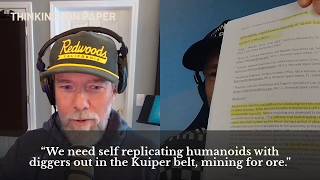
AstroForge CEO Matt Gialich wants to mine platinum from metal asteroids, which he describes as the cores of planets. On Earth, he says, most of that platinum sits in the core, out of reach.
What will it take to keep people on the Moon full time? NASA's user's guide for a moon base lays out three phases towards a continuous presence at the lunar south pole.
Sanjay Vijendran has left the European Space Agency and co-founded TerraSpark, which has raised 5.4 million euros in pre-seed funding to build space-based solar power.
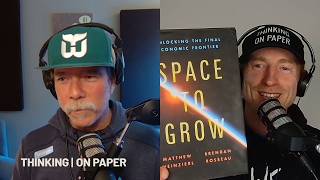
Harvard Business School economist Matt Weinzierl and Brendan Rosseau wrote Space to Grow. Weinzierl thinks the laws of economics are universal, and that nothing in them requires gravity.
Who owns the riches of the solar system? The closing chapters of Space to Grow ask whether we can stop our power games, conflict and corruption from following us into space.
Where is the money going in space? We count down the ten biggest space technology raises of 2026 so far, from Starcloud at number ten to a Chinese company, iSpace, at number one.
What happens when low Earth orbit fills with junk faster than it clears? Donald Kessler warned in 1978 that collisions could accumulate faster than atmospheric drag removes the debris.
What happened when space startups went public through SPACs? Space to Grow follows the boom, including Astra, which went public before any of its rockets had reached orbit.
GRU founder and CEO Skyler Chan plans to build a hotel on the Moon. He thinks the hardest problem in living off-world is keeping people alive on the surface for a long time, not the rockets that get them there.
Will most data centres be in space within ten years? Starcloud CEO Philip Johnston predicts they will in his TED talk, and we watch it to test the case.
Why would anyone pay to go to space? Chapter four of Space to Grow answers with Planet, the company behind a constellation of small Earth-imaging satellites called doves.
Was SpaceX inevitable? The authors of Space to Grow put its success down to iteration, vertical integration, economies of scale and reusability, and culture.
Danny Andreev founded Sunburn Schematics to design radiation-hardened electronics for space and defence, starting with isolated DC to DC converters, which he calls the beating heart of a spacecraft.
Glen Martin, CEO of the Extraterrestrial Mining Company, wants to mine helium-3 on the Moon, where the surface keeps absorbing it from the Sun.
Mark Boggett, CEO and co-founder of space technology investor Seraphim, backs space businesses that are actionable now rather than grand Star Trek visions.
Could twelve metric tons of hardware on the Moon start a space industry that eventually builds itself? Philip Metzger and his co-authors think so.
Martin Soltau directed the UK government study into space-based solar power, and the latest economic work at Space Solar puts its energy below 30 dollars a megawatt hour at today's launch costs.
Sanjay Vijendran led the European Space Agency's first dedicated research programme on space-based solar power, and is now director of his own venture, Space Energy Insights.