What Is Helium-3 Used For?
Asked who would enforce mining claims on the Moon, Glen Martin says it may look more like the gold rush in the Wild West. There's no Mounties on the moon, but there is the Space Force.



In this episode · 18 chapters
- The valuable isotope
- Quantum, and the demand
- Why so little on Earth
- Why it sits on the surface
- Dune, and the spice
- Is this another thing to strip?
- Fusion, corrected
- Space-based solar power
- The interstitial step
- Glen's background
- The elephant in the room
- Who plants the flag?
- No Mounties on the moon
- The CLPS programme
- Four hundred kilograms of lunar regolith
- What are you scared of?
- Tom Waits
- The Kevin Kelly question
Uber is a space company at the end of the day because you couldn’t do it without space assets.
Glen Martin, CEO of the Extraterrestrial Mining Company, explains why helium-3 lands on the Moon from the solar wind, and why the US only gets it as a decay byproduct of tritium in nuclear weapons. Quantum computing is already driving demand.
He walks through sifting regolith that recharges in a hundred years or so, China's sample returns, the UN's draft space resources treaty, and why he calls helium-3 the beaver pelt that could open a cislunar economy, as pelts did for the Hudson's Bay Company.
Glen Martin, CEO of the Extraterrestrial Mining Company (XMC), argues on the Thinking On Paper podcast that the Moon could become a source of helium-3, a rare isotope that cools quantum computers and could fuel fusion reactors. Scarce on Earth but plentiful in lunar soil, it is, he says, “the beaver pelt of the economy”, the one export that will open a commercial economy around the Moon.
What is helium-3 used for?
Helium-3 cools quantum computers and could fuel fusion reactors, Glen Martin explains. It is scarce on Earth but plentiful in lunar soil.
Why does quantum computing need helium-3?
Quantum computing already faces a helium-3 shortage, according to Martin. Dilution refrigerators, the machines that chill quantum chips to below 10 millikelvin, each need about 40 litres or roughly five grams, and he says makers including Maybell Quantum, Bluefors in Finland and Oxford in the UK cannot get their full allocations.
Where does Earth's helium-3 come from?
Earth's helium-3 comes mainly from the decay of tritium in US nuclear weapons, which the Department of Energy bleeds off and resells, Martin explains. He puts the US reserve at 29 kilograms and global production at about 20 kilograms a year, against estimated quantum demand of 300 to 400 kilograms and a NASA estimate of 1.1 million tons on the Moon.
How does helium-3 build up in lunar soil and how is it collected?
Helium-3 builds up in lunar regolith, the loose dust covering the Moon, because it arrives on the solar wind and the Moon has no magnetosphere to deflect it, Martin says. Collection means lifting and vibrating the top layer to release the gas, and he says a mined patch recharges completely in about a hundred years.
How does XMC plan to pay for lunar mining?
XMC plans to finance lunar mining as a public-private partnership (P3), the model used to fund toll roads and power plants, rather than relying on government or venture capital. Martin cites NASA's Commercial Orbital Transportation Services contract for Space Station resupply, which SpaceX won, as a P3 and says such projects have “a two to three billion dollar sweet spot”.
Is China already targeting helium-3 on the Moon?
China is already targeting helium-3, Martin says, having landed in 2020 and 2024 in the areas of highest concentration and returned samples. He expects a UN space resources treaty draft in 2027, but warns that if companies mine under US domestic law instead, “There's no Mounties on the moon, but there is the Space Force”.
Where Mark and Martin disagree
Mark asks how confident Martin is in the 1.1 million ton estimate, given listener criticism that lunar resources are overstated. Martin points to about 400 kilograms of Apollo regolith held at the Johnson Space Center and the 1994 Clementine mission, but concedes the figure is “not confirmed” until surface exploration takes core samples.
Links from this episode
Questions
What is helium-3 used for?
Glen Martin, CEO of the Extraterrestrial Mining Company (XMC), argues on the Thinking On Paper podcast that the Moon could become a source of helium-3, a rare isotope that cools quantum computers and could fuel fusion reactors.
Who is Glen Martin?
Glen Martin, CEO of the Extraterrestrial Mining Company, explains why helium-3 lands on the Moon from the solar wind, and why the US only gets it as a decay byproduct of tritium in nuclear weapons.
Why does Glen Martin call helium-3 the beaver pelt of the economy?
Scarce on Earth but plentiful in lunar soil, it is, he says, “the beaver pelt of the economy”, the one export that will open a commercial economy around the Moon.
Transcript
Jeremy Gilbertson Disruptors and curious minds. Welcome to another episode of thinking on paper My name's Jeremy. This is Mark. We're going to talk about something very tiny. We can't even see it's something that actually could make a tremendous difference in the world economy,
It's very hard to find on earth. There is a place where we can find it. The short hand is look up, but Mark, up this conversation. What are we getting into today?
Mark Fielding are speaking about moon mining. We're speaking about helium-3, one of the scarcest materials on Earth. it's a stable isotope used in quantum computing, cryogenics, neutron detection, and some say it is the key to fusion energy. But the problem is there's only 100 kilograms or so on Earth. But on the moon, there might be, could be, should be, is more than that. And today's guest...
Glen Martin is the CEO of the Extraterrestrial Mining Company and he's going shed some light on what Helium-3 is, why is it important, what moon mining is, how are we going to get that from the moon to the earth and lots of more space industry knowledge straight from him. So welcome to the show, Thank you for thinking on paper with us
Glen Martin Thank you, gents. I'm honored to be on your show.
Mark Fielding reading about you and your company, Helium 3 keeps coming up. And I'll be honest, I'd never heard of So for our audience, what is Helium 3? Why is it so important and why is it necessary or worthwhile to go to the moon to get it?
The valuable isotope
Glen Martin Well, your intro was very accurate. It is the valuable isotope here on planet Earth. It is already being used, actually, for a lot of different applications currently. One is neutron detection, as you mentioned. It's used to scan shipping containers within the US and other countries as they come across the border looking for nuclear.
materials, which is a code word for nuclear weapons. And so that that's the majority of use today. Also, it's a hyper polarized gas maintains its spin state, which is a little technical. But when you go in for an MRI for some ⁓ checking for asthma or some other lung disease, you actually inhale this stuff and it'll show up any of the diseases. And it's considered the best of these hyper polarized gases for this purpose.
Glen Martin It really gets interesting when we start talking about the two other major applications. One is quantum computing. As quantum computers get deployed at very large scales here in the coming five to 10 years, you're going to be needing a lot of it for getting the quantum computers below 10 millikelvin so they can stay entangled. It's a curious state, near absolute zero, it stays entangled and so can actually function as a chip. And then to your last point, fusion is going to be killer app for helium-3. It's interesting at the other end of the spectrum from absolute zero at a billion degrees, can fuse two helium-3 atoms together and create a burst of energy and heat without creating radioactive waste, which is gold standard within the industry. You can use deuterium and tritium, but they create radioactive waste. So you start mapping this out in demand, you're looking at, you know.
to your point, maybe 100 kilograms. The current reserve in the US is actually 29 kilograms. And we only produce about 20 of it globally per year, 20 kilograms. You start mapping out demand, even in quantum it's gonna be 300 to 400 kilograms. And on the moon there's 1.1 million tons estimated by NASA based on small samples.
Quantum, and the demand
Jeremy Gilbertson the quantum industry started to pull any of this demand through yet or is it kind of like a future thing that they're figuring out how to incorporate?
Glen Martin It's happening now. We talked to dilution refrigerator manufacturers like Maybell Quantum and Blue Force in Finland and Oxford out of the UK and all of them are running short of supply. They're not getting the full allocations they need. They're starting manufacture. Each dilution refrigerator needs about 40 litres which is about five grams or so and can't get the supply, they're shipping more than they can get fully charged before they ship. IBM, Google, Amazon, Microsoft, Intel, D-Wave in Canada are all building out larger and larger quantum computing data centers and they're already outstripping terrestrial supply.
Why so little on Earth
Mark Fielding Why is there so little on Earth and why is there potentially so much on the Moon?
Glen Martin It's a rare isotope of helium. So if you look at what we used to put in balloons, helium, it's primarily helium-4. So it's found primordially under the ground. They find reserves of it. You may know that it's relatively rare, but not nearly as crazy rare as helium-3, which only occurs in 0.0001 % of naturally occurring helium here on
And so we only get it here because we make tritium for nuclear weapons, actually. So within the US, there's a fairly large fleet of...
thermonuclear weapons, which are all tritium containers, about 12 years and a quarter in, 50 % of the gas turns into helium-3 because it decays. It's a decayed byproduct of tritium. So the Department of Energy has to bleed off the helium-3 and they can resell it for commercial purposes, which it does. So I...
It's rare because there's only 10 kilograms per year coming out of the US roughly. And again, early estimates of quantum demand is 2, 3, 400 kilograms per year.
Why it sits on the surface
Glen Martin Great question. On the surface. OK, so the reason that it's so concentrated on the lunar regolith, the dust that covers the moon, is that it's actually a byproduct of the fusion process of the sun. So it's carried on the solar winds. The Earth blows it back out into space because we have this magnetosphere that protects us all.
gamma radiation from the sun cooking us all like a microwave. But on the moon, there is no magnetosphere. So it just lands. This helium-3 isotope pours down on the moon continuously. And it turns out that the titanium oxide in the lunar regolith in the dark patches that we see from Earth, like the Sea of Tranquility and Serenity in the Ocean of Storms, that make, for us, the man in the moon. For the Chinese, the Jade Rabbit. So it's embedded in there very, very, very relatively higher concentrations than here on Earth.
Jeremy Gilbertson So when I think of mining, I always think of these just like giant devices that are digging deep down in. let's talk about what mining means for something that's just kind of landing on the surface. Is it more collecting?
Dune, and the spice
Glen Martin It's a little bit like the movie Dune if you saw the spice. And it was a case to be made that helium-3 is the spice, the melange of planet Earth for all the positive benefits it's going to have for us. But no, just, you go across the surface, lift up the regolith, you can vibrate it actually, about half of the helium-3 and other volatile gases disassociate because they're only loosely.
connected to these titanium oxide particles. And so you can actually take the gases out with a cold plate. And then you just take the gas, all this undifferentiated gas, because there's xenon and argon and krypton and some other amazingly named noble gases in the lunar regolith as well. And then you only have to go three meters deep at
And then the beautiful thing about it, it's almost like harvesting in so far that if you take all the helium-3 out of the lunar regolith over a large patch of ground up there,
In a hundred years or so, it recharges completely. So it's like a sponge. It absorbs helium-3 from the sun. So it's an ever-continuous, ever-green resource.
Is this another thing to strip?
Jeremy Gilbertson So it's not like humanity pointing towards yet another thing to just squeeze all out of and then discard, right? There's a little bit of regenerative stuff happening up there. That's pretty cool.
if it's so abundant, you wouldn't need initially to make much of an impact on the lunar surface to collect enough to go a long way.
Would that be accurate? the actual mining material you would need initially would be quite small.
Glen Martin from the Earth this will be invisible for first starters. ⁓ You know, so one square kilometer roughly you'd need to cover to make about 33 kilograms. And so 33 kilograms, one nuclear reactor would burn about 50 kilograms per year.
You know, if we completely go green with our energy mix, supply mix, which is to say mostly fusion, McKinsey's looking at the power supply mix in 2050, they anticipate, 46 % will be coming from fusion reactors. That means we're going to have to deploy a lot, a lot of nuclear fusion reactors because we're not only going to be replacing the current supply mix of fossil fuel based generation, but we're also going to be the decarbonizing and electrifying transportation sector and the industrial sectors are all going to electric and renewable sources. So it's pretty clear that fusion is going to play a major role in the supply mix. And we need a fuel, and that's the strategic bottleneck, and we have to go to the moon.
Fusion, corrected
Jeremy Gilbertson so fusion, correct my ignorance, please is we're basically trying to harness the power of of the energy of a star, right? Is that that's what we're doing. It's the same concept, right? The magic within a star just to kind of level set where we're at.
Glen Martin Correct, correct. It's, you know, the sun is a big fusion reactor and it's kept in balance by gravity. It's such a massive ball of fuel that the gravity contains it and just energy is released through the process. Ultimately it'll burn out as everyone knows way off in the future hopefully. But the point is, yeah, fusion reactor is basically a sun.
on planet Earth. So we just use magnetic confinement, sometimes laser confinement, there's other field reverse configurations and things that keep it, the plasma ball contained. But yeah.
Jeremy Gilbertson Kind of that donut, that donut thing, right? There's like, yeah? Yeah.
Glen Martin That's, yeah, the Takumak it's called. That's an old
Soviet architecture. So I think that was their gift to us to make sure that we never got there. ⁓ man. It did. And then there's a stellarator architecture where it takes the doughnut and adds a twist. So it looks like a cruller, French cruller. And the biggest, if you're based in France, ITER just fired up. It's one of the biggest fusion reactors on the planet in France.
Jeremy Gilbertson ⁓ that's the one that slowed us down. Yeah.
your take on, just general take on the possibility of fusion as the future for power?
Glen Martin honestly, I think it's going to be the core technology for generating electricity through, you know, our humankind's expansion into space, primarily because solar is very powerful, solar and wind, but all, at the end of the day, they're all derived from the power of the sun. And then the further away we get from the sun, you lose the, you know, inverse.
ratio, you lose the ability to generate electricity with solar power. if we go to Mars, let's say, you will need to generate your own electricity. We can start with fission, which is to say heavy elements that we break apart. But fusion is neat and tidy and powerful once we get the tech worked out, which is just an engineering problem, frankly. I believe that it'll be the core power source for all of our work in the solar system.
But also here on Earth, think it's going to be our go-to, frankly. And again, McKinsey was like, man, we're looking at it. If it gets below $2,000 per watt peak installed, overnight costs, it's called, they think it'll penetrate 46%, 50 % of our electricity supply.
Space-based solar power
Jeremy Gilbertson Last question about power and potential. based solar power is really interesting to me. We've had a lot of guests on here talking about the ability to capture that raw energy in space, converted to microwave, beam it to earth, land it and convert have you, have you looked in any of that stuff at all? What do you think about that?
Glen Martin One of the reasons I became an aerospace engineer back in the mid-80s was that one of my seventh grade teacher actually taught a whole class on Peter Glazer's space-based solar power construct, which came out of a big report back in the 70s for NASA. And know, looking at this massive, you know, when they're early, oh baby, now you're looking at that. O'Neill, yes, another man of, great influence on this field. So, ⁓ Glaser was of that period, that optimism that was coming in, know, man, we're going to have these space shuttles, they're going to be flying 30 times a day, basically free, you know, free to space. And then later I became a designer in the International Space Station and I had two payloads go up and it was far from free. ⁓ So, but the point is, yeah, they looked at, that's how I created a passion and I know it will work.
I know that space-based solar power, and you look at SPS Alpha by John Mankins and some other more recent architectures, there's new companies coming up that look like they're cracking a bit of the code relative to the cost of launch. Yeah, it's absolutely going to play a role,
Mark Fielding a few weeks ago we had some whistleblowers from Microsoft and they were speaking about the contracts that Microsoft have had with various fossil fuel companies and how they're using AI to streamline and make the process of extraction much more profitable, With the increased demand for GPU from the AI industry, does that
Put the brakes on any potential transition to fusion because the demand is going to be so immediate and the technology won't have caught up or am I looking at that the wrong way?
The interstitial step
Glen Martin there's an interesting interstitial step that may actually drive sort of the transition through to fusion, which is to say, because of the GPU energy demand and thermal cooling requirements, know, and hence potentially a lot of use of water, and one of the reasons in the southwest of the US, in particular, this is such a hot topic.
Tucson, Arizona is like, no, we're saying no to this particular data center because it was going to consume a lot of the groundwater. But the energy constraint is really, they're all running headlong into it. I think one of the companies is reactivating Three Mile Island, for God's sakes, and then nuclear reactors are going to be coming online as quickly as they can build them to power these things. They've got to be behind the meter.
is if they're the grid, they're going to be driving up wholesale electricity costs, which is what they're doing. But there's a ⁓ disruptive event that's coming, frankly, not many people are talking about it, because they're just projecting GPU deployments for AI on a straight line. And it's more electricity on planet Earth that we can generate for 10 times whatever we can generate. So we're going to hit a wall, frankly, on that. And Philip Johnston, brilliant man.
second down here Florida to low Earth orbit, potentially this idea of putting data centers in space is one of the relief valves for this bottleneck. The other is quantum. And so as these GPU-based data centers for training large AI, large language models run into these bottlenecks, and they're running out of places to put them as well relative to data latency, they're going to start deploying quantum GPU hybrids. a lot more quantum. Quantum is very good at certain types of calcs. And I think Willow at Google just ran a test where there were 27 septillions faster than a GPU or some insane number. Julian Kelly over there, another great candidate for thinking on paper.
So they're good at certain things and GPUs are great at certain things. So it's likely that we're going to see a lot of quantum data center hybrids being deployed in the next five to ten years. And so that's going to pull down on the power demand and the cooling requirements for water. But that then creates the strategic bottleneck of helium-3. And all of this will be in advance of the fusion deployment.
which if you look at Helion or Tri-Alpha Energy, by the way Sam Altman is one of the biggest investors in Helion as is Breakthrough Energies which is Bill Gates' investment arm in Seattle. So they're placing bets on fusion but my money and this is really well not a well ⁓ explored topic is these quantum hybrid data centers.
Jeremy Gilbertson every quantum guest that we've ever had talks about this hybrid approach to how quantum computing is going to scale. And it's not going to be like, hey, we're throwing away classical compute. We're just kind of bridging them. We're being smarter about what we use one and the other for. So let's let's talk about XMC a little do we get to be able to grab some of that wonderful dust off the moon and bring it down to earth and help solve some problems?
Glen's background
Glen Martin Right on. Well, look, as I mentioned in my background, I was a designer on the space station starting in early 90s down in Huntington Beach and worked on the starboard one and port one segments, which are the thermal control, you know, the heat rejection into deep space. One of the big constraints that Philip at the Star Cloud guys are really grappling with, how to reject heat into deep space. that's a 250 kilowatt array. The astronauts are creating heat. It's been flying for 25 years now, mercifully without...
knocking on wood without any operational problems. But that was, know, $150 billion investment across multiple civil space agencies, US, Russia, Canada, Japan, and the European Union. the idea that we're going to do another, Apollo 2.0 or ISS 2.0 to start expanding the global economy into cislunar space to create a cislunar economy is just not going to happen.
And it turns out, know, I took, you know, back in 97, I launched some satellites. I started a new satellite operator company, sold two satellites in space, then got migrated over to large scale solar development, a trust room, and started working with some really interesting companies and financial partners and development entities and some governments in Canada and elsewhere.
that really sort of drove this idea that you can use private capital through private public partnerships to develop massive infrastructure, billions upon billions of dollars. interestingly, there's like a two to three billion dollar sweet spot financing these things. So if you package space infrastructure in a very similar way that you might package a solar plant or a liquid natural gas terminal or a brand new bridge or tunnel or airport, it actually can be developed and financed very rapidly. And so that's the thesis of XMC, is that we'll be bringing all of that, the lessons learned that I got over the last decade of developing infrastructure on earth, solar and smart grid.
and bring that to space infrastructure. And I believe that's way we're going to crack the code, because it's not going to be government, not going to be defense. It's not going be venture-backed startups up there building billion-dollar lunar mines. It's going to be developers that are used to developing large-scale space infrastructure.
Jeremy Gilbertson Yeah, the public private partnership, I think is it is an interesting scale approach, right? You doing it one or the other is going to take forever,
Glen Martin And just to touch on Mark's background, it's a methodology that was really embraced by the United Kingdom, picked up in Canada and Australia. You had to modify the way the governments buy services. They have to think, okay, I'm to do a 10-year deal with this private entity, this private infrastructure entity, and give them a concession agreement, say, to build a highway from here to there.
The US is lagging somewhat in this area, which is interesting in so far that we don't do multi-year off-take contracts here. But it's starting to peak in. And one of our advisors, who you guys would love is Charles Miller. He's one of the early commercial space entrepreneurs. founded NanoRacks and more recently, Link Global. And he actually conceptualized the idea of the commercial orbital transportation services contract for the NASA.
resupply missions to the International Space Station, which is really a P3 contract. so, and you know, who won that was SpaceX, in addition to Orbital Sciences. So SpaceX is what it is today because of this P3 architecture of supplying the space station. And later actually they won the follow on, which was the human delivery of humans to the space station.
Mark Fielding I live in France and things get built incredibly slowly. And then you have other countries in the world, they build megalopolises in the time that we build a bridge over a stream. community for projects like this, are some countries moving quicker than others? Are they more ambitious? Do they have more readily accessible goals
The elephant in the room
Glen Martin Yeah, well, the elephant in this room. And we could talk about the United Nations Committee for Peaceful Uses of Outer Space. And they have a space resources working group that's working on a treaty for how we can actually make claims on the moon and.
the operations and have this country say, okay, this company is going to do this and we're going to be here and you stay out of this 100 kilometer keep out zone and under the outer space treaty, know, in honor of this particular treaty from 1967. But to your point, the big gorilla in the room is China. if you want to talk about high-speed rail, well...
I don't know the statistics, but it looks like in, I don't know, 20 years, they've completely blanketed their country in high-speed rail. They can build a brand new station in 12 hours. And they're doing the same with high-voltage electricity lines. They're building a massive solar and wind facilities in the northwest of the country and linking that down to the population centers.
They have absolutely cracked the code. And when I was a designer at station, in 1992 I was called in a conference room over a weekend, Thanksgiving weekend actually, to redesign the elements that we were building to bring in Russians, to bring in the Russian components, to do station keeping and resupply. Because we, after the fall of Soviet Union and then the Duma when Yeltsin came in, we decided that we didn't want the Russians to do, know, weapons for bad actors, so we wanted to embrace them and bring them into the space station, which we did successfully. And to this day, even with the war and everything else going on in Ukraine, the Russians are still flying to the space station. We still have Russian cosmonauts on the station. But we blocked the Chinese. Somewhere along the way, we decided that we didn't.
want the Chinese in on our top secret space technology. So we blocked them, a little bit like we did with Nvidia chips. And so they worked around that. And they've created an absolute relentless machine that has been OK. They built Tiangong, their space station, in three years.
It's been continuously operating the last four or five years. I can't remember exactly how long it's been flying. They have a plan to land taikonauts, which is what they call their astronauts, on the moon by 2029 because that's the 80th anniversary of the revolution in 1949. all analyses are showing they're just...
chunking away at that goal. landed on the moon in 2020 and 2024 in the fields with the highest concentrations of helium-3 and brought back two kilogram samples. So they're doing it. They know what's up there and they're going for the helium-3 too.
Who plants the flag?
Mark Fielding Who's planting the flag in the regolith? How do we solve that problem before we get up there? How do we come to some kind of global agreement?
Glen Martin Well, the answer is we do and we don't. there are two different approaches being parallel pathed right now. There's the United Nations strategy, which, when Russia and the US were, we're going to go land a human on the moon and there's big, you know, the first space race and, it looked like it was going to be before the decade was out according to the Kennedy speech and,
And so the United Nations got together very quickly and said, okay, you know what, we're going to draft and everybody's going to sign this outer space treaty where we're not going to put weapons in space, we're not going to claim any territory for either country, we're to treat space very differently.
and both the US and Russia and all the other countries which weren't at the time spacefaring, signed the outer space treaty in 1967, two years ahead of the 1969 landings. Right now the United Nations is doing exactly the same thing. They're coming up with a space resources treaty for draft is being released in 2027.
two years in advance of the 29/30 landings that everyone anticipates. So it'll have all the language about how we peacefully cohabitate and share. And then there's the rim of eternal light. I'm sure you guys have heard on the South Pole, which has 24 hour solar, you know, ⁓ and where the water is concentrated in the permanently shadowed regions of these craters like Shackleton Crater.
Jeremy Gilbertson a great little chat back and forth. think it was one of our book club lives where someone chimed in on what does a permit look like for the dark side of the moon. I thought that was pretty fun and clever.
Glen Martin Well, funny, that's where the Chinese landed, which they put together a relay satellite network to be able to land on the far side of the moon with a nuclear-powered rover, take the sample and go back to Earth.
then there's the, when I mentioned the parallel path, the other path is what's being done in deep sea bed mining. There's an analog right now happening in that the United Nations has the deep sea bed mining authority in Kingston, Jamaica, a little bit like the ITU in Geneva, where they control geostationary frequency regulation, everything else, and coordination between countries. So this deep sea bed mining authority in Jamaica,
You know, it's plugging away, but it hasn't come up with a framework yet. And so a US company, the metals company, just got an executive order saying, no, no, you know what? You're a US company. Go ahead. And that's the way we're going to do it. And so when it comes to the moon, it may look a little bit more like the gold rush in the Wild West, honestly, than Western Canada, which had RCMP officers showing up to instill order in the law beforehand. So.
We're going to see which methodology takes precedence, but honestly, if you just go up there and start mining under U.S. domestic space laws, we have to rely on the Space Force as the cathode.
No Mounties on the moon
Mark Fielding There's no Mounties on the moon.
Glen Martin There's no Mounties on the moon, but there is the Space Force. And the Chinese have their own Space Force, so it could get interesting.
Jeremy Gilbertson tech is an accelerator to anything. But we have some very biologically ingrained human challenges that work in counter to that. if we we could rewrite rules on how humans operate, what would be some optimization that we could consider and think about?
Glen Martin this is one of the big questions I get when we talk about how we're to do this mission architecture. How do we fly to the moon? How do we mine it or sift it, I guess would be maybe more accurate, and then bring, how do we bring it back? And the short answer in the timeframe we're talking about is autonomous robotics, AI driven little brains on the lunar surface, a little bit like Tesla, robotaxes, but out there without any humans in the loop, meaning we're not tele-operating them.
They're thinking for themselves, they're avoiding obstacles, they're not gonna tumble down the side of a crater. They're agents. the humans, we're talking about landing on the south pole, because there's water, and we need water, and we need radiation protection, and we need shielding from the micrometeorites, and from the thermal swings of the moon, which is still very bloody cold. And so, when you talk about enhancing humanity, this is an interesting thing, you know, I meant, no.
Elon Musk fairly well from, almost bought the first Falcon 9 for that satellite company I was talking about. If you squint and you actually look at the body of his work, you can see where he's going with creating a hybrid human species that will be able to survive the rigors of space travel and landing and settling, that loaded phrase, the moon, Mars, and other celestial bodies because of neural link and.
things that we're going to need to adapt the human biology for space because we are really poorly adapted for it.
Jeremy Gilbertson you mentioned rovers, intelligent rovers deployed on the moon. They're grabbing the stuff, they're sifting it up, putting it back on some sort of conveyance device to get back to Earth. so when is, do you have a goal in mind on when like the first little rover is deployed? what do your timelines look like?
The CLPS programme
Glen Martin NASA's been doing a great job with this CLPS program, is Commercial Lunar Payload Services. And so they've been sprinkling some development dollars throughout this really dynamic ecosystem that's emerged in the shadow of SpaceX. So $10 billion went into the SpaceX alumni startups. So you've got guys spinning out of there constantly and gals. And they're starting little companies, a lot of them in Hawthorne and El Segundo area, doing things like Star
Path is doing propellant manufacturing on the moon and little rovers and things like that. got lunar outposts. You've got intuitive machines. You've got astrobotic. You've got Firefly and others that are developing rovers and landers and robotics and other critical enabling technologies getting funded by NASA. And so you've got two, three, four commercial landers every year now landing on the moon, testing these technologies.
The tech is developing very, very rapidly. It's just looking for a customer. That's the thing, right? So lunar mining is actually the customer that all these companies need to go beyond just NASA research grants and maybe defense contracts.
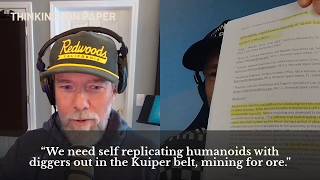
Mark Fielding a few weeks ago, we broke down Philip Metzger's paper. It's quite an old paper now about bootstrapping the space manufacturing industry. we got quite a lot of kickback from that by people claiming that, okay, you can't go to the moon and use 3D printers to self-replicate humanoids because resources aren't on the moon. How confident are you in that 1.1 million tons of helium-3 and resources on the moon's regolith in general.
Four hundred kilograms of lunar regolith
Glen Martin We're blessed in the U.S. we have about 400 kilograms of lunar regolith in Houston at the Johnson Space Center that was collected by the six missions that landed.
samples and they did it using a scoop and a bag and some other things that probably let loose a lot of the helium-3 molecules by agitation. So we've got really great data on what the regolith is composed of. did core samples. Jack Schmidt, who I've met over the years.
Apollo 17 astronaut Harrison Jack Schmidt, know, he was a geologist. He was the planetary geologist that was training all these...
test pilots and fighter jocks to collect rocks. But on the last mission they said, you know what, we're going to cancel the program at 18, so we better fly a geologist. So Jack went to moon in 17. He landed in the Littoral Highlands up just on the edge of the of Serenity and found the orange glass, which proved, you know, these lava ejections into space of magma.
volcanic activity, but the samples from 11, 17, and 12 actually showed the highest concentrations of helium-3. And so you can actually extrapolate. And then there was further analyses done. The Clementine mission in 1994 that BMDO did, the US Air Force, under then Brigadier General Pete Wharton,
They scanned the moon and found these titanium oxide locations where it's highly concentrated. So there's a lot of data that supports the estimate, again, 1.1 million. And a lot of people think it might actually be underestimated because of that collection methodology I just referred to. And then the Russians had three lunar landers that also correlated this data. And now the Chinese have brought back two samples. And so that's being analyzed now. And they actually found
⁓ a new crystal structure called, they've named Chang'e site for the Chang'e Lander, which is the Chinese legend of a maiden that flies to the moon. But it embeds helium-3 within it. So they're finding new...
forms of this stuff. So not confirmed, really, there's something in mining called prospecting, which is you look at it from space or from low flying aircraft, and then there's exploration. You need to get boots on the ground, take a core sample, say, you know, and capture it accurately and really say, okay, this much is in this regolith over this patch of land.
Jeremy Gilbertson question I always like to ask is like, what questions did you want us to ask that we didn't yet?
Glen Martin you touched on both the two questions that I really didn't want to cover. I mean, the second being, what is the benefit to humanity? What is the benefit of going to space? And if I can answer my own question this way, obviously, helium-3 is something. And I've looked far and wide, by the way, guys. I was looking at lunar ice mining at one point and platinum group metals on asteroids.
And solar power from space is something I worked at Phantomworks in the early 90s and hunting the beach. looked at this. And all these will come to be. Anton Brevde has this great thesis, which is there's this space for Earth economy right now. It's about $500 billion and it's primarily made up of exporting data from space. You've got telecommunications, you've got broadcast satellites doing mobile radio like XM, you've got...
direct to home satellite television. You've got GPS providing GPS for Uber. Uber is a space company at the end of the day because you couldn't do it without space assets. And then there's other elements, know, Earth observing satellites which are really becoming a very powerful thing with low launch costs. And so that's all, but that's all Earth economy focused, right? That's serving the Earth economy. And this idea that at some point we're going to transition to this $2 trillion space economy.
It's got to transition to something that's providing services to other space entities commercially. So that could just spin wildly once you kind of prime the pump. And I grew up in Canada, northern Canada, at a location, Sault Ste. Marie, where the Hudson's Bay Company used to trade fever pelt. And the King of England, King Charles II, signed a saying the Hudson's Bay company of explorers and adventurers are allowed to go to the New World and create a corporate entity on the New World to bring back beaver pelt. This one thing that was valuable back in Europe that the New World had. And so it actually kicked open the rest of the North American economy along with some other things like that. But the point is helium-3 is the beaver pelt of the economy. It's the one thing we can bring back from space.
that is worth it and will kick open the rest of the economy. We'll have mining operations in the robots. We'll be buying services from solar power guys, from telecom, from navigation startups. So I think that the analog holds really well here. This is the Hudson's Bay Company, the extraterrestrial mining company will be the one thing that kicks this cislunar economy open.
Jeremy Gilbertson the catalyst for B2B in space. I like that.
Mark Fielding Unfortunately one of my quickfire questions was what are you curious about at the moment but Glen's curious about everything. So what's the one most... What are you more curious about than anything else this week?
Glen Martin This week I've been extraordinarily curious about how debt is structured for social infrastructure. And I've been talking to a lot of my Japanese colleagues at Nomura Securities. How do they fund bridges and tunnels and LNG terminals? How do you approach that? What's the development process look like? so I've been doing this insane deep dive on.
large-scale infrastructure project development. There's a great author, Bent Fliv Bjerg, I'm sure I just mangled his name, a Dane who wrote a book with Dan Gardner from Canada called How Big Things Get Done. It's inspirational, it really speaks to what we're doing and we're doing a big thing.
What are you scared of?
Mark Fielding What are you scared of this week?
Glen Martin I'm scared that we're losing momentum. If we're in a great power competition with China, we need all to be firing in all cylinders. We need science to be working with industry. We need the man space program at NASA to be moving ahead.
It's under Artemis Accord, which is this brilliant international architecture. We've got, you know, now with this beautiful, amazing, know, Starship Flight 11 happening, we now have the platform to actually deploy rapidly to cislunar space. And so we just need to get our act together relative to how NASA is coordinating to get Jared Isaacman in full stop. That's my endorsement for today. So it scares me that we're not.
Jeremy Gilbertson Didn't NASA just lose some funding and cut a bunch of people,
Glen Martin JPL lost 500 folks. Yeah, and these are not dead wood, man. It's cut into the quick. we were founded in Pasadena. There's a lot of real talented folks down there with Caltech. ⁓
Jeremy Gilbertson 500, right? Yeah.
Glen Martin And so I've seen this before in the waves of consolidation. Honestly, I think they'll all find homes. I think they'll spawn some startups. I think there'll be great resources for new hires for these well-funded, this ecosystem that's emerging. So it'll just take a little time to adjust and absorb. Pretty much, yeah. That's it.
Jeremy Gilbertson Just a re-architecture more than anything else, yeah.
Mark Fielding Who are you listening to at the moment?
Glen Martin It's E Banks. I'm a huge fan of the culture series. that's who I listen to. I'm just re-listening to all eight books of Excession without a doubt, Excession It's focused upon the AI and their search for meaning and how they interact.
Glen Martin That to me is one of most fascinating questions to be answered now with the emergence of AI and potentially AGI soon.
Jeremy Gilbertson you mentioned a word that is a chorus in my head on a daily basis, the word curiosity. thing that scares me is the world is becoming less curious individual by individual. Tom Waits has a great quote that says, we're in a deficit of wonder,
What could you say to the world right now to help them activate their curiosity, their sense of wonder?
Tom Waits
Glen Martin Well, maybe I'll just quote or paraphrase Tom Waits on this point, which is to say his muse comes to him at the most inconvenient moments. I would simply say, you know, he's driving his car in traffic in Los Angeles and he's like, not now. And so I would say, listen to your muse, take the time. It's coming to us. Ideas are out there. You know, they're occurring to everyone all the time at the same moment.
It's nothing really unique and I can't really defend an idea. It's just execution, man. So listen to your muse. Listen to what Tom, it says to say. Make sure that you got a pen and pencil ready to write it down.
Jeremy Gilbertson Love it. Honor the moments. That's wonderful.
The Kevin Kelly question
Mark Fielding listen to more Tom Waits. Our final question, Glen, is from Kevin Kelly. We ask it to every guest on Thinking on Paper. What should humans be? And if you need it, how does technology help us get there?
Glen Martin should be good. We should be good. We need simply to be good to each other. How does technology get us there? Space resources alleviate shortage. They alleviate need. And I think using the power of AI, and this is why I'm a huge fan of Iain M Banks and the culture series, that shows what is possible when we have AI in our lives that's benevolent.
allowing us to be ourselves. And so he writes about what is called post-scarcity societies. And so the reason I'm pursuing space resources, I'm driving towards a post-scarcity society. So we humans can simply be ourselves and be good to each other.
Jeremy Gilbertson There you have it. Glen, thanks for joining us. This has been great.
Mark Fielding Thank you. Wonderful.
Jeremy Gilbertson There you have it Helium 3, the why, the how, the where. Stay tuned, it's gonna be a pretty dynamic story to watch. Mark, closing thoughts?
Mark Fielding be disruptive. Stay curious.
Jeremy Gilbertson Keep thinking on paper.