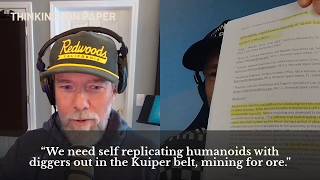
How Does Space-Based Solar Power Work?
Martin Soltau says Space Solar is not trying to invent new materials or new physics, unlike the fusion teams. We've already cracked the fusion problem. We're just using the beautiful fusion from the sun.



In this episode · 21 chapters
- Flying before driving
- The Belfast experiment, and a world first
- Why there's no battery on the satellite
- Sunlight to radio waves to electricity
- How 18 percent compares to coal
- Can the receiver on the ground shrink?
- Won't it cook the fish?
- What 120 members of the public decided
- Thirty dollars a megawatt hour
- The pitch to the data centres
- Power from space within five years
- No new physics, just engineering the economics
- What space laws need figuring out
- Does this need an Eisenhower?
- Sovereign energy, and the political problem
- Standards, and a meeting at the UN
- The carrot and the stick
- The adjacent technology Martin wants most
- The question he wishes he got asked
- What electrical co-ops could teach us
- The Kevin Kelly question
I do think there’s a real force for good in space-based solar power in that it provides abundance. And it doesn’t provide abundance selectively to those who have already. It provides abundance to those who haven’t.
Martin Soltau directed the UK government study into space-based solar power. He explains how Space Solar's Cassiopeia design steers its energy beam through 360 degrees with no moving parts, and why the beam will not cook the fish.
Soltau sets out a roadmap to demonstrate power from space within five years, and energy below $30 a megawatt hour at roughly today's launch costs. On finance: “And financing the first of a kind needs many hundreds of millions. It's not billions, interestingly.”
Martin Soltau of Space Solar, who directed the UK government study into the viability of space-based solar power, tells the Thinking On Paper podcast that a satellite beaming sunlight to Earth as radio waves can supply continuous baseload power at below $30 a megawatt hour with today's launch costs. He explains how Space Solar's Cassiopeia satellite and a ground rectenna would work.
How does space-based solar power work?
A satellite in orbit collects sunlight and beams the energy to Earth as radio waves. On the ground, an antenna called a rectenna turns the beam back into electricity, Martin Soltau explains.
How does the Cassiopeia satellite steer its energy beam?
Space Solar's Cassiopeia satellite steers its energy beam through 360 degrees with no moving parts. It does this with a phased array, a large set of small antennas whose timing points one combined beam electronically. Soltau says a small-scale model tested with Queen's University in Belfast was a world first.
What is a rectenna and how efficient is it?
On the ground, power arrives at a rectenna, short for rectifying antenna, a mesh of small dipoles that turns radio waves back into DC electricity. Soltau says the rectenna converts at more than 85% efficiency, and that at 5.8 gigahertz the beam passes through heavy weather with almost no loss.
Is a space solar power beam safe for people and wildlife?
The beam is too weak to harm people or wildlife, Soltau argues. He puts its peak at about 230 watts per square metre, less than a quarter of peak sunlight, calls it “a gentle warming”, and says 120 members of the public in a Royal Society exercise were fully supportive once they understood why it was safe.
How cheap could space-based solar power be?
Soltau forecasts space solar power at below $30 a megawatt hour, falling to around $10 if launch costs drop by another order of magnitude. He compares this with nuclear at well above $100, UK gas at about $65 and wind at about $82, and calls it “insanely cheap for baseload”.
When will Space Solar demonstrate power from space?
Space Solar plans to demonstrate end-to-end power from space within five years, with an 80 by 80 metre spacecraft generating about a megawatt in low Earth orbit. Soltau says the work needs no new physics: “We've already cracked the fusion problem. We're just using the beautiful fusion from the sun.”
Where Mark and Soltau disagree
Mark argues that assembling and maintaining these structures in low Earth orbit will need “some quite serious upgrades in technology”. Soltau answers that the task “is about engineering the economics”: making robotic assembly machines, like those in an Amazon warehouse, light and reliable enough for space, because every kilogram launched drives up capital cost.
Links from this episode
Questions
How does space-based solar power work?
A satellite in orbit collects sunlight and beams the energy to Earth as radio waves. On the ground, an antenna called a rectenna turns the beam back into electricity, Martin Soltau explains.
Who is Martin Soltau?
Martin Soltau directed the UK government study into space-based solar power.
What does Martin Soltau say about space-based solar power?
Martin Soltau of Space Solar, who directed the UK government study into the viability of space-based solar power, tells the Thinking On Paper podcast that a satellite beaming sunlight to Earth as radio waves can supply continuous baseload power at below $30 a megawatt hour with today's launch costs.
How much would the first space solar plant cost to finance?
On finance: “And financing the first of a kind needs many hundreds of millions. It's not billions, interestingly.”
Transcript
Jeremy Gilbertson Disruptors and curious minds welcome to another episode of thinking on paper. My name is Jeremy. This is Mark We unpack the future with the people that are building it we talk about technology But not tech for tech sake it's tech what it means to culture families businesses work all of that fun stuff today's episode is an exciting continuation of our conversation about space-based Solar power. Yes harnessing the power of the Sun beaming it to the earth
creating a sustainable, dare we say, more affordable means of power as our appetite for power is increasing and getting crazy with what's going on with AI. By the way, guys, AI requires a boatload of power. So this is a conversation if you want to preempt and dive into this topic a little more, we talk with Sanjay Vajendran, earlier episode about space-based solar power, but we're gonna dive in even deeper today.
Mark, what are you psyched about to dive into in our talk today?
Mark Fielding Well, so we left the conversation with Sande, just tiptoeing into the cultural and political landscape of space-based solar power. For this episode, think if we kind of put on our imaginary hats, go 100 years into the future, space-based solar power is the dominant power source. Fossil fuels are an echo from the distant past of humanity. Launch costs are negligible. Space infrastructure is kind of self-replicating and
Space is in the forefront of everyone's imagination, everyone's knowledge, because our energy is coming directly from space. Sovereign energy sources, countries who don't have access to fossil fuels, who didn't have access to fossil fuels in the past, now have their own energy sources. But what's it going to take politically and culturally to get there? And that's why we're very happy to have Martin Salto on the show today. He directed the UK government study into the viability of space-based solar power.
He's a successful leader in the aerospace sector, a member of both the IAF and the IAA international committees on space solar power. So if anybody knows, he will know. And one final thing, I think when we were all passing our driving tests when we were 17, he was learning passing his flying license. I think he was probably flying planes before he was driving cars. So we're looking forward to thinking on paper with him. Thank you for joining us, Martin. Thank you for thinking on paper with us. And did you have your...
your pilot's license before your driving license.
Flying before driving
Martin Soltau Great, thanks for that interview. Almost, yes, I got it at just 17.
Mark Fielding Wow. I guess.
Jeremy Gilbertson Unbelievable.
Martin Soltau been flying ever since. It's been a privilege, it's great fun.
Mark Fielding How often do you fly and what's your choice of plane?
Martin Soltau yeah, not enough enough. I have a share in a classic Jodel, which is a lovely wooden fabric five seat aircraft, which I've owned for well over 20 years. Got it when the kids were just born and they've been flying in it ever since.
Jeremy Gilbertson That sounds amazing.
Mark Fielding Hey, just, could I just ask one last question on the flying, on the pilot's license and has, cause I passed my, I don't know what year you're talking about. I passed my driving license in 1990.
seven and it's a lot harder to get your driving license today than it was back then. Does the same thing apply for pilot's licenses?
Martin Soltau It probably does. Yes, that's right. Yeah, you need about 45 hours of instruction and lots of ground school and things, but it's open to anyone. No, it's not. Although flying is something that is unforgiving of carelessness. It's a skill that anybody can take up, but it's hugely fun.
The Belfast experiment, and a world first
Jeremy Gilbertson All right. Well, well shouts to my grandfather who wanted me to attend Embry-Riddle Aeronautical University. I did not do that. but, you know, we're living vicariously through you as a pilot today. So let's, let's, let's start with this about a year ago. let's set the stage. think it was Queens University, Belfast. There was an experiment, something that was that you did that no one else had done previously. And that was kind an interesting.
Hey, prove the concept as to what we're gonna be talking about with space-based solar power. Tell us, walk us through that a little bit.
Martin Soltau Yeah, so perhaps worth saying why we needed to do this experiment. A solar power satellite, as it goes round in the orbit, to deliver base load energy, 24-7 continuous energy, which is what the world needs, you have to continuously harvest the solar energy and you have to continuously beam it.
And so somehow you either have to steer your solar panels to continually point at the sun or you have to steer the energy beam onto the receiver. And the unique thing about our solar power satellite design Cassiopeia is that we can steer the energy beam through 360 degrees with no moving parts. It's a phased array.
but it can steer through 360 degrees, which is very unique. It's a three-dimensional phaser rate. And so the experiment in Belfast with Queen's University was to demonstrate this. And it was a world first. It was a small scale model of our large solar power satellite, which is a beautiful helical array of antenna, which forms this.
And it was a well-first to demonstrate this ability to steer the beam through 360 degrees. And we also demonstrated this ability to provide a retro directive pilot beam from the receiving antenna to the kind of pseudo satellite, which allows it to point. it was...
It was massively successful. It gave us a lot of information to allow us to validate our computer modeling and it demonstrated this core ability. So a real milestone.
Why there's no battery on the satellite
Jeremy Gilbertson So one quick follow on question to that. So this idea of this satellite to be in space, to constantly be taking in, but also constantly be converting and beaming down to the source. And is the reason why that's so special, is it because if you don't beam it instantly and you don't convert it instantly, you got to store it, right? Is that?
Martin Soltau It's partly that, but so we don't have storage on the satellite because storage is very heavy and the whole design intent is to minimise the mass of what you've got to put into space. But it's mainly because base load, reliable base load energy to continuous 24 seven energy is really what's needed on earth to provide our continuous, abundant, affordable power. And by being able to
make this sort of rotating joint between those two functions electronically with no moving parts. Our satellite is much, much lighter and more compact than other designs. So there are designs of satellite out there that have big heavy mechanically driven solar panels or reflectors. Some designs don't even bother to try and...
have continuous power. at six o'clock in the morning and six o'clock in the evening, the panels are edge on to the sun so they don't provide any power at all. And that's still got utility, but not nearly as much as providing continuous power.
Sunlight to radio waves to electricity
Jeremy Gilbertson So walk us through the conversion process a little bit, right? Because you got sunlight that you take in and that's got to be converted to some sort of electrical and the electrical has got to convert into something that could be transmitted with low loss. So think it's probably a microwave kind of thing. And then there's a conversion on the other side. Walk us through that a little bit.
Martin Soltau Yeah, sure. So Cassiopeia, the design, looks like a sort of helix in the middle. Imagine a spiral staircase twisted through 180 degrees. And that's the power core. So that has the photovoltaics integrated with power electronics, which convert the electricity into high frequency radio waves, just Wi-Fi frequency, just like we have here on Earth.
and the little antennas. So that's the power core. And top and bottom of that helix, we have these large primary reflectors that are always pointed at the sun and they direct and concentrate solar energy onto the PV. So the chain of energy is that we could create electricity from these photovoltaics on the tops and bottom of the sort of steps of the helix.
It's converted into high frequency radio waves and that's done pretty efficiently. And today's components, you can get up to sort of 80, 85 % efficiency in conversion. And then the antennas form this large transmitting array aperture, which
Just like a phased array radar on a ship or an aircraft, it forms this coherent collimated beam at a single frequency down to the earth-based receiver. And the reason we use, in our case, 5.8 gigahertz is that at that frequency you can transmit through the atmosphere and even heavy weather with almost no loss. So there's very minimal loss through transmitting even over 36,000 kilometers.
And then on the grounds element, there's a receiver, a large receiver called a rectifying antenna or rectenna. And that comprises these little dipoles that are tuned to convert the RF back into DC electricity. Again, it does that very, very efficiently, more than 85%.
Mark Fielding How big is that?
Martin Soltau It's a large, so for our large, most economic systems, they're about 1.4 kilometres in diameter and the receiver on Earth is between two and three and a half kilometres in diameter, depending on how much energy you capture. And you can imagine the beam in cross-section is like a sort of
Gaussian profile. So you've got a sort of peak of the energy in the middle and it tapers off a great deal towards the edges. So you build the rectenna to capture sort of 85-90 % of the beam. It's not worth capturing the whole that, otherwise the rectenna would be way too big and it would just be uneconomic. So you lose a bit by just not quite capturing the whole beam and then you convert that DC into AC electricity just through a normal
inverter. And then to the energy system, this rectenna just looks like a gas-fired power station or a nuclear power station. It provides continuous reliable 24-7 energy. So there are a few other sort of elements in the energy chain. We've modelled it all in great detail. So we've got a very good understanding of this. And I think where this is going, people kind of worry about, how
can this be efficient, you know, with all these conversions from photons to electrons to photons to electrons again. Overall, if you measure from the Sun to the plug on Earth, it's about 18%, 1.8 % efficient. If you do the same calculation for terrestrial solar, you get between 1 and 5%.
because you've got night and atmosphere and weather and seasons and so forth. So the efficiency is actually quite high and a big part of the economics. I think the other part of the economics is that if you have a solar panel in space, you've got very high solar installation, 40 % more than you have at the very, very peak in the kind of midday desert on Earth.
and you've got no night and things. You generate 13, one three times as much energy from that solar power than if you'd put it on earth, at least in the Northern hemisphere. So these are the things that make it, the economics work for space based solar power.
How 18 percent compares to coal
Jeremy Gilbertson Quick question as a comparison. Real quick, Mark, let me ask this question. We're talking about efficiencies of things, right? So you said from sun to plug, it's 18 % efficiency. So how does that compare to coal fire generators?
Martin Soltau That's it.
Well, good question. any thermal plant is, well, if you compare it with a gas-fired generous ratio, which are the very efficient ones, they can be up to 60 % efficient. Coal is a bit less depending on the technology. But you've got
You've got different metrics because you have to mine the coal or drill for the gas and then you have to pay for the gas whereas the sunlight is free and limitless in that respect.
Jeremy Gilbertson And by any stretch, I'm not advocating that, we should keep be keep burning coal when there's this beautiful thing we could capture 24 by seven. But I think it's important to kind of root that in because there's a lot of systems that we're going to talk about. I think that I'd like to talk about that are in the way of this groundbreaking tech. Yeah.
Martin Soltau Yes, that's right. I think the point is for your listeners, efficiency is quite important where the fuel source is finite and perhaps expensive. You want as high efficiency as you possibly can. When your fuel source is free and limitless, efficiency just determines the capital cost, the capex. And so as long as the capex
works out and you get an economic levelized cost of electricity, it doesn't really matter how efficient it is. So there's an interesting trade actually we're going through at the moment where because space launch is still a big part of the CAPEX, even though the costs have come down, you want to minimize the mass and it might be better to actually have slightly lower efficiency but lower mass. So there's an interesting trade there which is a different trade from designing a
gas-fired power station for example.
Jeremy Gilbertson Yeah. So I read somewhere. please, please. Yes.
Can the receiver on the ground shrink?
Mark Fielding Can I play my silly question? Yeah. if we go back, so what we learned from Sanjay, check that show out here listeners, that space-based solar power is reliant or not reliant, but needs adjacent technologies to really get to realize that potential. connecting to the rays, so...
You say that the receiver on Earth needs to be about two kilometres across to collect the beam, but a lot of the beam is centred in it. Can that shrink? Can that, so as the other technologies progress, can the space-based solar power technology progress? Because I'm thinking from the politics view that we kind of like framing this around what needs to happen politically and obviously politicians, their constituents is what really matters.
eyesores, people are used to having wind farms spoiling their view, they want another renewable technology is going to spoil their view and two kilometres, is this two kilometres flat, is it built high so it kind of spoils the view as well or is it low down so it's all on a very thin two kilometre radius, like how does that all work and how small can it become?
Martin Soltau Yeah, it's a really important point. these systems are quite low impact. They're flat. They're built just off the ground. But they're like a of sparse mesh-like structure, potentially on poles. They're very transparent. they let rain and sunlight through. So you can grow crops underneath them. They could even be put overlaid over an existing solar farm to make best use of the grid connections. In a sort of crowded island like the UK,
actually talking to National Grid and Crown Estates about putting them offshore. So there wouldn't be sort of industrial infrastructure in people's backyards. And because it's involving power beaming, even though this is safe and regulated and everyone has Wi-Fi routers in their house and quite happy with it, nevertheless,
acceptance of new technologies is a really important thing that takes time to get the public comfortable with. And so for all those reasons, I think the early systems would be offshore or at least well away from centres of population. But they're fundamentally sparse, low impact structures which are nothing like big vertical wind turbines or they won't look like of bleak, black solar panels.
Won't it cook the fish?
Mark Fielding Okay, just I'm thinking of as a constituent here, if you put those nets, that system out at sea, I don't believe I'm asking this question, but I'm gonna ask it. Won't it cook the fish?
Martin Soltau Yeah.
No, sadly no fried chicken and no kind of boiled basil. think the... Yeah, this is as much as I'd like to be a kind of Bond villain. Sadly, these are not capable of being doing disruptive damage like that. The peak of the RF...
Mark Fielding You've seen that video too.
Martin Soltau frequency radio waves. It's about 230 watts per square meter. It's less than a quarter of the peak intensity of the sun on Earth, just to give you a feel for it. It's a gentle warming. RF is at these frequencies, it's non-ionizing, it's regulated to say we use it with Wi-Fi every day in our houses, and so from that point of view it's safe and it can't
Yeah, and this is why the receivers are large, because actually the energy density is relatively low. It's four times the energy density of solar, so these things are much smaller than solar or wind, but it's low compared to a nuclear power plant, for example.
Jeremy Gilbertson I think it's important to click on this for the listeners too. Is it safe to say this same stuff, same frequency, similar frequency to what we're roaming about in large office buildings to connect our iPhones, right? Like it's literally the same thing we're literally swimming in right now. But I think here's the, a perception thing, right?
Martin Soltau Exactly right.
Jeremy Gilbertson What we hear about space-based solar power, we think there's like an astronaut up there with like a big magnifying glass beaming this high powered concentrated thing to the earth that's gonna tear things up, but that's, it's using stuff that we're already around. And I think that's one of the cultural humps we have to get over, isn't it?
Mark Fielding I think it's a major hump as well.
What 120 members of the public decided
Martin Soltau Yeah, we've done a lot of public outreach actually, which has been interesting, including a big structured survey which was organised by the Royal Society. And so they got 120 members of the public from all over the UK. They had a couple of days of workshops and one of the major case studies that they had to kind of discuss was space-based solar power.
And actually, once they understood why it was safe, they were fully supportive. And this is, think, because the public understand the importance of reliable, affordable energy. It's fundamental to our quality of life and to our well-being. And they get very much by and large that we can't do this energy transition relying on weather dependence.
wind and solar, and that we need to look at these more capable sources of clean energy. So I think from that point of view, and the second point is just saying, once also they realize this is not large industrial infrastructure in their backyards. So it's safe and it's not going to affect their lives. In fact, it's going to enhance them because their energy bills are going to come right down. And the latest work we've done, the economic work, and we've just finished a
technical study is that this really can be energy at below $30 a megawatt hour. And that is broadly with today's launch costs. If launch costs come down, as predicted by many analysts by perhaps another order of magnitude, the cost of space based solar power is around $10 a megawatt hour. This is insanely cheap for baseload.
Thirty dollars a megawatt hour
Mark Fielding Can you give us a comparison for our listeners just so they can visualize what that is compared to other energy sources?
Jeremy Gilbertson So all right, let's.
Martin Soltau Yeah, nuclear in, mean, things get subsidized and taxed, so there are distorting things, but broadly nuclear is well above $100 a megawatt hour. Gas in the UK is about $65 a megawatt hour. Wind is about $82 a megawatt hour at the moment. Those are the kind of wholesale prices. And then
the retail prices you pay are kind of more than that, but they're influenced by the wholesale prices. So the point is this could be a tenth of the cost of nuclear or less, and so you can see bills coming down substantially.
The pitch to the data centres
Jeremy Gilbertson Let's talk through, try to relate this to the everyday person that talked through the chain of this. So people that are using Claude, people that are using ChatGPT, people that are creating startups using AI models, don't really understand that they're connecting to these large facilities that are the size of cities. I've worked in many of them. Size of cities, the power...
capacity and the redundancy systems in there are tremendous, right? So, so we think about the greatest impact would be to get some of these large data center providers and systems to start going, man, I think this could be a great reliable power source. know there's a lot of things in between like utilities and all that's, that's, this is so complicated. Like it's tough to get my head around it, but I'm trying to kind of segment it out. So
As a data center service provider, say I own a bunch of data center facilities, I see my costs going up, reliable power is important, people pay for concrete encased power lines and redundancies and all that. What's your pitch to the data center providers?
Martin Soltau Yeah, exactly. there's a strong view that the cost of data centers is going to asymptote to the cost of energy. It's so dominant. And of course, data center providers are, this is the bottleneck that's restricting growth in AI and data centers, the availability of reliable, cheap, abundant energy. And so people were looking at
building data centers where they can access energy rather than for other considerations. The pitch to data centers is that we can provide this reliable, continuous, affordable energy. We've talked to Google and OpenAI and Amazon and Co, but actually they want to just procure energy they can buy tomorrow. So whilst they're super excited by what we're doing,
They want to engage with us when we're ready to promise them an energy contract rather than to support our development. it's the, mean, there's been some incredible predictions. I Eric Smith said that he can foresee that 99 % of US energy could be consumed by
data centers and AI in the future. The growth in the energy demand is asymptotic. So that's why people are looking at data centers in space, because you've got abundant energy there, which initially seems insane. But it starts to make more sense when you look at some of the economics of this. The other challenge with data centers is getting grid connections is really, really difficult.
here in the UK, especially the same in the US and France, that you've got big lead times, like more than a decade to get a grid connection. And space-based solar power can provide off-grid power. So you can build a rectenna over your data center or next to your data center and your off-grid power.
Jeremy Gilbertson would seem to me like the really interesting proof of concept pilot kind of thing to get going with a data center provider and just say, let's, we're, we're going to do, let's, let's power a rack. Let's power a 20 KW rack full of AI stuff with space-based solar power, but that the cost of that might be pretty insane, right? At least at the moment.
Power from space within five years
Martin Soltau So the beautiful thing about space-based solar power is that it's supremely scalable. Space solar has a roadmap where we're going to be developing and demonstrating end-to-end power from space within five years. So that's generating about a megawatt in space from a low Earth orbit. It's an 80 by 80 meter spacecraft. And because of that small scale.
you don't get very much power on the ground. But it's meaningful power. It's the right sort of power density. And you've got pretty much all of the technology demonstrated. A year later, we've got our minimum viable product commercial system. But then after that, you've created all of the supply chains, the technology and things. And it's so modular that you can start to scale very rapidly. So by the mid 2030s, we'll be
building these much larger economic systems and scaling them ultimately to tens of gigawatts per annum. so this is what the scale is everything both for meeting the kind of burgeoning demand of clean energy from all nations and.
particularly kind of technology like AI and robotics in a way that it's very difficult to see nuclear being able to scale anything like that. It takes 20 years to build two gigawatts, let alone tens of gigawatts per year, which is what we're proposing.
Jeremy Gilbertson Can I run through that just so I understand what you're talking about? Like, so five years is not very long away. Five years is not very long away. So you're talking about taking a megawatt from space and converting that through your 18 % efficiency mechanic, right, to a specific amount of power landed on the ground, applied and used and continually. That's five years away? That seems pretty groundbreaking.
Martin Soltau Yeah, exactly. That's right. And this is because although there are lots of engineering development to do.
we're fundamentally using today's technology in solar panels, in terrestrial robotics, in power beaming. We're not trying to invent new materials, new physics and things, which is what the fusion teams are trying to do. They're still trying to work out how to hold the sun in the palm of their hands. We've already cracked the fusion problem. We're just using the beautiful fusion from the sun. And so whilst we don't underestimate the
the engineering.
programme that we've got to do. We've mapped this out in detail and as you say five years is nothing.
Mark Fielding There will have to be some, it's not like fusion, but there will have to be some new technology, some new materials, especially with like self assembly in lower earth orbit with maintenance of that, which will be done autonomously, I suppose by robots. will have to be some quite serious upgrades in technology there.
No new physics, just engineering the economics
Martin Soltau Yeah, so what I mean by kind of no new physics, no new materials and things is that this is about engineering the economics. So we've built very sophisticated robotic assembly machines on Earth. Think of a sort of Amazon warehouse. It's that sort of thing. Now we've got to lightweight it massively. We've got to make it reliable in the space environment. Those are engineering challenges.
But we know how to do that. I say, I don't underestimate, there's lots of work to do and testing and failing and testing and evolving. But that's stuff we're good at. can do that and we know how to do it. The engineering, the economics is really the challenge. because
it's so mass driven, because you've got to launch everything, you've got to keep the mass down. It's making these systems reliable and lightweight in the space environment. And so if they're too heavy, you start to, it just impacts the capex cost. That's the big challenge I think we face. But we've got huge upsides.
Our forecast is with pretty much today's technology, we can get to $30 a megawatt hour. Even if we were providing it at $100 a megawatt hour, that is insanely attractive to the energy market because you're providing not only base load, but it's dispatchable, i.e. it balances the grid and it's exportable. So it's hugely flexible. So we've got a lot of upside in the work to engineer the economics.
What space laws need figuring out
Jeremy Gilbertson I loved, I love what you said about, the difference between like what, what kind of fusion is trying to do nuclear fusion, like, you know, creating new physics, right? You were, you're borrowing fusion from the sun, this great resource that's up there where it's already doing its thing. Let's just harness it and bring it around. And I think it's important to note, like a lot of these technologies, a lot of these capabilities have been around for a while, just like
know, CRISPR's capabilities were around in the 80s, but we haven't, we didn't really figure out how to use it and apply it till, you know, much later. Mark's going to giggle at me, but I always got to throw up my high frontier book. You know, some of this technology has, has been, you know, ready and available since the seventies, right? But now we're figuring it, we, I'm not saying we, you are figuring out how to apply it and how to get somewhere in five years. That's, that's, that's pretty incredible. One question I have for, I've got a bunch of questions, but
What space laws need to be figured out before all of this stuff can happen?
Martin Soltau Good question. I think we're going to be assembling these very large systems in space, which we've only really done with the International Space Station. that was, you know, this is going to be very, very different done remotely with autonomous assembly systems. And doing that reliably, sustainably, not creating debris,
I believe needs strong collaboration with regulators. Inherently, it's a, because the design of the solar power satellites is essentially like sort of.
thick paper, it's that sort of consistency. So you don't, you don't spall off debris if you, if you get hit by micrometeorites or something, so if you have an accident. But nevertheless, that is one area of regulation. There's establishing spectrum is an important thing through the International Telecoms Union. I think there's, whilst it integrates
supremely well into our energy systems, as I say, the of the rectener just looks like a conventional baseload power plant, that there are novel aspects to it, particularly the ability to, you know, switch the beam like an interconnector without wires. And there will be important cybersecurity aspects and physical security things for these systems.
I think there are these are going to be very strategic assets in space and with the increasing we're seeing space increasingly being a contested
of security and military field and so that's an important consideration. So I think for all these reasons there are a number of kind of stakeholders, state and regulator stakeholders. We're already engaging quite closely with them, with defence, with the Civil Aviation Authority, Ofcom and the ITU here, so and there's real willingness and excitement by the regulators. I've never seen regulators excited before like I have with Space Holopower.
Jeremy Gilbertson Wow.
Martin Soltau bit of an oxymoron but yeah I it's good.
Mark Fielding No, one of the... No, like, follow on.
Jeremy Gilbertson So more, yeah, go ahead.
was just, so Mark and I recently read, we've been unpacking these essays that, that we've found interesting in various topics. One we recently unpacked was, machines of loving grace, which was written by Dario Amadei founder of Anthropic and had a couple of really interesting moments of how, how, you know, AI can change and add to the world and, and, and, us as humans having to step up and really harness
and accept the responsibility for what is building, right? So you have all these technologies like space-based solar power. It's a brilliant, it's a great technology. It's like, is there, there was a moment referenced in Amadeus' paper about Eisenhower and atoms for peace and kind of what happened when nuclear kind of came up. was like, all right, this is pretty groundbreaking, but man, how do we get our arms around it? Does space-based solar power need an Eisenhower right now to...
to get people together and what could that individual look like? Characteristics, capabilities, like sensibilities.
Does this need an Eisenhower?
Martin Soltau Yeah, no, so I think that's a really great question. It does need some sort of really visionary champion who's a big leader. And must say, it'd be interesting to see who is picked for the NASA administrator, because one of the hot tips is Steve Quast.
who's a really strong space based solar power advocate and he really gets the big picture of where space is going with the ability to assemble large infrastructure and really open up a new economic horizon and things. So you can see if somebody like him got into authority and was
really stirred the imaginations of another Kennedy saying, we've got to do this, as humanity has got to do this. It would change the conversations completely. think in the UK, whilst we've got lot of government broadly supportive, governments are naturally cautious. They're risk averse. They don't want to be kicked out by the electorate for
making mistakes or taking risks or being seen to look stupid in front of the media. And so it's really tricky to get the average government to really be bold and ambitious. But ultimately, it does come down to individuals who, as you say, like an Eisenhower moment, say, we need to do this. We need to be bold. We need to
because the rewards are immense for the whole of humanity. Sadly, as a human race, think we have to come close to of catastrophe before we kind of realize that we need to change course. of course, thinking back to earlier this year, there was a huge blackout in the whole of the Iberian Peninsula, Spain and Portugal.
had almost a day without any power in quite benign weather conditions. Seven people died directly as a result of the unexpected loss of power. So it was a very serious incident and of course hundreds of thousands, probably millions, were greatly, greatly inconvenienced. People reliant on energy for their perhaps medical devices and all the rest of it.
It takes, sometimes it takes something like that to make politicians wake up and say, my God, know, the trajectory we're on, business as usual, is not the right course. We've got to look at these more capable systems.
Sovereign energy, and the political problem
Mark Fielding So since we're on humanity and since we're on the machines of loving grace essay as well. one of the, so this essay for those who don't know essentially it's what will the future look like if everything we get right, everything we get everything right about AI. There is no evil super intelligence. There is no malfunctioning AGI. It's a perfect stroll to this utopian future. And one of the things that he mentions and one of the things that always comes up again is like, okay, yeah, that's yes, but politics.
humanity gets in the way and reading about space based solar power and what you mentioned earlier about taking the energy off grid, putting nets over your data centers, this idea of like sovereign energy sources and my biggest, I studied international relations at university and like politics, modern politics is essentially built on energy flow, on fossil fuel roots essentially and
To the idea of states now that don't have access to fossil fuels being able to have their own energy sources with big tech being able to move off the grid and have their own energy sources. How it's decentralized, that's real decentralization. It sounds crazy that many governments will allow that to happen. I know you're speaking, you're in great contact with the UK government, I believe the UK space agency.
I don't know how the UK now is connected to the rest of Europe in regards to space based solar power, to America, to China. I don't know. Are these isolated systems? Like how do we bridge the political problem of this?
Standards, and a meeting at the UN
Martin Soltau Yeah, that's a great question. I think, again, another attractive thing about space-based solar power is it doesn't, from an operational and energy system perspective, you don't need to have to sort of build a global grid to make the whole thing work. You could envisage one nation building its own sovereign system, demonstrating it, and then, because it fits into our existing energy networks and grids,
supremely well, it can grow at its own pace, the pace of the kind of the with the political will to invest and build it. And so whilst we strongly believe that we need international partnerships for all sorts of reasons, I also believe that this has got to be developed in a very commercial way by commercial companies.
rather than by big national space agencies or some horrific international consortium, a government-led thing, which would be, very expensive and take many decades and probably result in just a very slow research program. We've got the technology. We've done enough studies now to know that this is both
economically and technically viable. And we need to get on and demonstrate small scale systems, get the regulations sorted, which is the one area where we do, I think, need strong international collaboration. And I think where the international agreements are most needed is to make the common standards.
both for sustainability and so forth to make sure these things have developed responsibly, but also so that your solar power satellite can interoperate with my rectenna. And so we build this very vibrant market of competing, but also collaborating designs. And so I had a wonderful meeting a couple of years ago with the
Secretary General of the United Nations, Mamounas Sharif, she was the Director of UN Habitat, which is responsible for cities, know, kind of sustainable cities and she was super excited by space based solar power because she pointed out that it really democratises energy access because the local mayor can just build a rectenna, which is kind of the cheaper part of the system.
and then receive energy from space. They don't need to own the expensive space assets. And so those standards, international standards to make those systems interoperate, I think is going to be very important.
The carrot and the stick
Jeremy Gilbertson So think about, think about wifi, think about wireless, right? And you have IEEE 802.11, 802.11X, like these are, it's basically like, guys, this is the main way that these systems are gonna operate. You build to these standards and you could have a wireless system that interoperates and all that. So there's precedent for this with other systems. Here's, let's go back on the philosophical side of this thing, right? So when you have a resource,
a resource, whether natural, whatever it is, a resource that can help people, um, help people in life, help people be better humans, give people access to things. You have that. And then you have entities that are trying to control it and that have this. So in the, in the Amadei essay, I know we're bouncing into this quite a bit, but it's really interesting. It got us thinking this, this Entente strategy where you have this carrot and you have the stick, right? And controlling this thing, the entity that controls this valuable resource.
has the carrot like, if you behave to our rules, we'll let you have access to this thing. And if you don't, here's the stick that follows. How do humans get out of the way? Like how, we have to get better. that's the thing that always fuzzes my mind up on this stuff quite a bit. I don't know, I have a question there, but yeah.
Martin Soltau Yeah, suppose, I mean, there's a couple of points there, I suppose. mean, from the point of view of...
So I think in one respect, because these are just like any other energy generation and transmission technology, to some extent, will be developed largely commercially. It will be regulated by governments in different countries. But it'll have its own force of providing this very economic
reliable energy. And so from that perspective, it's about just making sure it's this new technology is regulated to be safe and secure. Getting it going from where we are today to being a thing in, you know, really powering our televisions in 10 years time, that needs these bold leaders to say, I'm going to take a risk. This is the
benefits are so huge here, we're going to do this and it's no regrets because even if for some reason we can't foresee, it ends up proving too expensive or too difficult. There are so many really important disruptive technologies that we're going to be creating along the way in power beaming and the ability to build these large structures in space routinely and regularly and things. yeah.
The adjacent technology Martin wants most
Mark Fielding Could you just personally, which of those adjacent technologies are you most excited about? I mean, a while ago we had on the founder of Star Cloud and they're building data centers in space. And towards the end of the show, he turned on his sci-fi brain and he went deep like about where humanity could go with space manufacturing and space engineering. I was wondering if you could paint your sci-fi picture.
That there's not science fiction that is actually going to be reality sooner rather than later.
Martin Soltau Yeah, we know the star cloud guys really well. mean, the technology that we're excited about, the underpinning technology, I think are these very, very light, integrated kind of large solar arrays. We're working with particularly University of Cambridge on this. They're going to be transformative and for technologies like
Mark Fielding Excellent.
Martin Soltau kind of large-scale data centers in space, being able to have these distributed computing and integrated thermal management and large-scale abundant power is just transformative. mean, abundant energy in space is not a thing yet. We're completely power constrained. And so that's restricting everything. Elon Musk has unlocked the
the access to space, but now it's power in space. Once you can do that, I think the next thing is getting really good at building these large structures in space. again, SpaceX shows that if you launch three times a week and not three times a year,
you get really good, you practice, you learn, you get really good at things. And this is what's needed to get really good at rendezvous proximity operations to do these, you know, building these systems. We've already built a demonstrator of how we envisage building these kilometer scale structural trusses in space. There's another technology which is
very precise timing across very large arrays. We've got some super cool technology about that. That's got lots of different applications. And so I do think that these are sort of the... And power beaming is a critical technology that's going to be really important for providing power on the moon.
to kind of CIS lunar applications and asteroid mining and things. Energy and resources is absolutely critical. I think learning to get, and power is everything, and the first thing we need to do is to be able to afford all this. And cheap energy underpins everything we can do on Earth. there's always stepping stones to
know, good disruptive new technologies and space-based solar power as it unlocks cheap energy on earth, it unlocks the ability to build these large structures in space, it unlocks a huge market demand driver because you've got to have a commercial market and not just go at the pace of government funding and so there are some really, it's absolutely fundamental to our next economic revolution in space.
Jeremy Gilbertson So many cool things in that answer. One, just the coordination aspect, the real time coordination of assets at work and doing that quickly and efficiently. If you could figure out that technology, maybe we could apply it to humans and we could solve all the problems that we need. But another thing you mentioned too is this is real guys. This is the access to cheap power, affordable power, cheap power.
lets humans thrive and the people that don't have access to it aren't able to thrive and it's a large percentage of people on the earth. So that's a really big, really big piece to this puzzle. Very thoughtful. I'm inspired by what you're doing, like the tangible nature of what you're doing to take, to take these ideas, right? Some of these ideas into something that's going to change the world, man. I, I, I'm walking away from this chat. Very inspired, man. Congrats to all the stuff you've been doing and man, we can't wait to see where this thing goes.
Martin Soltau Thanks, it is super exciting. Timing is everything, isn't it? And everything's come together. And I'll just go back to your earlier point about the sort of cultural things. I do think there's a real force for good in space-based solar power in that it provides abundance. And it doesn't provide abundance selectively to those who have already. It provides abundance to those who haven't. And that's just really, really important. You can see all the problems we've got.
pretty much around the world of people who haven't got enough, feeling aggrieved and it causes massive geopolitical problems. So I'm sort of super optimistic from that point of view as well. And if we can behave more sensibly and rationally as a species through these sort of things, we can achieve massive things.
Jeremy Gilbertson Well, another callback Mark to, to machines. my gosh. I'm not. Yeah. The, the States. Wow. We can't, we're going to pause on that. Cause I've got some major thoughts, but, back to machines of love and grace. We keep going back to this thing, but you're so many of the themes that he ran through. And Amadei says that if, if we don't use this, this capability that AI could do and do it distributed, you know, help everybody.
Mark Fielding Yeah, geopolitical problems.
Jeremy Gilbertson level up, missing the mark. And I totally agree. And you hit the same thing. If this, if we develop this and it's just another way to concentrate and amplify power to, to, to the things that already have it rather than distributing it, that's the key puzzle, I think, to all of this.
Mark, closing thoughts, what are you thinking?
The question he wishes he got asked
Mark Fielding And just wondering in your travels, what have you missed? What question does people not ask you whenever you go somewhere and you wish that they would?
Martin Soltau So I think finance is the big challenge here. a couple of things we haven't talked about. These are large systems, at least the RF versions, which are the ones that are going to provide the baseload grid scale, gigawatt scale power. That's the only technology, the RF power being as opposed to laser or mirrors in space and things.
But they are large, which is their one drawback. And financing the first of a kind needs many hundreds of millions. It's not billions, interestingly. And for an energy infrastructure, it's pretty small change. But in space terms, it's quite large. getting the public and private finance together and where
Typically, private capital once returns within a 10-year time frame, and it's looking for risk averse, it's happy to pump funding software as a service, but not deep tech and hardware. That's the big challenge we're fighting at the moment. And it really needs governments to pump prime and provide confidence for private capital to come in that they're not going to be left high and dry.
And the second thing I think probably is the international partnerships. There's some great work going on in Japan and the US military, DARPA and USAFRL and NRL, and some really interesting research in China and Japan and Korea, and of course the UK.
and other countries very interested to come in. I think we do need closer international collaboration. As Space Order, we're reaching out, building those sorts of partnerships. But I think that's key. And whoever funds this is going to have huge economic advantage for their nations. The manufacturing
of these systems alone in semiconductors and all of the components and technologies and systems is huge. It's going to create massive high value jobs and economic growth and things. And so that's an important thing. And for the developing nations, it's important that they have a share of that kind of economic growth when we're thinking about that.
What electrical co-ops could teach us
Jeremy Gilbertson As you were thinking about the finance piece of this puzzle, is there anything we can learn from electrical co-ops in the way that they're organized? could something in that model work for a, you know, a county, a state, a country, an area like to kind of make it happen?
Martin Soltau Well, absolutely. mean, I think there are a range of models that work already. I don't think we need to invent too much that's new in the finance. I think it just needs a little bit more risk capital.
Ultimately, a philanthropist, a high net worth could make this happen, an individual could. So it's not out of the bounds of possibility that that sort of thing could happen. I do think it needs, I do think it needs a set of governments to come in, but there's the SMR models.
case in point, the sort of funding we're talking about is very similar to that. So, sorry, small modular reactors. There's insane amounts of funding going into fusion research and the fusion industry, a strong proponent of carrying on fusion research, but I think it's, you know, there are billions of dollars going into that publicly and privately, and yet it's
many, many decades away with great uncertainty about whether it can ever be commercialized at a reasonable price and certainly impossible to see how it scales. So there's lots of breakthroughs needed to make that something that would really impact our lives from clean energy. And as say, many people think that's going to end of the century, but you can never tell. You need breakthroughs and you never know when they're going to come.
Just to point out that there's a lot of money going into fusion. we had 10 % of what was going into fusion, space-based auto power would be a reality. So there is the funding out there.
Mark Fielding Excellent. The more I hear, the more we speak to people about space-based solar power, the more sense it makes. Maybe I'm just reading all of the material from the people doing this, but yeah, it just seems to make perfect sense to humanity. I like this decentralized, democratized access to energy. As you pointed out, it is the crooks of most of our civilization. My only worry is that most of those geopolitical problems we speak of are down to, religion or B.
energy. I think there's a cultural stumbling block to overcome there. But otherwise, yeah, awesome. Thank you. Thank you for painting us very optimistic paint picture of where this can go. And we'll keep track.
Martin Soltau That's right,
Jeremy Gilbertson Yeah, Martin, we'd to stay in touch and do some check-ins with you as you hit different milestones in your journey. You've already hit a bunch of them. With what's coming next, we'd love to track your journey and advocate for what you're doing because I think it's phenomenal.
Martin Soltau Yeah, no doubt.
I'd love to stay in touch. mean, we're just one part of a chain that goes right back to, you know, Peter Glazier in the 60s, you know, these sort of big visionaries. John Mankins done a great deal. And, these are the people who've, you know, kind of saw what the vision was way before reusable launch was a thing. so, yeah, same timing is everything. We're just picking up the L'Equadal and keeping it going.
Jeremy Gilbertson Nice, nice. Mark, do you want to end with a closing question? Do we want to do the Kevin Kelly question?
The Kevin Kelly question
Mark Fielding If we have time for the Kevin Kelly question. Kevin Kelly was on the paper. I don't know if we mentioned that listeners, but yeah, he was on here and he left the question for our guests. What should humans be and how does technology help us get there?
Martin Soltau Humans should be kind and look out for each other and be ambitious and...
in, you know, have creative curiosity and imagination and how does technology get us there? Technology is so important to solve problems that perhaps non-technical people can't see a way through and politicians can't see a way through. Very often there are really capable technology solutions and so having
people, lay people have greater understanding of science and maths, I think is a really important thing. to, yeah, and I think free speech as well is just so important because you have the freedom to ask and challenge and question. And because we'd need to think differently very often to come up with
solutions that ultimately are going to make us all prosper.
But I hadn't prepared for that question, so that.
Jeremy Gilbertson that's it. It's a very interesting that a lot of folks like you that we talked to, there's a very interesting thread of this, this kindness, empathy, curiosity, open-mindedness that is wonderful. And you hit on that very well. Appreciate you entertaining that question. Mark, do we want to do a, I think on paper with Mark and Jeremy thing if Martin's open to it? So Martin, we do some promos and stuff like that. So for our guests, what we'd like.
Mark Fielding yeah
Jeremy Gilbertson If you're open to it is say your name and I think on paper with Mark and Jeremy, if you're open to that.
Martin Soltau Yeah, sure. But Martin Salto, I...
Mark Fielding Or you could say, if you could mention that you're from space solar.
Martin Soltau Martin Salto from Space Solary Think on Paper with Jeremy and Mark. So shall I say that again? Mark and Jeremy or Jeremy and Mark?
Jeremy Gilbertson Yeah, maybe one more time. Mark will get mad at me. Either way, Mark and Jeremy are Jeremy Mark.
Mark Fielding I can edit that out.
Martin Soltau Martin Salto from Space Solar, I think on paper with Mark and Jeremy.
Jeremy Gilbertson Outstanding, Well, there you have it. Space-based solar power, episode two of many. We're gonna track this technology as it grows and as folks like Martin are doing their thing to make this thing a reality. Thinkingonpaper.xyz is where you can find all of these episodes, including our breakdown of Amore's Machines of Love and Grace. Mark, closing thoughts.
Mark Fielding Thank you. Brilliant.
Be curious. Stay disruptive.
Jeremy Gilbertson Keep thinking on paper.