What Is Space-Based Solar Power?
In 2022, Sanjay Vijendran stood a few metres from an invisible beam carrying 2 kilowatts of power across a hangar in Germany. I'm pretty sure we had the world's first wirelessly cooled beers that anyone has ever had.



In this episode · 20 chapters
- What space-based solar power actually is
- Energy poverty
- Leading the programme at ESA
- Power beaming, and Tesla
- The beer, chilled wirelessly, in Germany
- Space elevators, and how big this has to be
- What it costs to get there
- Manufacturing in space
- Hot buttons
- Meeting Arthur C. Clarke
- What implementation looks like
- Ten megawatts, and what it compares to
- Who is actually building this
- Radio frequency, or lasers
- Safety, and what happens if the beam drifts
- The chicken in Sabine Hossenfelder's video
- Is it a race or a collaboration?
- Changing the culture
- If you do not work in energy, why this matters
- A question for the next guest
If you think about a nuclear power station or hydroelectric dam, those are huge structures and the Burj Khalifa in Dubai, almost a kilometer tall. People know how to do big things if they put their mind to it.
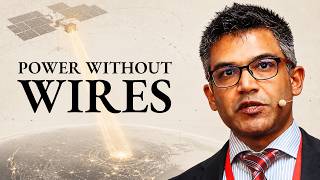
Sanjay Vijendran led the European Space Agency's first dedicated research and development programme on space-based solar power. He explains why a solar farm in orbit sees the Sun all the time, and why reusable rockets have reopened an idea that is over 50 years old.
He walks through the pilot beam that stops a drifting beam from concentrating, radio frequency versus lasers, why low tens of megawatts may be the first commercial step, and why he wants the energy sector lobbying governments for public funding.
Sanjay Vijendran, director of Space Energy Insights, led the European Space Agency's first dedicated research and development programme on space-based solar power. On the Thinking On Paper podcast, he explains how wireless power beaming from orbit works and argues that reusable rockets, by cutting launch costs, have changed the economics that sank earlier studies.
What is space-based solar power?
Space-based solar power means putting a solar farm in orbit, high enough to stay out of Earth's shadow, so it sees the Sun all the time and can send energy down day and night. Vijendran says almost 900 million people still live without electricity or reliable electricity in 2025.
Does wireless power beaming work yet?
Power beaming, or wireless power transmission, already works at small scale. In 2022, Vijendran says, an ESA demonstration at an Airbus hangar in Germany beamed 2 kilowatts across 36 metres to light a model city, run a hydrogen electrolyser and chill beer: “I'm pretty sure we had the world's first wirelessly cooled beers that anyone has ever had.”
Why did earlier space solar power studies fail?
Launch cost has been the main barrier. Vijendran says the 1970s NASA and US Department of Energy study found space solar power economically unviable with expendable rockets, and that reusable launchers such as the Falcon 9, plus factory-built satellites like Starlink, have changed the sums.
How big would a first commercial space solar system be?
A first commercial system would sit in the low tens of megawatts, Vijendran estimates, at a cost of tens to hundreds of millions, not billions. For scale, he notes the International Space Station's solar arrays generate about 240 kilowatts, and he says investors will judge the result on its levelised cost of electricity, the lifetime cost of each unit of energy, which typically runs from $30 to around $150 per megawatt hour.
Why does space solar power use radio waves rather than lasers?
Most designs beam radio waves rather than lasers because radio passes through cloud and rain. They aim using a pilot beam, a signal sent up from the ground receiver; Vijendran says that without it the satellite cannot focus, so the energy spreads out harmlessly. He contrasts this with Aetherflux, which he says uses a constellation of smaller satellites and lasers.
Where Mark and Vijendran disagree
Mark raises Sabine Hossenfelder's video in which a power beam roasts a chicken flying through it. Vijendran replies that beam intensity is deliberately set to a level not harmful to things passing through, “typically a few hundred watts per square meter”, which he compares to about a quarter of the midday sun.
Links from this episode
Questions
What is space-based solar power?
Space-based solar power means putting a solar farm in orbit, high enough to stay out of Earth's shadow, so it sees the Sun all the time and can send energy down day and night. Vijendran says almost 900 million people still live without electricity or reliable electricity in 2025.
Who is Sanjay Vijendran?
Sanjay Vijendran, director of Space Energy Insights, led the European Space Agency's first dedicated research and development programme on space-based solar power.
How old is the idea of space-based solar power?
He explains why a solar farm in orbit sees the Sun all the time, and why reusable rockets have reopened an idea that is over 50 years old.
Who should fund space-based solar power, according to Vijendran?
He walks through the pilot beam that stops a drifting beam from concentrating, radio frequency versus lasers, why low tens of megawatts may be the first commercial step, and why he wants the energy sector lobbying governments for public funding.
Transcript
Jeremy Gilbertson Disruptors and curious minds. Welcome to another episode of Thinking on Paper where we get behind the next groundbreaking technology that is going to change the way we live, that change the way we work, and change the way we interact as individuals, as societies, all the fun stuff. Today, we're talking about big problems and big problems need big solutions and everything points back to this book called The High Frontier that I read.
quite a long time ago, it written in the 70s about creating colonies in space. And some of the quotes I thought were really interesting in this and applicable to what we're gonna talk about today. By the way, this is Mark over here. Mark is gonna tell you about what we're getting into in the big questions we're gonna be addressing. But Mark, I'm gonna throw this quote at you to kind of set the stage today. So quote from this book, High Frontier, almost any static society is forced in self-defense to suppress new ideas.
Jeremy Gilbertson Something to think about right there. This is, talk about these calcified systems is how we refer to these old systems that suppress new information, suppress new ideas in an effort to preserve themselves. Really interesting that.
Jeremy Gilbertson Correct, correct. then secondly, the other quote I want to pull out of here that's really interesting, again, written in the 70s, the construction of solar powered stations in space as the first industry for space colonies. So as he was talking about building these colonies in space, how are they going to generate an economic return to sustain themselves economically? Guess what? We're talking about stuff today. So everyone's heard about net zero carbon emission by 2050, and we're going to talk about a solution
It involves a big bright circle in the sky, not the way you currently think about it unless you think on paper with us. Mark, I've been blabbing, intro our guest, let's dig into the show. I'm really excited.
Mark Fielding It's my turn to blab now before we get to our guest who apparently wrote the blurb for the new version of the High Frontier. So Jeremy is a big fan, obviously. I want to mention the book club, the second pillar in the thinking on paper framework for a more acute, deep understanding of the impact on technology and culture. We're reading Irreducible by Federico Faggin and he speculates on the nature of consciousness. He theorizes that it's a quantum process woven into the very fabric of the universe is the universe quantum is every thought that pops into your head, the wave function collapsing. And I mentioned that because I think there's a universal conscious agreement that the climate is changing. We're cooking ourselves and yet 85 % of all the energy we create is the result of burning fossil fuels. And which leads me to the other book.
the previous book in the book club Nexus by Yuval Noah Harari who Jeremy is still not replying to my emails or my social outreach to come on the show. And he, in his statement that how can one species be so incredibly wise yet so ridiculously stupid, so wonderfully creative and yet so absurdly, absurdly reluctant to embrace new
Jeremy Gilbertson Soon, hang tight.
Mark Fielding things. And I think that's a nice segue to today's guest. And like as it's happening a lot at the moment, at thinking on paper, Jeremy, the answer lies in space. We're going to space. Our guest is Sanjay Vijendran He is the director of space energy insights, his new venture before that he was at the European Space Agency. And he's here today to speak to us about space based solar power.
Welcome to the show, Sanjay. It's a pleasure. Thank you for thinking on paper with us.
Sanjay Vijendran Thank you very much Mark and Jeremy. Pleased to be here.
Mark Fielding And don't worry about that, big long winded intro, we'll edit some of that down.
What space-based solar power actually is
Jeremy Gilbertson So Sanjay, welcome. Let's jump right in. Let's talk about this different viewpoint of harnessing this amazing energy source that we have very close to us, but doing it very differently than we do here on Earth. So talk to us about space-based solar power. What is it? How can you break it down super simply for people that haven't heard it? And let's dig in from there.
Sanjay Vijendran Sure. So the easiest way to think of it is essentially putting a solar farm that you're familiar with from the countryside up in space, in orbit above the Earth, above the clouds, and high enough that you're effectively out of the shadow of the Earth. So there you see the Sun 100 % of the time. And that's one of the main characteristics of space-based solar power, is you get a source of clean, reliable energy 24-7, because...
There's no day and night, there's no weather, there's no clouds, there's no seasons up there. So you get more intense sunlight and you get it all the time. And if you can then convert that to electricity and beam it down or indeed even have mirrors and reflect that down onto the surface of the Earth, you have a way to get energy when and where it's needed on the planet all of the time.
Jeremy Gilbertson So again, this is not science fiction. This is stuff that has been experimented with and tested in various ways. I know we're moving forward and doing a lot of that stuff, but let's talk about what this can do and why it matters because there's a tie between energy or access to energy and living standards. Let's talk about that for a little bit. So if we have just this way to bring a massive amount of power to the grid, keep it from being harmful.
to the world itself, to natural resources and so on. What does that mean for people and their lives? Can we dig into that a little bit?
Sanjay Vijendran Absolutely. there's definitely a direct correlation between the standard of living of human societies and their energy use in the sense that having available affordable energy allows you to improve standards of living of people. And if you look at across the world, societies which have the highest standard of living tend to have the highest availability of energy and use a large amount of energy as well. So today, a huge number of people on the planet. fact, about three quarters of the planet are not receiving, not having available a substantial amount of energy to improve their quality of life. And in fact, almost 900 million people live without electricity or reliable electricity on planet Earth today in 2025, which is amazing when you think about that. So energy poverty is really a huge issue on planet Earth with 8 billion people and growing.
And one of the big challenges, not just to decarbonize existing societies, especially in the industrialized world in the next 30 years that we need to do to mitigate climate change, we need to find a way to be able to grow the availability of energy and electricity, especially to societies around the world which simply don't have it today. And we want to do that in a clean way and they shouldn't be restricted from being able to have a lot more energy into the future. So we've got multiple problems that we need to challenge.
to address at the same time, to provide all of the energy that's needed to the people who need it and to do it in clean way.
Energy poverty
Mark Fielding energy poverty. It's such a powerful phrase because as long as energy poverty is a part of the human collective condition, those with the energy streak ahead and those without the energy get left behind and that gap that seems to be everywhere just keeps getting bigger and bigger and bigger.
Sanjay Vijendran Absolutely, there's this huge inequality in terms of standards of living and competition for resources of course as well that exist when when they're scarce and availability of energy is not equal let's say and too heterogeneous across the world.
Leading the programme at ESA
Jeremy Gilbertson So you led for a while, you worked with ESA leading the program to determine how this stuff could impact Europe, the energy program, where they're looking, how space-based solar power specifically can be a great solution. You have a new role now, we'll talk about your consultancy in a bit, but while you were heading up this initiative, what...
What was the, how are they taking it as far as a viable solution? What were their sentiments on it and how bullish were they about it?
Sanjay Vijendran So yeah, I led the development of a proposal for a new initiative at ESA, which was actually the first dedicated research and development program on the topic of space-based solar power that the agency was to have back in 2022. And that was established then, and I then led up the implementation of that program, which was essentially trying to dig deep into the technology development as well as the concepts of space-based solar power to really understand whether this was the right time to move forward in a big way with this technology because it's not a new concept, a new technology, it's been around for over 50 years but it's always been seen as economically unviable as long as the costs of getting things into orbit and building large structures in orbit were very high, which they have been for decades until the last 10 years or so when things have dramatically changed. So through this initiative we really wanted to get that hard data to convince ourselves and our stakeholders that yes, now everything has come into place and the challenge for, of course, decarbonization has only grown in that time. Everything has come together to really show us that we do need to move forward at pace to develop this capability here in Europe. So as part of that initiative, we funded some technology development activities and we did concept studies for how you might build full-scale commercial scale space-based solar power systems to inform our next steps.
Jeremy Gilbertson So as we transition, we're going to transition into more of the technical stuff with Mark here in a second. And maybe this would be a cool way to transition into that. So you mentioned this stuff works. wireless power distribution works. And tell us about the test a couple of years ago that was done in a large warehouse. I think it was two kilowatts going across the warehouse from one side to another. Tell us a little bit about that and what that means moving forward.
Power beaming, and Tesla
Sanjay Vijendran Yeah, sure. So wireless power transmission or power beaming, it's sometimes known as, is probably the most science fiction part of the whole concept of gathering energy in space and delivering it down to the ground. Because, you know, people can understand putting a large solar farm up in space, but how are going to get that energy down, not with a long cable? So actually delivering energy wirelessly is something that we don't see in our everyday lives down here on Earth.
most people aren't aware that it's actually a thing. In fact, I myself didn't realize about five years ago that it's actually a thing. I vaguely heard about it, you know, in the scientific literature, but I always thought it was a kind of laboratory scale thing that people were working on. But actually it goes all the way back to Nikolai Tesla, more than 100 years ago, who had grand visions of being able to transfer energy wirelessly across the planet from towers distributed across the Earth that could could beam power to different parts of the planet. He wasn't successful with that, although he was successful with transferring energy across the distance of a room. But it wasn't until technology improved back in the 60s in the US when people first started to demonstrate that you could, in a directional way, in a focused way, send wireless power across a distance. And since the 1960s, there's been dozens of experiments from international organizations across the world who've shown repeatedly that energy can be moved from one point to another from the ground into the air across distances from meters up to kilometers distances and at power levels of up to a few kilowatts. So we know the theory, we know for a fact this can be done.
certainly at small scale and it's been demonstrated many many times on the surface of the earth at least and up into the air. But what we haven't done is shown that it can be done at a much larger scale to deliver huge amounts of power over much longer distances like what would be needed from space to earth which we're talking about thousands of kilometers. So it's really not a question of science or understanding some new physics but really being able to develop
Sanjay Vijendran from an engineering perspective, large enough antennas to beam that power, to transmit that power, and large enough receivers that can receive that power to be able to make this a useful technology if you want to use it for power delivery at scale. So it's about the demonstration that we did in Germany in 2022. So that was done at a hangar at the Airbus, a space company in in Europe's facility where we beamed across 36 meters 2 kilowatts of power as you said and I was stood a few meters away from where this invisible beam of power was going across from a transmitter that was about 2 by 2 meters squared to a receiver the same size on the other end and we fed that power into the electricity that came out of the receiver into a small mock-up of a city to show it could light the lights of a city. It also went into a small hydrogen electrolyzer to split water into hydrogen and oxygen and some of the power went to cool some beers in a fridge as well. And so we got to to open a pub. Absolutely. I'm pretty sure we had the world's first wirelessly cooled beers that anyone has ever had.
Jeremy Gilbertson The most important test case, of course, yes.
Mark Fielding Yeah, that is real, real utility right there.
The beer, chilled wirelessly, in Germany
Sanjay Vijendran because this is Germany. So we know it works and we did it in a safe way because we were measuring the power levels that were kind of leaking out of where this beam was being sent and it was extremely low and within all the safety limits. So the technology is there, it's known, it's proven, but the big challenge is can we scale this up to the dimensions that would be needed to be able to deliver power from space to Earth? That's the challenge ahead.
Jeremy Gilbertson So to quickly wrap, this particular segment will transition into these technical challenges of scaling, right? It's a viable solution, it works, you've done some economics on it, people are open to it largely and putting more time and energy into studying how this thing can happen, which your consultancy is largely gonna be doing that as well. But Mark, let's dive into some of the scale challenges here. You got some great questions here and let's move to that.
Space elevators, and how big this has to be
Mark Fielding Yeah, let's move to that. I just want to bring up space elevators because you said you can't use a big wire, but maybe if you have a geostationary orbit, you could build a space elevator, put the wire and cable inside that and then send it down to Earth that way. no, it doesn't take long on YouTube to find naysayers to the idea of this. And there's quite a few challenges that they say this is why it's not feasible on a large scale.
capacity, power, density, the sheer size of the arrays you need on earth to gather, because you have to make the beam, the power beam so weak that therefore you need lots of amplifiers on earth to make it viable and inexpensive again. Maybe if we could speak through each one of those and how you think about how they're wrong and how it is possible. So if we start with capacity.
apologies if you've already mentioned how this works but how do you overcome that challenge?
Sanjay Vijendran You mean in terms of how large a solar farm would need to be in space to be a useful power plant to use on the earth? Of course.
Mark Fielding Yeah. And would you need on the earth, the reciprocal enormous centre of arrays to channel the electric, the energy turn into electricity.
Sanjay Vijendran Yeah. So first of all, space-based solar power has a myriad different applications, from the smaller scale where you might send power to users that need relatively small amounts of power, but need it in a place that they can't get it otherwise. So for example, for defense applications, forward operating bases where troops are away from the grid and access to to energy, they typically fly in diesel for running generators and that has huge logistical costs, also costs in human lives as things get ambushed. So being able to receive even say a megawatt or so of power when you need it, where you are in these remote places can be very valuable for such an application. But on the other end of the scale, if you want to really power cities and countries and help make a dent on our energy transition and climate goals, you need to provide power at the levels of hundreds of megawatts to gigawatts like a nuclear power station, a fossil fuel power station and many of these eventually. So that's another scale of the problem versus the small end. But if you look at the top end of the scale where we imagine space-based solar power contributing to a good fraction of the world's energy needs into the future, you'd need to be able to build gigawatt scale power plants which would mean that you need to put up something similar in size to the solar farms, the large solar farms we have down here on earth. So think of an area of some square kilometers in size. That's pretty big.
of course, and looking at what we've built in space so far historically, there's been nothing even a hundred times smaller than that built by humanity so far. So this is the first problem when people compare it with what we've been doing so far in space that naturally scares people. In fact, it took me six months to get my head around the idea of what we were trying to propose to do here. But the thing to remember is that
Sanjay Vijendran You know, things have changed a lot in the last decades. The International Space Station, for example, which is the largest object in space that's ever been built, was put together by astronauts built out of very complicated, large parts launched with the space shuttle. And that's a very different kind of structure, infrastructure and build process than is imagined to be done for something like space-based solar power plants, where by design, especially the more modern designs, people are are working out are very much modular. So think of just a solar farm on the Earth. It may be huge, maybe kilometers across, but it's all made up of two meters by one meter size solar panels, which are put into place by people onto racks and just repeatedly done a million times. And this is how the designs of new space-based solar power stations typically are also considered now to be very very modular, made of mass-produced parts in factories down on Earth, using automotive consumer electronics types of production technologies. And then all of these are flat-packed into rockets, launched into space and put together by robots, not human beings, not fleets of astronauts, autonomous robots. it's these kinds of capabilities which are coming online now. Of course, we haven't demonstrated it at this scale ever before.
but we're seeing the building block technologies are there and we believe that with development and experience we will be able to put these things together built up over time into these large structures. So that's the first problem, the scale which of course hasn't been demonstrated but there's every reason to believe that we will be able to work out how to do this. And don't forget in the energy sector on Earth does really big things. If you think about a nuclear power station or hydroelectric dam, those are huge structures and the Burj Khalifa in Dubai, almost a kilometer tall. People know how to do big things if they put their mind to it. It's just so we haven't done it yet in space and we have to prove it.
What it costs to get there
Mark Fielding There's lot of this rely on the cost of getting the stuff into space. A few weeks ago we had star cloud on it and they're building data centers in space link here to see that show. And it's essentially the whole business model came down to getting the cost of launching into space low enough. And I think they were talking about $600 a kilo, Jeremy, if I remember correctly. And they're talking about the new star class starship, getting it down.
to as low as potentially $10 a kilo, I think he said, it's just the same thing apply here where the cost of getting the stuff into space is a big obstacle at the moment. And how do you overcome that if it is?
Sanjay Vijendran Absolutely, that's been the number one reason why space-based solar power has not seen the light of day yet. It's because historically the cost of expendable launchers, when you throw away a launcher after using it once, has meant that even if you could build these things, technically, it would have costed so much to build it that the price of the electricity you'd have to charge to your users would be so high, no one would buy that electricity. This was the conclusion in the 1970s by the big study done by NASA and the Department of Energy in the US, which first looked, took a thorough look at space-based solar power because of the oil crisis in the 70s, they were rushing around looking for alternative sources in space-based solar power and nuclear, were two big topics in development then. But the conclusion was with the technology that they had at the time, the type of launch technologies that they had, and manufacturing technologies, it just wasn't economically viable. And that's been the case since then, until the more recent advent of reusable launches in the last 10 years, which has now proven that launch costs can be reduced by the use of reusable launches. And this is now going to be, this is a growing industry, there many more players across the world who getting into this space because it's been proven.
in the case of the Falcon 9, for example, from the US. So as more people work on reusable launches, the competition will increase, the prices will drop, the availability of launch mass to orbit will increase, but people are also working on much larger launches. So they're combining reusability with scale, huge scale, putting up a hundred tons of mass into orbit in one go or more.
So once you bring all of these factors together, and we're not far away from seeing that now, it's really going to open up space to many applications. But it has been absolutely critical to Space-based solar power that this launch cost coming down situation has come about. So this is one of the main reasons why everyone is taking a much more closer look at Space-based solar power now.
Sanjay Vijendran and that they weren't 10 or 15 years ago. So that's number one. And then the manufacturing costs as well, producing space hardware on a factory line rather than by hand, which we're seeing, for example, with the Starlink constellation where factories are mass producing satellites by the thousands. This is also a brand new thing and that dramatically reduces the cost of the space hardware itself.
Jeremy Gilbertson One, yeah, well that's kind of where I was headed with what I wanted to ask you. the launch costs are definitely coming down. I think it's gonna be easier to get things up in space. Once they're in space, these giant things are actually way easier to move than they are on Earth just because of the zero gravity kind of thing. has the idea of like 3D printing stuff come up and what's the status of that? If we could just figure out how to.
Manufacturing in space
Jeremy Gilbertson manufacture this stuff up there. What's the status on that?
Sanjay Vijendran Yeah, we're all on the future topics today. So in space manufacturing, that's what you're referring to. And absolutely, that's something that people are working on all around the world because it solves a lot of problems of constraints of building things on Earth and then having to package them into a launcher and launch them and then assemble them. If you could just send the raw materials or basic parts.
up into space and then make them much more complicated or produce them in space. There's a lot of benefits for that. So people are working on developing those technologies and I think we'll see the first experiments being done in the coming years. And of course, being an even newer technology than assembly of pre-made structures in space, it will take a little bit more time to start to see big applications of that. So expect for space-based solar power, the initial designs will be done with prefabricated systems on Earth, but in the longer term, and don't forget when we're talking about space-based solar power, it's not a single space mission or something like that. This is creating a whole new industry that will last not just decades but into the future. So it's the first iteration of space-based solar power, what the structures look like, how we do it, the types of launches we use, whether or not we use in space manufacturing.
That will all change in the future as technology gets better, as we get better at doing these things and there's more investments. So I think we will start to see in later iterations in the future, parts of the space-based solar power system being manufactured in space. And if we really want to scale this up to the thousands of power plants that will need to provide a good fraction of the Earth's energy needs, there's a strong case for sourcing the materials from the Moon to do this.
and fabricating a lot of the hardware solar power plants on the surface of the moon and launching that into orbit around the earth. Because actually, thanks to Newton's laws, it takes far less energy to get stuff from the surface of the moon into orbit of the earth, than from the surface of the earth to that same orbit above the earth.
Jeremy Gilbertson Is that mass driver technology? The idea of magnets?
Sanjay Vijendran That's one way you could do it and that's concepts that have been around for quite some time to send either prefabricated fabricated material or even raw material off the surface of the Earth, like in the High Frontier book that you referred to Mark, where raw material is sent to some place in space where there's a colony that receives it, a colony of people that receive it and turn it into parts for space-based solar power stations.
So yes, we actually did a study at ESA on the use of lunar resources for space-based solar power and the conclusion of that was if we could do that, industrialize the Moon and produce the parts for space-based solar power plants, then it would become the cleanest and cheapest energy technology for planet Earth.
because it reduces the cost, because you don't have all that transportation costs. And it will be environmentally even cleaner than all of the launches coming from the Earth, which even if you make each launch relatively clean, it's still going to have some environmental impact. when you have tens of thousands of launches, there will be a significant impact on the Earth's atmosphere. So that's how we would want to do it in the longer term if we're going to do this really at scale.
Mark Fielding I love these big ideas, Jeremy. Right, should we lighten the mood with some hot buttons before you get into the economics, the serious business of how much this is all gonna cost and how much it's gonna save us, Jeremy?
Hot buttons
Jeremy Gilbertson I think that's a great idea. So Sanjay, here's what we got. We're gonna put 30 seconds on the clock. Don't worry, there's not a trap door that you fall through if you don't answer all of them in 30 seconds, but we're gonna try and shoot for that, put 30 seconds on the clock. Mark's gonna fire away. And thinking fast, thinking slow, right Mark?
Mark Fielding Let's get to know Sanjay personally.
Mark Fielding thinking fast, thinking slow. We'll learn something hopefully. yeah, let me show you. Show us the clock, Jeremy.
Jeremy Gilbertson Three, two, one, go, I'm tracking it.
Mark Fielding Arthur C. Clarke or Philip K. Dick.
Sanjay Vijendran I'll see Clark, I met him.
Mark Fielding Books or Kindle? Books or ebooks? SpaceX or NASA?
Mark Fielding Favorite city to visit on holiday.
Sanjay Vijendran Kuala Lumpur where I'm from.
Mark Fielding Will AI take all our jobs? Yes or no. AGI or aliens, which is more likely?
Jeremy Gilbertson Outstanding, you have one second left on the clock, Sanjay. Well done, well done.
Sanjay Vijendran Easy questions.
Mark Fielding Well, the last one could have been what book should everyone read, but the answer is the high Frontier Hold it up, Jeremy.
Sanjay Vijendran So, absolutely.
Meeting Arthur C. Clarke
Jeremy Gilbertson Oh yeah. um, Sanjay follow up question. What did you say to Arthur C. Clark when you met him?
Sanjay Vijendran Oh, I think he did a lot of the talking. So I met him in Sri Lanka at his home in Colombo years ago, back in 2003. I didn't say I was just awestruck because I had always had the ambition to collect every single one of his books. I'm still working on it because he was prolific. Yeah, I...
Mark Fielding How did the meeting come about?
Sanjay Vijendran By complete coincidence, I was down in Sri Lanka on holiday and as part of the tour of the city, we were taken past his house because he was a famous person in Colombo. And the driver said, well, if you're really interested, why don't you go and ring the bell and see if he's home and say hi, just like that. And I said, nah, I can't do that. He said, go on. He's a nice guy. I'm sure he'll let you in if he's there.
Sanjay Vijendran So rang the bell and his aide came out and said that he was on some travels. He wasn't around, but he'd be back the next, the following week. And because I was coming back through Colombo on my way out in that timeframe, he said, yeah, give us, give us a call. Here's his number and we'll arrange a meetup on your way back. So I did that. I gave him a call and that was a bit scary. He came on the line and we arranged a...
meeting and he was instantly asking do you know this person at NASA JPL? Do you know that person? Because I was working in Mars exploration before and he was of course fascinated by Mars exploration and in fact when I went into his office he was poring over some pictures that had recently come down from one of the Mars orbiters. Didn't see anything, I sat down and then he just flipped over one of these charts in front of me and said what do see there? And I couldn't make anything on it really, was just some picture and he looked up with a glint in his eye and said, that's Mars. It looked like some kind of alpine sea with snow and some trees but actually it was the surface of Mars. Yeah, yeah, was quite something.
Jeremy Gilbertson So last question on the Arthur C. Clarke thing. So what book would you recommend to someone who's never read Arthur C. Clarke to be the rabbit hole into the world of Arthur C. Clarke?
Sanjay Vijendran Ooh, it's gotta be Rendezvous with Rama, I think. The first of his Rama series. It's just one of those books where I simply could not put it down to eat or go to the bathroom or anything till I finished it.
Mark Fielding If you're a teenager, read that book because it's been 30 years since I read that book and it's still in my memory banks. It's so, so powerful. And listeners, take a chance if you get offered an opportunity, ring the door. Wow.
Jeremy Gilbertson For sure, for sure. All right. So thanks for, thanks for entertaining the hot buttons and your, your amazing experience of chance with, with ringing a doorbell. That's amazing. Let's, let's dive into the, a bit of the economics and a bit of the feasibility of this. Cause I know you, you led some, lot of studies you've been, you've been in this world for quite a while. What,
What implementation looks like
Jeremy Gilbertson What are we looking at from an implementation standpoint? If you could just sketch it out from high level, what it would take to do a minimum viable product for space-based solar power, and what does the output of that look like with power delivery and quality and that sort of thing? If we could just riff on that.
Sanjay Vijendran Yeah, so there a number of startups now in this field that are looking to produce a minimum viable product to get investors interested in that early steps where you might get some return on your investment as you scale up the systems to the much larger systems. And from what I've seen and the work that we've done, it looks like the sweet spot might be in the low tens of megawatts or so.
where it's still a big challenge in terms of scale from anything we've built right now in space. For comparison, the International Space Station has the largest set of solar arrays in space today and that's generating 240 kilowatts or so, that's about a quarter of a megawatt. So when you talk about 20 megawatts, that's still a hundred times larger. But yet that's a good step up on the way to the gigawatt scale and it's a quite a useful amount of power where you might find a number of customers that could be interested whether it's the military or the mining mining sector for example and other kind of small users that might be willing to pay top dollar because necessarily because of the smaller scale it's going to be relatively more expensive than once it's scaled up you get the the benefits of scale in terms of reduced costs when you go
Jeremy Gilbertson So, Andre, real quick, I'd like to add some context to the 10 megawatt kind of level, right? So listeners, if you're just thinking about like Fortune 100 businesses, right? That have servers, networks, storage, compute, these data center facilities that support their businesses, on average, they're in that one to two megawatt, one to three megawatt footprint for their data centers. If you just think about that at scale, obviously now with AI, we're well past.
10 megawatt facilities, 100 megawatt facilities, that sort of thing. So just to add a little context as you talk through the numbers. Yes.
Sanjay Vijendran Yeah, and there a lot of solar farms on earth which are roughly in that scale as well, some tens of megawatts. So we know that that's a scale which the energy sector would be familiar with and that people could be interested in as an early market. And then once that's demonstrated and real customers are paying money for that scale of power, I think that will be a step change in interest in...
in the topic because it's essentially going to be proven from a technology point of view and that there's a commercial market. And then of course there's still a huge step up when you go from 20 megawatts to say 2 gigawatts, it's still 100 times bigger. So may not be the next step, but I think most of the risks by then will be brought down. And then it's a case of basically building a lot of hardware.
doing lot of launches and making much larger structures.
Ten megawatts, and what it compares to
Jeremy Gilbertson So if we look at this 10 megawatt use case, right? And we have the equipment put together, launched, put in place, assembled, the stuff happening on the terrestrial level to convert it and distribute it. What sort of order of magnitude cost are we, you know, just, I know it's such a, so many things involved with that, but just order of magnitude cost, is it, you know, eight billion? Is it 10 billion? Like, what does it look like?
Sanjay Vijendran No, no, no, when you talk about tens of megawatts, that's not going to be in the range of billions. That's going to be in the range of tens to hundreds of millions for the smaller scale initial systems. when you look at the, know, ultimately what matters to investors in particular is how much you're going to be able to sell that energy for and how that compares with other sources of energy people might buy. it's...
They typically use what's called a labellized cost of electricity to be able to compare the costs from different sources. if you're in the ballpark range of other similar energy sources, which can range from 30 dollars or euros per megawatt hour of energy up to say 150 or so, depending on whether it's solar and wind on one end and...
fossil fuels and other and gas and nuclear as well. So that's the kind of range that you'd want to play in to be able to be considered from an economic point of view. That was the main consideration. But it's important to remember because there's quite a large range that there's a reason for that and there's a different set of characteristics in terms of the energy you're providing depending on the technology that you're using.
So, Solar and Wind for example, while it might be cheap on the one hand, it's also variable and not reliable in terms of when you get it. So, the price you can charge when you sell it to a user is then necessary also relatively low, because its value is affected by its unreliability. On the other hand, if you have another source, which may be expensive to produce the energy, but because it produces reliable energy when you want it, when you need it, your user may be willing to pay more for that reliability depending on who they are to lock it. So that's an important thing which actually a lot of people who don't understand how the energy sector actually works in detail, in depth, don't realize that you're not comparing like for like
Jeremy Gilbertson To lock in the rate, yeah.
Sanjay Vijendran when you're looking at different energy sources from a cost, generation cost point of view, because they are different. mean, it's like comparing an iPhone with a cheap substitute. One may be cheaper, but you don't say that there's no market for the iPhone because it's three times more, because you're getting something else from that. And there's a bunch of users that are willing to pay more for a different quality product.
Jeremy Gilbertson So the idea once this stuff all gets built, you gotta find users that are willing to pay the delta for that type of energy, not only to support the testing and implementation of it, but also to see the energy output that comes down. It's cleaner energy, it's more consistent, that sort of thing. Really interesting. So in your role at Space Energy Insights, being an advocate for the community, of tying...
the tying different people together, making connections and supporting initiatives. What are some of the private companies out there that are trying to tackle this problem in little steps that you're most excited about?
Who is actually building this
Sanjay Vijendran Yeah, so there's been quite a growth of private companies in recent years, especially in the last five years, particularly in the US, in the UK, few in Europe, and there's some in China and Japan as well. So in terms of the ones that I'm quite familiar with, I would say
Two of the leading names in this space right now are SpaceSolar in the UK and Virtus Solus in the US. Virtus Solus actually has a little footprint in the UK as well. So they've been around for a few years and they are developing, going straight for developing SpaceSpace solar power at scale.
They're also a bunch of companies. And in fact, what's really topical for today is that one of the newest companies that have entered space-based solar power, the field of it, only in October last year, is called Etherflux in the US. And they just announced just yesterday that they've received $50 million in private investment as part of a Series A round.
and they're planning to have their first demonstrator in orbit already next year, a very small scale system. Their concept is a little bit different to the ones others are pursuing in the sense that they are not going for larger individual systems but distributing it as a constellation of smaller satellites and using laser as a source of wireless power delivery rather than radio frequencies which
Radio frequency, or lasers
Jeremy Gilbertson So in the difference between the, I think in my research I found, know, reading the stuff that you sent, the optical laser, RF is preferred, RF and microwave is a little bit more preferred in that sense because it doesn't have as many issues related to loss. Is that correct or?
Sanjay Vijendran Yes, so losses is one of them. all the studies since the 1970s have usually traded off these two different ways of getting power down. In fact, the third is, as I mentioned earlier, having a mirror in space and reflecting sunlight onto the ground. So that's a third way to get energy down to the ground, which doesn't actually involve any conversion to electricity and then to something else and then back again. But in terms of...
whether to use radio frequency or lasers. Most of the studies have always historically fallen back to the radio frequency approach for two main reasons. One, if you really want to deliver 24-7 weather independent power, which is one of the big plus points of space-based solar power, which is just simply impossible to get on the surface of the Earth, then you need to do that in the radio frequency.
region of the spectrum because if you choose your frequency right it has almost no absorption through the atmosphere and it doesn't get reflected or absorbed by clouds and rain significantly. So it's really an all weather, all condition way to get clean energy from space down to the earth. You could alternatively use lasers which have the benefit that your systems to send that power and receive that power can be much more compact.
because a laser beam can be, because of its higher frequency, can be focused into a tighter beam than the radio frequencies. So your receivers can be smaller. But if you do focus it highly, then you get into the problem of safety. Because then you've got a highly concentrated amount of energy and that could have safety issues if it's pointed away from where it should be pointed.
So from a space safety perspective and say public concern perspective, the use of radio frequencies, which are essentially the same frequencies as we use today for satellite communications and Wi-Fi. It's like sending Wi-Fi down from space to the Earth, but with a bit more power, somewhat more power than we have with Wi-Fi in our home. But it's the same type of frequency. So we understand that technology really well.
Sanjay Vijendran and this is why people have typically gone with radio frequency as a way to get the power down. However, for some applications where, and the other thing with lasers is the loss issue because you'll get absorption and they get reflection and be completely blocked by clouds generally. So in parts of the earth like where I live in the Netherlands, in Europe, today is a really sunny day so that's great but that's not always the case.
Sanjay Vijendran then if you want to offer reliable service of energy from space, then lasers are probably going to be very challenging to show your customers that you're to be able to provide that reliably. On the other hand, if you're providing power down to Chile or the Middle East or something like that, where clouds are not typically an issue, you might have a good business case with an alternative way to get that energy down. So it depends.
Safety, and what happens if the beam drifts
Jeremy Gilbertson I'm glad you brought up the safety thing. I think Mark was going to hit on that too, but before we go into the public perception and some of the policies and regulations that could maybe affect the adoption of some of this stuff. So if you have an array up in space that's focusing beams down, it's RF based or microwave based, and say it gets knocked out of position and it basically sends that beam a little bit off course, it's going to be a little less troublesome than that laser getting knocked off course. Is that correct?
Sanjay Vijendran Yes and no. So first of all, it's not going to get knocked off course because that's just impossible by design. So with space-based solar power systems, people have been thinking of this from the beginning, how to make it intrinsically safe by design, because otherwise you're going to be really challenged convincing the regulators and the public that you've designed a safe system. So almost all the designs today use a system where the pointing of the beam from the satellite to the receiver is determined by a beam that comes up from the receiver to the satellite, which we call a pilot beam. Right? And there's receivers on the satellite which are looking out for this beam that comes up from the receiver and only when the satellite and the receiver are pointed exactly to each other does the satellite actually focus the beam down into a concentrated beam towards that receiver. And if it doesn't receive the pilot beam from the ground because it's off-pointed, then the focusing of the beam doesn't happen. And so the the microwaves, the radio waves, just basically spread out across space, across the face of the earth at very low intensity.
Jeremy Gilbertson Is that real time action? like, it comes, so if it's off, it just shuts off or it disperses the beam.
Sanjay Vijendran It's a real-time control loop, because the antennas that they're using are transmitters which are actively controlled in order to basically put together a large number of individual beams into a single one. They call it a phased array antenna. And this is an active process where you have to time the beaming of the power from each of these million or more panels.
together in such a way that it creates the correct shape and intensity and direction down to the earth. And if that's not done right, then the power just goes everywhere at low intensity and that's not going to cause any safety issue. But you're obviously not going to get the energy down to the receiver where you want to get it to. So this pilot beam acts as a safety interlock.
to make sure that the beam is always and can only be pointed in a concentrated way at a receiver. And so this is a major fail safe designed into the system to operate in this way. It's one of the ways we assure safety.
The chicken in Sabine Hossenfelder's video
Mark Fielding So Sabine Hosenfelder on her video where she has a chicken flying across the sky and the beans coming down and they roast the chicken. That's not at all possible.
Sanjay Vijendran So that's a different issue because of course when the beam is correctly pointed down to the receiver there's still going to be things that are going to be passing through the beam like satellites for example on the way because we're going to have this solar power plant thousands of kilometers away so there'll be satellites passing through, there'll be planes, there'll be birds and you're not going to switch off the beam each time something passes otherwise you won't have reliable power.
Sanjay Vijendran The other safety aspect that's built into the design of the system is that the power intensity, which is what really matters, is deliberately set to a level which is not harmful to things that will pass through the beam. So even though we could, even with radio frequencies, concentrate the beam to thousands of watts per square meter, at those levels that may be harmful.
to things that spend a lot of time in the beam. And it can also affect the ionosphere of the earth, the top part of the atmosphere where there's a lot of charged particles that can interact with the radio frequency that comes through the atmosphere. And if the intensity is too high, then you can get unwanted interactions that happen there and absorption of the beam as well. So for these reasons, sorry.
Mark Fielding Don't do that. That doesn't sound good. Don't do that.
Sanjay Vijendran That doesn't sound good, no. So for these reasons, everyone designs their systems to use relatively low power beams, typically a few hundred watts per square meter. And at that frequency and that intensity, the studies that have been done, the research that's been done so far suggest, has shown that the interaction with the atmosphere is benign and that those low power levels ecologically and flora and fauna will not be...
affected as well in a detrimental way. So this is like a quarter of, you know, midday sun for example. So there will be some feeling of, let's say, heat and warming if you were to stand in the middle of this beam at 250 watts per square meter, like the afternoon sun for example. But these are frequencies that, as I said, we use for Wi-Fi mobile communications. There's a lot of research that has been done to show that there are no discernible detrimental effects on humans and animals.
Jeremy Gilbertson We're already swimming in a minute anyway, right? So Mark, forgive me for this rabbit hole, but I have to ask this question. So you mentioned ionosphere, this charged particle area. I heard something a long time ago that there's actually a resonant frequency within the ionosphere that's called the Schumann resonance. And have you ever heard of that before?
Sanjay Vijendran No, I'm sorry, that's beyond my physics knowledge.
Jeremy Gilbertson So there's a study out there that points to how the frequency in the ionosphere resonates with and it matches theta brain waves. So it actually is like the whole back to nature idea. I don't know, I had to ask that just because it just, one of my silly questions. But Mark, let's talk about.
Mark Fielding Hold on, if you own a silly question, I want a silly question, it's all fair. Here's my card. My question is just going back to your Space Energy Insights consultancy. And I think my question is a bit twofold. Is this, the first part of the question, is this a race or is this a collaboration? I saw that Japan has quite a lot of companies, the USA, Europe, UK, China, obviously I doubt they're sharing much of their information, but.
Jeremy Gilbertson Where's your card? Show me your card.
Is it a race or a collaboration?
Mark Fielding Is it a race or is it a collaboration? And a second part to that question is, you've mentioned the UK a few times and I'm English, I'm from the UK. And is this a, one of the silver linings, if such a thing exists, of Brexit for the UK where they're able to push ahead in space-based solar power at the expense of Europe?
Sanjay Vijendran Mm-hmm, to mine.
Sanjay Vijendran I'm not sure I want to answer that last one. So is it a race? The way I always talk about that is really we are all in a race against time when it comes to mitigating climate change. So I think that's the big race to be able to get off our dirty energy sources and get to a clean system as soon as possible and sufficient energy for the world as well.
Sanjay Vijendran And given that everyone is still at relatively early stage, I think there's a lot more cooperation than competition going on. And the community is still relatively small. Pretty much everyone knows everyone. We meet relatively regularly in international forums and exchange the status of what we're doing. And, you know, everyone is having the similar struggles, not just from an engineering and technology point of view, but the public perception and the interest from investors in the energy sector and trying to get the funding in.
and trying to get the world to wake up basically to the potential of this and treat it like it should, which is it's got huge potential. It should be receiving a similar amount of investment as all of the other major future energy technologies that are out there today that are getting vast amounts of investment. So from that point of view, everyone's success is the whole communities and the whole field success right now. And we're all helping each other as much as we can to grow, I think.
Jeremy Gilbertson tell you what too, if you think about it, all the news cycles, all the headlines, all the social media blasts are talking about AI this, AI that, and funding and chips and all of that stuff. And it's like, man, what we're talking about is such a more pertinent problem that, I don't know, people tend to of slough on to, man, this is a, so where can we go?
Mark Fielding You've to get your priorities straight, don't you?
Jeremy Gilbertson to these consortiums, these meetings that you talk about where all these awesome people are getting together, being open-minded, trying to connect the dots. Where are some of those that happen throughout the year?
Sanjay Vijendran Yeah, so there have been space conferences which have had special sessions on space-based solar power for some time, particularly the International Astronautical Congress, one of the largest space conferences annually that brings the international community together. They've probably been the center point of space-based solar power discussion and presentations. And then some other space conferences as well have smaller side shows for this topic. But that's really been the problem in my views that it's only been space folk talking amongst themselves about this and trying to pitch it to other space focus, typically the higher level funders and the agencies especially to try to get interest to invest more into this. But really the user community for space solar power is the energy sector.
This is an energy technology which happens to have a big hardware component that's located in orbit. But in the end it's to provide solar power to the Earth. There's receivers on the ground which are essentially the power stations that plug into the grid. And know solar power is receiving stuff from space anyway. It's just natural sunlight photons that come onto receivers.
Here we're putting something in the way to do a couple of conversions and then it comes down. So it's been relatively neglected by the energy sector who've not known about it or not believed it's somehow their business because it's a space thing and have been unaware how beneficial this would be to solve many of the challenges that they have with terrestrial energy. And the space folk have not typically had much to do with the energy sector in the past, apart from providing bit of satellite imagery and stuff like that for helping locate solar farms on Earth. So the two sectors haven't really been talking to each other and making themselves aware about the potential for both for this technology. So that's why we
Sanjay Vijendran together with the European Space Agency, together with a couple of departments in the UK, the UK Space Agency and the Department of Energy Security, a couple of years ago, put together the first international conference on energies from space where we really wanted to bring together the space and energy folk into the same room to discuss this topic. So bring the, especially the energy folk into a space.
related discussion. So it's still a challenge. Yeah, well you need to kind of drill up rather than drill down or expand your thinking from you know energy has to be sourced from the surface or underneath the surface but why not you know from above as I said.
Mark Fielding That'll be exciting. on, wake up energy folk. You're going to space. Come on.
Jeremy Gilbertson Ooh, I like that.
Jeremy Gilbertson Perfect segue, sorry to jump on you there, but perfect segue, Mark, the power industry, the energy industry that you're mentioning, trying to bring with the space power industry and kind of connecting the dots there. Power industry is one of the most regulated industries in the world, I think. And Mark, you have some line of questioning related to kind of some public opinions, some policies and regulations, that sort of thing. I'd love to get into that.
Mark Fielding I don't mean to be a sportsman, but I've got to go and do, I've got to stay on planet earth and go pick up some children in a minute. we could talk about the, so the political barriers to entry into space. Do you want to go on the political or the cultural? think the, maybe the culture follows the policy, the policy. So it is the first thing to change the politician's mind or.
Jeremy Gilbertson Or not, or not, or not.
Changing the culture
Mark Fielding to change the culture at large is mind or and kind of what's happening there.
Jeremy Gilbertson Inside out or outside in, yeah.
Sanjay Vijendran Yes, yes, it's typically these things are done in a a serial way. So the technology is worked on first to a certain level and then the politicians are engaged to try to get a large amount of funding to be able to start to build these these things up at a larger scale. And then regulations and public and stuff are brought into it to make sure that they're in on board at the time such a technology was.
ready to be deployed. Now with the climate crisis, I feel we need to tack, because we're in a climate emergency, we need to tackle all of these things in parallel. Because if we did the business as usual approach, new energy technologies don't come about every day. There's only been half a dozen or so in the last century in terms of energy technologies that really have come into our everyday lives. So it's a big thing to introduce.
a new energy technology into the terrestrial system. Each step takes a lot of time if we're going to do it seriously and we don't have that time. So it's about doing it all together. As to your question about the political barriers, the problem with this topic is it's not well known within the energy sector or governments dealing with energy policy.
those who may have heard about it probably have not looked into it in the enough depth to really understand what it offers and might just quickly dismiss it as another type of thing like fusion or even further away. But not realizing that the only reason it's far away is because nobody's actually investing in space based solar power, unlike all of these other technologies. And actually we would be ready to do this in the next decade if the proper amount of development funding was put on it. So one of the big things I want to do through this new consultancy is to try to raise awareness, particularly in Europe, but internationally, to governments about the potential for the technology and try to get them to really look deeply into it and trade it off with all of the other technologies that they have planned for their future energy policy. And the way to do that, to get their attention,
Sanjay Vijendran and this comes back to the other point about culture and maybe the end user, is to get the energy sector to really start shouting from the rooftops to the governments to say, hey, you guys should be investing public funds to de-risk this technology and create this new industry. And then we'll come in once it's shown to be viable, we'll come in with our private capital and scale this thing up. But like with every other energy technology,
It needed government help to get going, to get onto its own feet before the private sector was willing to take all the risk of commercializing it at scale. And that's not happening today. That government input is simply not there at the level it should be. And this is why I'm trying to get the energy sector to basically come together, speak with a louder voice, show them how interesting this is for them.
and get them knocking on the doors on the halls of power and say, guys, put some public funds into this and then we can really create something new.
Jeremy Gilbertson That's how the biggest.
If you do not work in energy, why this matters
Mark Fielding If you're disruptor or curious mind and you don't work in the energy industry, take a pen, take a paper and write a letter to your local politician.
Sanjay Vijendran Yeah, yeah, absolutely. Getting the word out is already something that your listeners could do and that contributes directly to realizing this future capability. And I think everyone has a role to talk about it with their friends and families and write to the MPs and just tell people that such a thing could exist. But why are we not investing in it? That's the question.
Jeremy Gilbertson So Mark, great point. So Mark, know you've got some time constraints. You wanna, I'll let you kind of quarterback the last landing of the plane here, so to speak. And yeah, we'll go from there. Sanjay, this has been great. Like I think there's a lot of clarity out of this and will generate some interest.
Mark Fielding clarity. Thank you for thinking on paper with us. If you're listening, think you check out a few other episodes. We're having some common threads between our space episodes of late Jeremy where there's a few common challenges that need to be overcome to get to where we want to be most notably launch costs. But also people's bandwidth, people's ability to pay attention and think about these technologies on a deeper level because it's very easy to be to be not fit to be fearful or to think that it's not serious or to push the kick the can down the road and it's okay we're talking about building data centers in space or solar powered space based solar powered this is for the future but it isn't for the future is it I think we can all see as I mentioned at the beginning of the show we are slowly cooking ourselves and we have to invest and we have to move and we have to build now for the future because if we wait and we wait and we wait then everyone knows that that's too late don't they
Sanjay Vijendran I agree, if a crisis like we're in is not the time to look at all possible options, then when is? And you're absolutely right, too many people think these seemingly crazy concepts are just crazy at the superficial level and don't look into what could this really offer and why is it worth working on? And I think once you look more deeply into it, then your eyes start to open a lot more.
Mark Fielding Don't wait until all the oils run out.
Sanjay Vijendran Yeah, we didn't talk about actually the synergies between orbital data centers and space-based solar power, but as you mentioned, launch course is just one of them, but lightweight solar panels and large structures, robotics to assemble them, all of these things are needed for both of these applications. And I think we'll probably see orbital data centers being a first application on a roadmap towards then being able to use that same capabilities to large scale space-based solar power at a later point.
So the two fields should definitely work together.
Mark Fielding Thank you very much and Jeremy since we you are the fan of the High Frontier perhaps you could close the show with a quote from the High Frontier you have one to hand that would be appropriate.
Jeremy Gilbertson Man, I don't, but I think the way we land a plane on this is we've talked through what this technology is, that it's been around for years, that it's been tested in small ways, and the idea is to start incentivizing some investment to do bigger tests to prove the model and move towards where this could be a problem solver or solved.
solve for the one of the biggest problems that we have right now. So I would love to stay in touch with you Sanjay and get updates from how your work is progressing. And you know, obviously, what what can our listeners do right now to to jump in to learn a little bit more? Is there is there a link? Is there a YouTube video that's out there that would spark people's interest beyond Carl Sagan's pale blue dot and Gerard O'Neill's
The high frontier, I highly recommend engaging with both of those individuals. But Sanjay, where would you lead everybody?
Sanjay Vijendran Yeah, there's a lot of good resources just Googling space based solar power and yeah, even ESA's efforts.
in the last years. We've put a lot of material out there to try to communicate this with the public, including some cool videos and there's a lot of cool videos explaining how space-based solar power works and why it's important. So encourage folks to have a look at those and especially if you think after watching one of them, now this is crazy, it doesn't make sense, do try to look into it a little bit more deeply to see why is it that so many clever people have been working on this continuously for the last 50 years trying to make it happen. There's got to be something there. So put that extra effort in to see what it's all about.
Mark Fielding They will do, they think on paper. That's why they're here. Don't need to ask me twice, do we, Jeremy?
Jeremy Gilbertson We don't we don't lastly before we before we let you go Sanjay and thanks Thanks again so much for joining us Leave that question for our next guest if you will this could be on any topic any subjects, whatever you're feeling
Sanjay Vijendran You're welcome.
Mark Fielding Who's our next guest? Who's our next guest, Jeremy?
A question for the next guest
Jeremy Gilbertson my gosh, actually, this is really important. So leave a question for our next guest who just happens to be Kevin Kelly, admired futurist, maverick at Wired Magazine, author. He does a ton of other things, but what would your question for our next guest, Kevin Kelly, be?
Sanjay Vijendran What's the best reason to go to the moon?
Jeremy Gilbertson Outstanding outstanding All right, sanjay. Thanks. Thanks so much for joining us We'll let you drop off and we'll get all the links and everything out published and share it with you before it goes out Thanks for joining us stay in the loop man And if you know of any of these companies That are these private companies that are doing great work We would love to continue to explore this topic as one of our threads on thinking on paper
Sanjay Vijendran Yeah, you're welcome. Thank you.
Jeremy Gilbertson Sounds great. Have a great rest of your day. Enjoyed it.
Jeremy Gilbertson You want to do a quick wrap or are good?
Mark Fielding I've got minus one minute.
Jeremy Gilbertson No, no, no, no, just we're, think we're good on that. I guess we gotta be just a little bit, I don't know, I thought we did okay staying on task largely. I think it just maybe went a little longer. Maybe we go from like the seven sections down to five for each of the shows. yeah, getting better every time, man.
Mark Fielding That did seem to be more cohesive, didn't it?
Jeremy Gilbertson Let's do a quick, let's do a quick, you can carve this up. Really, hold on one sec. Disruptors and curious minds, we just talked about space-based solar power. Holy smokes, dude, this is not solar farms sitting in a field in Kansas somewhere. These are solar farms in space that direct this energy, they convert the solar energy into electricity, into RF frequency and beam it.
down to the planet for us to use. This is gonna be the future or one of the potential futures that we see. You have to listen to this episode and you have to jump into it. Mark, what did you think about it?
Mark Fielding space rockets, lasers, solar arrays in Earth's orbit, moon manufacturing. I think we spoke about space elevators, we spoke about politics and culture and how we need to start thinking now about, well 50 years ago, 100 years ago, about a new way to create electricity because we're cooking ourselves and it might just be that space based solar power is the solution not a pipe dream not a science fiction story but actually a tangible execution of a solution
Jeremy Gilbertson So, P.S., our guest, if you listen to the full episode, met Arthur C. Clarke and had a talk with him about Mars and all of that. So, check out the...
Mark Fielding Forget everything we've just said, yeah, he met Arthur C. Clarke and he speaks about it. Listen for that.
Jeremy Gilbertson ThinkingOnPaper.xyz. My name's Jeremy, this is Mark. We like to think on paper, we hope you do too. Be curious, stay disruptive.
Mark Fielding Keep thinking on paper.