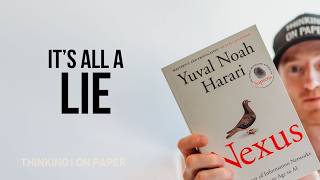
Yuval Noah Harari’s Nexus, Chapter 1: What Is Information?
Yuval Noah Harari opens Nexus by arguing against the naive view of information: the idea that more information leads to truth.



In this episode · 18 chapters
- The prologue: power is not wisdom
- What the book sets out to do
- Why we summon powers we cannot control
- The naive view of information
- From data to information to knowledge
- More data has not solved our problems
- Information as a slippery eel
- Astrology, and decisions made on it
- Cher Ami the pigeon
- Most information represents nothing
- Pigeon or dove?
- Carlo Rovelli, and the order of time
- Information from an AI perspective
- What Ian made from very little
- Music as coordination
- What you do not play
- Connection, not representation
- What comes next in the book
You have to be willing to do silly things like smash things together in really weird ways and generate references and try to connect the dots. And we’re doing that in real time.
Mark and Jeremy open Nexus with the prologue and chapter one, and set Harari's argument beside the move from data to information to knowledge, and why more data has not solved our problems.
Along the way come astrology, Cher Ami the pigeon, shutters signalling to British troops and Carlo Rovelli. They end on music, and Harari's view that information is defined by connection rather than representation.
The prologue and chapter 1 of Yuval Noah Harari's Nexus: A Brief History of Information Networks from the Stone Age to AI, read on the Thinking On Paper podcast book club, set up Harari's case against the naive view of information: the belief that more information leads to truth, and truth to wisdom and power.
What defines information in Harari's Nexus?
The defining feature of information in chapter 1 is connection, not representation. The line read on the show: “Most information in human society and indeed in other biological and physical systems does not represent anything.”
What is the naive view of information that Harari rejects?
The naive view holds that big networks which gather more information will understand the world better. Harari rejects it, and so does Jeremy.
Why do humans summon powers they cannot control?
Harari argues that our tendency to summon powers we cannot control comes “not from individual psychology, but from the unique way our species cooperates in large numbers.”
How does Harari define truth?
Truth, in Harari’s definition, is not a one-to-one copy of reality. It draws attention to some aspects of reality while ignoring others, and some accounts are more truthful than others.
When does a shutter become information?
The chapter’s examples include Cher Ami, a pigeon that carried a wartime message, and shutters opened or closed to signal to British troops. The test offered on the show for when a shutter becomes information: “When it's used to communicate something.”
Where Mark and Jeremy disagree
Mark objects to the pigeon on the cover, arguing that the bird of peace is a dove. Jeremy adds a step before information, data, which has to be cleaned before it is useful.
Links from this episode
Questions
What is information?
The defining feature of information in chapter 1 is connection, not representation. The line read on the show: “Most information in human society and indeed in other biological and physical systems does not represent anything.”
What is Nexus by Yuval Noah Harari about?
The prologue and chapter 1 of Yuval Noah Harari's Nexus: A Brief History of Information Networks from the Stone Age to AI, read on the Thinking On Paper podcast book club, set up Harari's case against the naive view of information: the belief that more information leads to truth, and truth to wisdom and power.
Who was Cher Ami?
The chapter’s examples include Cher Ami, a pigeon that carried a wartime message, and shutters opened or closed to signal to British troops.
Where does data fit in Harari's view of information?
Mark and Jeremy open Nexus with the prologue and chapter one, and set Harari's argument beside the move from data to information to knowledge, and why more data has not solved our problems. Jeremy adds a step before information, data, which has to be cleaned before it is useful.
Transcript
Mark Fielding Disruptors and curious minds, CEOs, founders, book lovers. Welcome to book club live. This is the rebellion to the 15-minute book summary. If you're tired of being told you should read 30 books a month, you're in the right place. One book, one chapter, one week, and we have a new book. And that's why we're going live, because we thought it'd be a good occasion to to test our nerve in front of a live camera. The book is Nexus by Yuval Noah Harari. It's book number six in the thinking on paper book club. Can you believe that, Jeremy? Book number six. Feels about right. Yeah, it's exciting.
Well, if you want to read the others, thinkingonpaper.xyz I'm losing track, but Nexus by Julio Ottino, The Design of Everyday Things by Don Norman, Clear Thinking by Shane Parrish, The Order of Time by Carlo Rovelli, and Quantum Supremacy by Michio Kaku. And I don't think we'll be able to do that again. Is it like seven digits you can keep in your head? Seven books. It's impressive, man. A brief history of information networks from the Stone Age to AI. We're talking about truth, power, reality, and pigeons. Well, I wonder where that would come into play. Yeah. Well, it shouldn't be a pigeon. It should be a dove. But we'll get to that. Can I start with something a little silly before we jump in?
Jeremy Gilbertson I would love to get a vote from the people watching, and you know, if you're not watching live, if you're watching later on, I have a problem with book jackets, like a very serious problem with book jackets. They frustrate the ever-loving you-know-what out of me so much so that as soon as I get a book, the first thing I do is remove the jacket because you're reading it and it shuffles around. I see you have your book jacket on, Mark. My soft back. Oh, even... All right, so you're good. Okay, so reply in the comments, book jackets, yes or no, for my sanity. Okay. Well, just for your sanity, it's quite funny that you mentioned dust jackets and everyone's watching this completely live. This is not scripted, so we have no idea what each other's gonna say.
That's part of the beauty. But my son, Luca, was actually crying about book jackets yesterday. He's five and he takes the dust jackets off because they get in the way. He doesn't like them. So you have at least one person who is on your side. It's amazing. Awesome. Well, let's jump in. Today we're gonna cover the prologue and we're gonna cover chapter one, which is plenty. The beginning of any really good book does a great job of setting the tone for the journey, kind of like tickling some things to get us thinking about where we're headed, Mark. So what jumped out at you in the prologue or how do you want to kick this off? The prologue. I was gonna read the first part of the prologue.
The prologue: power is not wisdom
Mark Fielding Power isn't wisdom and after a hundred thousand years of discoveries, inventions and conquests, humanity has pushed itself into an existential crisis. We are on the verge of ecological collapse caused by the misuse of our own power. We are also busy creating new technologies like artificial intelligence that have the potential to escape our control and enslave or annihilate us. Yet instead of our species uniting to deal with existential challenges, international tensions are rising, global cooperation is becoming more difficult, countries are stockpiling doomsday weapons, and a new world war does not seem impossible. If we Sapiens are so wise, why are we so self-destructive? Bit dramatic. Happy Friday, everybody. A bit dramatic. No, Jeremy, do you think that was a bit over?
Jeremy Gilbertson No, I actually don't. I actually don't like there's a lot of there's a lot of wacky stuff going on and we all want to get to the root of the wacky stuff and why it's happening and guess what? The most of the wacky stuff has this through line that permeates throughout history. Mustafa, thank you for commenting. He's in the notebook jacket club. I am outvoted. We're up to three. Three against one. Keep them coming, guys. Keep them coming. So, no, I actually don't. I think if you think deeply enough, there are you could get overloaded with the challenges that we have as a global society, right? But a couple things that popped out to me, power isn't wisdom. And if we are so damn wise, why are we so destructive?
He asks these really great questions and, you know, we're good at accumulating information. We always think more information is better and it's going to lead to things. And, you know, we're good at accumulating information and power, but not so great at accumulating wisdom is what he posits in this first chapter. Yeah, and he uses some cautionary fables, some forewarning from history doesn't need to highlight that. We've got the Greek myth of Patheon, the son of Helios. We have Johann Wolfgang von Goethe, who I didn't know that the Sorcerer's Apprentice was from that. So I learned something. I actually didn't either. That was pretty cool. Page two, Mickey Mouse, Walt Disney. There was an animated version of that. Yeah, so the prologue is setting the scene.
What the book sets out to do
Mark Fielding So the second half of the prologue is outlining what the book structure is. But the first half is about teasing at what information is, what knowledge is, what power is, what reality is. And I think, and this is on purpose, and I think it's something we should all be thinking about, the everything you read always has kind of the specter of AI loitering menacingly in the background, doesn't it? Whenever he speaks about information, he says, you know, throughout history, many traditions have believed that some fatal flaw in our nature tempts us to pursue powers we don't know how to handle.
I wonder what he's talking about, you know? It's always there, isn't it? Well, yeah, there's a lot of things in it, and it's interesting. He goes beyond, you know, the steam engine or even AI. He talks about things like religion as systems and not particularly any, you know, I think it's religion as the ability to corral and connect people and point them toward a certain mission, right? You know, as we get into what he defines what he defines information as. Well, he calls these delusional networks, doesn't he? But for tens of thousands of years, sapiens built and maintained large networks by inventing and spreading fictions, fantasies, and mass delusions about gods, about enchanted broomsticks, about AI, and about a great many other things.
Why we summon powers we cannot control
Mark Fielding I just want to read the one bit about chasing power. Our tendency to summon powers we cannot control stems not from individual psychology, but from the unique way our species cooperates in large numbers. The main argument of this book is that humankind gains enormous power by building large networks of cooperation, but the way these networks are built predisposes us to use that power unwisely. So that goes against perhaps common conception of like power is an individual. I'm power crazy. I've got a thirst for power. The power corrupts. These are kind of all individualistic notions, but he's saying no.
Jeremy Gilbertson Well, this road of cooperation, this road of coordination that is built by connecting all of these different things, right, to make them move in coordinated fashion, can be used for good and bad, right? It can be used to spread really good information to make society better. It could be used to spread really bad things that put power and control of someone that is going to do nefarious things, right? A couple other questions that jumped out. Yeah, speaking of which, this is a question in the prologue. Why do human societies choose to trust their worst members? I was like, wow, that's pretty big and it's happened in the past. And why is that?
Mark Fielding Well, probably because that information network was so profoundly efficient at distributing whatever message to coordinate that particular individual disseminates, right? Yeah, like a few it's like a trend, a few early adopters believe, and then maybe people are buying into the fact that everyone else has trust in these nefarious rather than themselves having trust in nefarious. They have trust in the group. Oh, they're saying it, so it must be right. They can't be that bad. But maybe that's, I think the big question or the big takeover of the prologue is this naive view of information, he calls it, which I think sets up chapter one and probably the rest of the book. Because the naive view of information, so what is information?
The naive view of information
Mark Fielding The naive view argues that by gathering and processing much more information than individuals can, big networks achieve a better understanding of, and then he lists these things. So the point is that the naive view of information is that more information is better. If you come to a problem, more information will solve it. There's nothing that information and more information can't help with. Am I wrong in that? Yeah. The view posits that insufficient quantities information leads to truth.
Jeremy Gilbertson Yeah, I think about this a lot. So in fact, there's a nice little graphic in the book. I don't know if you want to pull it, if you can see it. There's one that has the information, yeah, truth, wisdom and power, right? That's the naive view, yeah. I think about this a lot, and I'm not going to label this a certain type of view. This is the Jeremy Gilbertson view, right? So I teach this concept of how information goes on a journey through what I call knowledge and into wisdom, right? So to me, and we'll get this into chapter one, but I wanted to put this out because it got me really thinking because I talk about this stuff a lot. Information is like the encapsulation of something. It's like, you know, and it can be a lot of things, right?
From data to information to knowledge
Jeremy Gilbertson It could be the context associated with a physical object. It could be, you know, a piece of data, digital data, right? And, you know, that information becomes knowledge. It becomes known to the person digesting it, then it kind of, okay, it's knowledge, it's kind of known, but then wisdom is the applied version of that, right? It's you take this in, you mix it with your experience, and you apply it, you play with it, you do things with it to understand really its purpose. So there's a rabbit hole for you, but that's how I think I immediately, I was like, oh man, this is resonating because this is stuff I do all the time. The naive view is resonating with you.
No, no, no, no, no, my view, my view, I think is different from the naive view because the naive view talks about all information, large quantities of information leads to truth and which leads to power and wisdom, right? But, you know, as we'll learn here in a bit, I want to talk about truth because I talk about truth all the time and I think about truth all the time. It's very different than the naive. I don't subscribe to the naive view of information, as the author doesn't.
More data has not solved our problems
Mark Fielding No, and a lot of the book is going to be about that and despite or perhaps because of our hoard of data, we are continuing to spew greenhouse gases into the atmosphere, pollute rivers and oceans, cut down forests, destroy entire habitats, drive countless species to extinction and jeopardize the ecological framework of existence. So yeah, so if more information... Again, big, big, big smiles on Friday, everybody. Well, like if more information is the route to wisdom, why if we have access to all this information, are we so shit? Well, I would almost argue like there's a step before information. Hopefully, I can learn more from the author as we move through it. We're just in the prologue. We're already like spinning and grooving, right? That's why we do this. I know, I know.
Jeremy Gilbertson I would almost think like information has a step before it. It's like data. You know, data is maybe a step before information and which is something kind of without context is where I think about it. And you look at IT departments today, you know, like and I come from, you know, IT background, data center background among other things. They're like, oh, yeah, we need to capture all of this data because we can make sense of a lot of this data.
And now there's so many companies and services and businesses that actually clean up the data, right? They clean up the data to make it useful. So they discard like a third of it or half of it, right? So that automatically points to this naive view of information is you know, a whole pile of information is not going to get you to wisdom, right? The right information is going to get you to wisdom. Well, that's a nice segue to chapter one. What is information? What is information? Hey, shout out to the chat. If anyone has read this yet, please chime in with your thoughts and especially on like the what is information. This is a really interesting chapter because I think about this quite a bit and I was excited to dive in. Let's start with the stars as the cosmic script, right?
So you look at a star not just as like an individual dot in the sky, but a star as a participating in a group of other stars like billions, right? And interconnected with all of those, right? So there's this potential that exists in it versus just being one thing. Cosmic script. Keep going. Okay. Well, then he goes into astronomy versus astrology, right? Right. With how you read a network of information. Some people read it totally differently. Some people look at the stars from an astrological perspective and read into the myths and the stories and the, you know, some other way to interpret that grouping of information. But then astronomers look at that from more of a scientific perspective. Okay. Okay. Let's just back up for listeners then.
Information as a slippery eel
Jeremy Gilbertson So he he says that information is like a slippery eel. It's very difficult to define exactly what it is. That's his first kind of observation. So now you're saying that astrology and astronomy. Unpack that for me again. They use the same, as I read this, they use the same collection of potential, right? So if we think of like stars or information as an interconnected group of potential, right? Little bits of information connected to be interpreted in different ways. You have astronomers that interpret the relations between the stars in one way and you have astrologers that interpret that same amount of information in a different way through a different lens.
Astrology, and decisions made on it
Jeremy Gilbertson Okay, so almost like the delusional view, but then and then he posits that during history, astrology has actually had a lot of impact and kings and governors would choose based on astrology, wouldn't they? Delusional is relative, right? Like, you know, the scientists are going to look at astrology and call it delusional perhaps and astrologists are going to look at certain aspects of science and do the same thing. But this is, this is perspectives and we get this, we get this down the road. Mustafa actually got another comment in here that's pretty interesting. Why don't you take a look at that and unpack that, Mark?
Mark Fielding My favorite part is the first few lines where Harari admits that defining fundamental concepts is very hard and yet he attempts to give us some definitions, which is why I'm interested in hearing what different definitions people would choose and why. Okay, so Harari, in everyday usage, information is associated with human- made symbols like spoken or written words.
Cher Ami the pigeon
Mark Fielding And then he gives some examples where that's not the case and he gives a story of Cher Ami, a pigeon in during the war that carries a message and information doesn't have to be symbols, it can be. But I think of information as the transfer of a story or knowledge or in the transfer of communication, let's say. It's communicating something between one source and another, that transfer, that communication is information. But at some point in this chapter he makes me question that. Because to quote, most information in human society and indeed in other biological and physical systems does not represent anything. I want to spend a little longer on this complex and crucial argument because it constitutes the theoretical basis of the book. Probably want to pay attention to that.
Most information represents nothing
Jeremy Gilbertson Yeah, I'll read that again. Most information in human society and indeed in other biological and physical systems does not represent anything. What does he mean it does not represent anything? Mustafa, what does he mean when he says information does not represent anything? What did you take from that? So, while you have a moment to think about that Mustafa, let's go into what... Let's talk about the shutters. Let's talk about the shutters. Let's talk about the house on the Mediterranean that was opening and closing shutters to signal to the British troops out in the harbor or wherever they were as to the status of the Ottoman soldiers in the city, right? You're on the boat. You're far out.
You're trying to figure out as a military strategist what's going on in the village. I'm a villager that leans towards the British side. So I'm going to try and signal you, right? And maybe the open shutter means there's 10,000 and then a closed shutter means, hey, it's safe. You can kind of come in. But this another question that I highlighted here. When is a shutter just a shutter and when is it information? So here's how I got my head around. When it communicates something. When it's used to communicate something. But the something that's communicated also has to be in there too. So like an embedded context or an encoded context or I used encapsulated when I was earlier talking to it.
Mark Fielding So the reference that the shutter means something in a certain position, that's the encapsulated piece of it. And then the communicating of it gives it that information quality as well. So the medium is not the message, right? Yeah. A little McLuhan was referenced in here. The pigeon. Could I just like on a lighter note, could I take take what? I can't remember the word. Lost my words. It's not a pigeon. God doesn't send out a pigeon from the ark. It's a dove. And he talks about pigeons being, but it may be later on the book. It's all a big joke and it's like his transfer of information is incorrect. But who's ever heard of the pigeon, the piece, the pigeon of peace, the peace pigeon.
Pigeon or dove?
Jeremy Gilbertson They don't release pigeons. They release doves. Do you think that was an error and carryover from the story of the pigeon that had the had the military message in it? No, because he mentions pigeons again and there's a pigeon on the front cover and I maybe this is Cher Ami, in which case it's okay. But if this is the pigeon of peace, he's got on the front cover. It's a big faux pas. Okay. So are you saying that Harari is actually he knows he knows He's demonstrating misinformation and disinformation. Do you think this was done on purpose or by accident? I hope later in the book He it's well, is it misinformation or disinformation? So if I remember this correctly misinformation is accidentally And disinformation is on purpose.
Mark Fielding Yeah, so I I think this is disinformation He's done it on purpose because he knows damn well that it's a dove, not a pigeon. All right.
Uh, If the author would like to come on our next show and uh talk to us about the hidden gem we've uncovered the nugget the uh, the easter egg within the book, um, that could be an interesting discussion Um on information so you were speaking about truth earlier And he speaks a lot about truth and reality Uh truth then isn't a one-to-one representation of reality rather truth Truth is something that brings our attention to certain aspects of reality while inevitably ignoring other aspects No account of reality is 100 accurate, but some accounts are nevertheless more truthful than others why Is he why does he spend so much time talking about truth?
Jeremy Gilbertson with information here Yeah, because I think I think it's important well it I think it's rooted in the naive view of information Which is what he talked about earlier. I think that's why he's trying to reference truth um, and and how the his definition of information differs from that and There was a piece in the prologue that I that I circled that I thought was really interesting. Um a common objective reality Common objective reality. How difficult is that?
Carlo Rovelli, and the order of time
Jeremy Gilbertson Like with it, you know with the order of time carlo ravelli like there's not there's not a coordinated, you know, uh Common objective reality and then we dive into some of the other things that we learned in um Quantum supremacy the michio kaku book and all the quantum mechanical stuff Um, do we get into this like many worlds interpretation of reality and wave collapses and and all of that fun stuff? but not to not to get too deep, uh in back in that but Truth to me I've thought about this a lot like truth to me is should be locked into a moment in time So I always use this example.
I've got this i've got this tree Big tree that's outside my front window where I usually do a lot of reading and a lot of writing And I look outside when i'm stumped on what to write or what's a journal So I I look around and I observe and I just kind of write what i'm thinking Sometimes that tree has green leaves on it Sometimes they're red and they're yellow and sometimes there's no leaves at all But you know at a moment in time when i'm looking at I would say, you know Mark, those leaves are green you would look at the tree and the leaves would be green But you know, I don't know a couple weeks later, you know, the leaves are yellow, but they're still the same leaves, right?
Mark Fielding so It's a quality of information tagged to a moment in time is the way I think about it So carlo ravelli, maybe you can come and talk with uh, mr. Harari and we could hash all this stuff out Is that right with the leaves is that there are there is no truth truth with the leaves because there is no now If we're going to combine books carlo ravelli said there's no now so there's no truth because there's no present Truth is always evolving um I was thinking about this from a less poetic Perspective than you.
Information from an AI perspective
Mark Fielding I obviously need to get outside more into nature and look at the trees. I was thinking of Information from An ai perspective possibly because we had such an amazing show yesterday with leonard tang about Language models and how to make them safe And all he talks about all of this information.
Obviously, we get more and more and more and more and more information ai is going to Both Screw us and help us because it's going to screw us because you're going to create all this data It's going to help us to to sift through it and find the truth to find the information that matters and I just feel almost like a crossroads or a junction where like jimi hendrix take do you go left and he sell his soul just go this way and play music and robert johnson Yeah him and if you if if you think about Medicine, for example, there's one person studying one disease right now the most advanced specialist on a disease in the world will have so much information that they simply cannot Know it all about for one tiny tiny little domain.
They're an expert in because there'll be so much more information available, but they need to Be able to communicate that information to other departments to other doctors studying other diseases like they all need to be connected together But there's so much information that it's just impossible for us to do that. So what role? Is ai going to play in helping the dissemination of that information and hopefully he's going to get into that yeah, and you can also check out a lot of our uh, A lot of our episodes that dive deep into what ai is going to do down the down the road I think with anything, you know technology supercharges everything.
Jeremy Gilbertson It's it's jet fuel on whatever, you know Whatever you apply it to right and you know Those jets can be used to fly and do bad things those jets can be used to fly and do really good things, right? So that's I think about I think about that a lot. Um, let's see All right So ian, uh chimes in and says we should hold the debate between harari and ravelli So, um, we'll get we'll get we'll get our team on that and you know the man Ian, uh, just feel free to connect us and uh, and we'll make it happen. Um, if anyone doesn't know ian Um ian is the guy that did our video, right? So if you watch the pre-roll video, he does a great job, uh connecting everything and uh, Helping us tell our story with information.
What Ian made from very little
Mark Fielding So thank you ian He yeah, there's a there's a message in there about information we gave in very limited information and he created something which encapsulated that very small amount of information in a very Very efficient way as if he had lots more information The opposite of the naive view of information he used minimal information to create something That most would think would need a lot of information So, all right, so yeah, this is really interesting It's really so mustafa your your question, uh diving into the musical side of the fence here. I think the the musical aspect of of Information using music as an example.
Music as coordination
Jeremy Gilbertson I think is really interesting what the author does here that the idea that music uh connects and coordinates People in an activity whether it forces you to tap your foot or it takes you to an emotional Response or whatever it is, but music isn't true or false like music like when you listen to a song Well, that's true or that's false. No, but it's information. So that's an interesting way to get your head around um the idea of As he defines as harari defines information It's not about truth. It's not about truth or false.
Mark Fielding It's about about connectivity uh connection and you know Enabling something bigger By connecting it with other nodes I I think music as well Going back to that you're communicating Something and music very obviously communicates in emotion Between the creator and the listener between between listeners that there's an audience players. Yeah, there's a commute it's It it Music is communicating emotion. There you go That's that's what it is and different music different emotions, but it's still transmitting Something between I heard something very interesting about I can't remember it was on a podcast, but they were talking about ai generated art And I think it was Neil Stevenson, actually, Snowcrash writer, maybe he was talking about it.
We like art because it tells a story of what the art, those micro decisions that the artist made when they created it. So you're not just listening to a piece of music, you're listening to all of those micro decisions that the artist went through to make it. You read a book, how many hundreds and thousands and millions of decisions that the author had to take to create that piece of art. And you're never going to have that connection with AI generated art because you don't have that human connection of what it takes to create that, all those micro decisions that need to be made. And I thought that was very powerful because it goes back to the information is communication. And if you're not communicating something worthwhile, the information is not making.
Jeremy Gilbertson Well, what about, so you mentioned, you mentioned, you know, us giving Ian a bit of information, not a lot of information that he took and did something pretty awesome with it. Right. And the naive view of information, the subscription is a lot of information leads to something, right? So in music, you know, tying music back into it, you know, great music can happen when someone puts one note down on the piano key and there are like seven great musicians around that one note. And there's improvisation that happens with that, but there's also great music that happens on the front end with a lot of, I guess, if you call it coordinated information on the front end with a score and a hundred piece orchestra and that sort of thing.
What you do not play
Jeremy Gilbertson I don't know where I'm going with that, but there's, there's the riff for you. But also, as you like to point out quite often is a lot of music is what you don't play. It's the non-communication. It's the silence. It's the, that those gaps may be, and there's some kind of connection there between information and passing it on. I mean, like less is more. Oh man, I'm going to stay on this because you, you, you pulled me back into this. All right. Do you know why, do you know why like grooves hit you so hard? Like a really funky groove gets you kind of making, see a little bass face and gets you like doing this. Do you know why? Is it because it's kind of getting my brainwaves in sync somehow or something? I don't know how. So really groovy stuff. Like one of my favorite drummers of all time, I've told this story a ton is Levon Helm with the band. And he always played just a touch, just a touch behind the beat.
Right. And then you have Jay Dilla on the, on the opposite side of that. One of like, you know, one of hip hop's best producers, beat makers was in front of the beat, right. Was ahead of the beat. So your anticipation of the beat and when it hits differently, that surprise creates this, creates you locking into that, which is, it's fascinating man. When you really listen to it and figure out why things making, why information makes you do certain things. How about that? Yeah. Well, he's communicating across the void to your internal core about, yeah. Anticipation or is it, okay. On that, just saying on that, we'll talk about rhythm. I understand. What was the drummer's name who played just before the beat? Oh, Levon Helm. Levon Helm. Okay. So that's anticipation.
Mark Fielding You're anticipating something just after the beat. Is that frustration? What's that that Jay Dilla is? Oh, actually let me, I have those flip-flop. I have those flip-flop. Jay Dilla was early, Levon Helm was late. Jay Dilla was early, Levon Helm was late. Okay. So Jay Dilla has given us like the anticipation. What's, what's just after the beat? What is that communicating? Is that like, why does that make him, is that frustration? I'd be like, Oh, he missed it. Oh, he missed it. I think it's the lag that makes it interesting. And then it's the early that's like, Whoa, what the hell was that? Right. All right. So I got a, I got a question for you.
Connection, not representation
Jeremy Gilbertson If we, if we think about like the main powers, the defining feature of information as he writes in chapter one is connection and not representation. So if you think about like this node of bits of information, whether it's like synapses in your brain, stars in the sky I don't know, whatever, whatever it might be is information really just like potential. Is it like the potential of what those interconnections, what those dependencies can deliver? What do you mean exactly? The potato, are you talking quantum again? Is this like maybe it's like the likelihood of things, the potential of, of, of this inner, this, this disparate bits of things, the potential lying in their ability to connect and coordinate. It sounds reasonable.
Mark Fielding I don't fully grasp what you, what you, what you mean, but keep going. Oh, I don't know. I don't know. I think I, I, I like the idea because now you're linking, showing now you're linking this to the quantum realm. So maybe all information is actually all information and it just, the path of least resistance in the quantum realm is the information that we get where if you, I don't know. Think about ingredients. Think about ingredients in a cake. You're making a cake. Right. Yes.
Jeremy Gilbertson Got like 10 ingredients and there's a... That's a pretty flamboyant cake. I know there's a, there's a specific ratio of those 10 ingredients that will deliver a certain result, deliver a certain cake. If you tweak the ratios on that, the cake is going to differ, right? So the potential outcome of the ingredients coordinated in different ways is the cake. Is that information? Is that the potential of information? I'm going to say yes. That's called a pregnant pause audience. We do that on purpose. Okay. This is why I really like what we're doing because we haven't read the whole book. We've read the prologue and chapter one. So obviously we're trying to make sense perhaps of the whole book just by reading what little we've read.
And I think our understanding will mature and evolve over the weeks as we read more of it. Disruptors and curious minds. Guys, the beauty I think of really locking in, taking in information and turning that into wisdom, right? Or turning that into something applicable. You have to be willing to do silly things like smash things together in really weird ways and generate references and try to connect the dots. And we're doing that in real time. We're willing to look silly real life in time to demonstrate the power of what that can do. The understanding that it creates versus me just reading the book by myself versus me and Mark pushing our ideas around. I love it. Yeah. And a little teaser for next week.
What comes next in the book
Mark Fielding So in chapters two to five, we'll take a closer look at the history of information networks. We'll discuss how over tens of thousands of years, humans invented various information technologies that greatly improved connectivity and cooperation without necessarily resulting in a more truthful representation of the world. These information technologies invented centuries and millennia ago still shape our world, even in the era of internet and AI. And the first information technology we'll examine, which is also the first information technology developed by humans. And incidentally, my favorite. Also the sponsor of our last show, right? And the sponsor of our last show and possibly the sponsor of our next show, Story. Story. There you have it. There you have it.
Jeremy Gilbertson Hopefully you enjoyed this. This is real time knowledge acquisition with the hopes of something interesting. But hope you guys are reading this with us. Jump into it next week. Thanks to everyone who contributed live to the discussion. We'll continue to do that. You can find us at thinkingonpaper.xyz. Where are our social handles, Mark? Where can you find us? You can find us. Well, let's transmit a more coherent story. Rather than 8 million channels, go to thinkingonpaper.xyz and choose your favorite. Oh, remember the stories like choose your own adventure back in the day? Choose your own, yeah.
Mark Fielding Choose your own thinking on paper vertical, Spotify, Apple, Instagram. It's all there. Choose your own. Maybe we should get Mustafa on the show next week, Jeremy, if he's up for it. Sounds like a good idea. Hit us up. Be curious. Stay disruptive. Keep thinking on paper. Bye-bye.