Book club
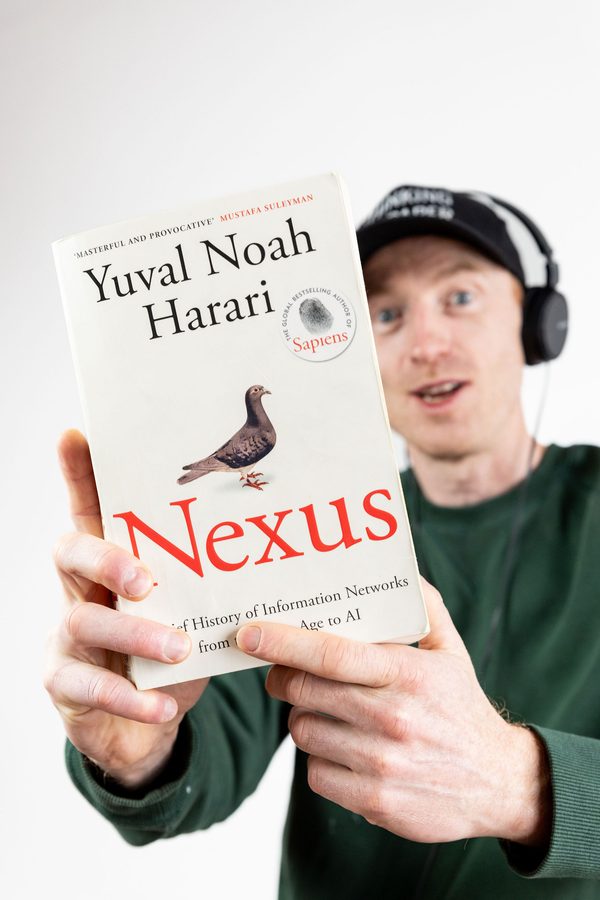
Nexus by Yuval Noah Harari
This is the most important book of the AI age. If you’re thinking about the impacts of AI beyond your bloody email, read it.Mark Fielding
Here’s an example of why AI might not be totalitarian dictator’s best friend. The AI spends 10 seconds on the internet and goes, hold on, I call bullshit here and then the AI starts ridiculing the authoritarian dictatorship. I like that. The alignment problem, Russian style.
Nexus book club: every chapter
 Prologue and chapter 1 · What Is Information?
What Is Information?
 Chapter 2 · Stories
What Is Intersubjective Reality?
 Chapter 4 · Errors
How Was the Bible Compiled?
 Chapter 5 · Decisions
What Separates Democracy From Dictatorship?
 Chapter 6 · The New Members
How Did GPT-4 Get Past a CAPTCHA?
Chapter 7 · RelentlessWho Pays for the Surveillance of Modern Life?
Who’s creating those shortcuts for you? Who’s writing those shortcuts? Who’s harvesting them from the internet without due diligence, without critical thinking? Thinking on paper is learning your own shortcut by critically thinking and processing and writing and all of that stuff.
 Chapter 8 · Fallible
What Is the AI Alignment Problem?
Chapter 9 · DemocraciesCan Democracy Survive AI?
 Chapter 10 · Totalitarianism
Is AI a Dictator’s Best Friend?
 Chapter 11 · The Silicon Curtain
What Is Data Colonialism?
AI is not the problem. AI is not the problem. That’s what this book should be renamed. AI is not the problem. The problem is us.
And I think that you asked about what it’s like to be wise and I don’t know the answer to that, but I do know that you gotta read both sides of the story to get anywhere near being wise.
This is participatory. This is not designed to be a broadcast. This is designed to be a book club. Come in and read it with us.
Synthesis cannot be outsourced.
About the book
What is Nexus about?
Nexus: A Brief History of Information Networks from the Stone Age to AI is Yuval Noah Harari’s history of how information connects people. He argues that more information does not automatically lead to truth, that stories let humans cooperate in large numbers, and that AI brings agents that make decisions inside our information networks.
Is Nexus worth reading?
Yes. There is a world before AI and a world after it, and you have to read both sides of the story to get anywhere near wisdom about what comes next. Nexus makes the cautionary case, and makes it very well. That is Mark Fielding’s verdict from the end of our book club, and Nexus is one of Thinking On Paper’s five books to read to understand AI.
What does Yuval Noah Harari say about AI?
Harari argues that AI is an agent, not a tool: algorithms make decisions and can learn things no human engineer programmed. He warns about the alignment problem, a surveillance network that is always on, and a silicon curtain dividing the world, and calls for institutions that can correct their own mistakes.
When was Nexus published, and how long is it?
Random House published Nexus in the US on 10 September 2024. The hardcover runs to 528 pages.
Who is Yuval Noah Harari?
Yuval Noah Harari is a historian and philosopher, and the author of Sapiens: A Brief History of Humankind. Born in Israel in 1976, he received his PhD from the University of Oxford in 2002. His publisher says his books have sold 45 million copies in 65 languages.
The top 5 books on artificial intelligence, chosen by Thinking On Paper
If you want to understand the past, present and future of AI, where AGI and superintelligence could take humanity, the harm that could be waiting, and how good it could be if it all goes right, read these five.
- Nexus, Yuval Noah Harari (2024). The past: how information networks shaped human history, and what changes when computers join them.
- Empire of AI, Karen Hao (2025). The present: how OpenAI went from a nonprofit set up for the good of humanity to a company racing to scale, and who paid the cost.
- Klara and the Sun, Kazuo Ishiguro (2021). The personal: a novel narrated by Klara, an Artificial Friend bought as a companion for a sick teenager.
- Superintelligence: Paths, Dangers, Strategies, Nick Bostrom (2014). The perils: what happens if machines become smarter than us, and how that could go badly wrong. We discuss his paperclip thought experiment in Nexus chapter 8.
- Excession, Iain M. Banks (1996). The beauty if it all goes right: a novel of the Culture, Banks’s post-scarcity civilisation run by AI Minds.
Help sharpen our minds. We can help sharpen yours maybe.