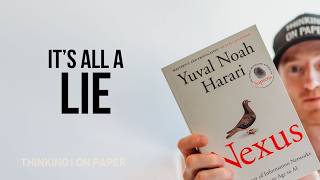
Yuval Noah Harari’s Nexus, Chapter 4: How Was the Bible Compiled?
The Bible didn't exist in biblical times, and chapter four of Nexus follows the men who decided what went into it.


In this episode · 10 chapters
So in short circuiting the error prone nature of humans, we’ve reintroduced ourselves into the equation. Is that backwards or what? Didn’t see that one coming, did they?
Chapter four of Nexus turns to holy books and the people who interpret them. Yuval Noah Harari argues that the most important function of religion is to provide superhuman legitimacy for social order, and treats the book as an early technology for bypassing error-prone humans.
Mark and Jeremy take in the Oracle of Delphi, the ship of Theseus, the story of Thecla left out of the Bible, Heinrich Kramer's witch-hunting book and a Prince Bishop's letter, then ask how science built the self-correcting mechanism the church lacked.
Yuval Noah Harari's Nexus, chapter 4, asks what gives religion its authority. Read on the Thinking On Paper podcast book club, it shows how religions tried to bypass error-prone humans with holy books such as the Bible, why interpreters brought those humans back in, and why science succeeded by admitting its mistakes instead.
What was left out when the Bible was compiled by committee?
The Bible was compiled by committee, and the choices mattered. Jeremy contrasts a line that made it in, from the first epistle of Timothy, “a woman should learn in quietness and in full submission”, with the story of Thecla, St. Paul’s disciple, which did not.
What does Harari say is the main function of religion?
Harari’s opening claim, read on the show: “The most important function of religion is to provide superhuman legitimacy for social order.”
Why was the book an early religious technology?
A book, unlike a document, exists in many identical copies, which made it an early religious technology for fixing information. But someone still had to interpret the book, so the humans it was meant to bypass came back in.
What was Heinrich Kramer's book on witchcraft?
Heinrich Kramer wrote a guide to extracting confessions of witchcraft through torture, and it became one of Europe’s bestselling books. The hosts read a letter from the witch trials in Würzburg describing the arrests and executions.
How does science differ from religion in handling error?
Science differs because it rewards self-skepticism and treats error as something to correct. Jeremy’s example is the DSM, the psychiatric manual, which once classed being gay as a disorder and later removed it.
Where Mark and Jeremy disagree
Mark argues the Church cannot admit its doctrine is wrong without saying God is wrong, so it blames individual priests. Jeremy notes he has not checked Harari’s account of how the Bible was compiled and is trusting the footnotes.
Links from this episode
Questions
How was the Bible compiled?
The Bible was compiled by committee, and the choices mattered. Jeremy contrasts a line that made it in, from the first epistle of Timothy, “a woman should learn in quietness and in full submission”, with the story of Thecla, St. Paul’s disciple, which did not.
What is chapter 4 of Harari's Nexus about?
Yuval Noah Harari's Nexus, chapter 4, asks what gives religion its authority. Chapter four of Nexus turns to holy books and the people who interpret them.
Which stories do Mark and Jeremy discuss in Nexus chapter 4?
Mark and Jeremy take in the Oracle of Delphi, the ship of Theseus, the story of Thecla left out of the Bible, Heinrich Kramer's witch-hunting book and a Prince Bishop's letter, then ask how science built the self-correcting mechanism the church lacked.
Why did science succeed where the church did not?
Read on the Thinking On Paper podcast book club, it shows how religions tried to bypass error-prone humans with holy books such as the Bible, why interpreters brought those humans back in, and why science succeeded by admitting its mistakes instead.
Transcript
Mark Fielding Disruptors and curious minds, CEOs, founders, book lovers, welcome to the Thinking on Paper Book Club where we read between the lines of books that have stood the test of time, books that will change your mind. We are the rebellion to the 15-minute book summary. We are a bastion of critical thinking and we're on book six of Book Club. We're reading Nexus by Yuval Noah Harari and like last week and like every week going forward, I'm going to start with some Shakespeare and then Jeremy's going to guess what play it's from.
I'm bad Shakespeare. Action. A sailor's wife had chestnuts in her lap and munched and munched and munched. Give me, quite I, aroint thee, which the rump-fed royans cry. Her husband's to Aleppo gone, master of the tiger. But in a sieve are thither sail, and like a rat without a tail, I'll do and I'll do and I'll do. I'm going to rhyme and say Taming of the Shrew. It's Macbeth, it's The Witches.
I told you I was bad at Shakespeare, man. I'm not above admitting that. By the end of this Book Club, you're going to know because for every episode, I'm going to try and get a bit of Shakespeare that's relevant to the chapter that we're reading and obviously that was Act 1, Scene 3 of Macbeth with The Witches. And I just did a little date check, written 1606, 1607. So in the midst of what we're going to talk about at some point in a bit in the Book Club, aren't we?
Jeremy Gilbertson So yeah. Witches. But no, we're not going to start with that. Chapter 4, Jeremy, before we get to Witches. First take. First take. I'm going to tell you where this where this sent me right off the bat. I think it was like in the first, second or third paragraph, something like that. Quote, the most important function of religion is to provide superhuman legitimacy for social order. I'm going to read that one more time.
The function of religion
Jeremy Gilbertson The most important function of religion is to provide superhuman legitimacy for social order. All right, here's where I went. I'm going to, I'm going to. Are you going to upset the Catholic Church today, Jeremy? There's a, there's a slight possibility of that. All right. So, so I read this book. This is another book called Total Freedom. I don't know if you, it's kind of focusing. Total Freedom, Jiddu Krishnamurti, essential writings of a man that Dalai Lama described as one of the greatest thinkers of the age. All right.
So this guy was anointed like when he was really young to be this, uh, be this prophecy of this religious sect and they figured out, Hey, this guy was going to be the dude. He was like 10 years old or something. And he kind of got into it and went, no, no, no, no. I'm not the dude. Like I'm not like this anointed one. And then he just started doing his own talks and figuring things out on his own.
And what I've learned from this book largely is what that first sentence is. It's just like, not just religious institutions, but large organizations, um, are, are a mechanism of control. And the way they control is by, by feeding off of this fear and security thing that happens with, with humans, right? We want to feel secure and we're scared when we're not secure. And we look to lean on things, uh, to feel more secure.
So immediately that's this, I mean, this is one of my favorite books. I totally recommend anyone reading this. Um, but that's where my head lands with this, with this thing at first sentence, that sentence is powerful, man. And it's like, I'm not saying, you know, I'm not saying if, if you believe in a certain type of religion that I'm calling you wrong. I'm just calling this really interesting that this author has this position on religion as we are talking about stories that scale stories that are used to organize large groups of people in action.
Um, sorry. I just, when you said I'm not the dude for all, for all our big Lebowski fans out there, I just couldn't stop thinking of the big Lebowski. I'm the dude. You're the dude. Here's real quick on that. So my eighth grader, my eighth grader always wears a robe, like always wears a robe. And I'm like, you are the dude. He's like, what are you talking about? And I, we're going to watch the movie together.
Mark Fielding I showed him pictures. He goes, oh, I get it. Um, well, a bit of a digression, but the dude has become a, a religious symbol for some people, Jedi, star Wars, like these quasi religious movements have built up around these non-deity symbols like the dude. But, um, yeah, in order to function self- correcting mechanisms need legitimacy. If humans are prone to error, how can we trust the self-correcting mechanisms to be free from error?
He talks about, yeah, superhuman legitimate, the superhuman legitimizes social order. As you've just said, um, God is infallible, but so he speaks a lot in chapter four about religion and how religion came to be because, you know, was it possible to bypass humans? But like humans are prone to ever, was there a way to bypass humans? And then as society became more complex, the religious systems built on it became more and more complex. And he gives us quite a deep, quite a nice, quite a good. I enjoyed it. Breakdown of the, how the Bible came to be. And it was very interesting.
Jeremy Gilbertson I don't know how much you learned from that, but I found it a ton. I learned a ton. No, it really was. And in this idea of, um, you know, humans, you know, being prone to error, right. And in, you know, stories kind of extending and coming from humans. So how do we know what is imagination and invention and what is truth and what the hell is truth, right? What the hell is truth kind of in general, you start thinking about that, but a good example of humans, uh, being, uh, prone to error.
The Oracle of Delphi
Jeremy Gilbertson I enjoyed the story about the, the Oracle of Delphi actually being bribed or potentially being bribed, right? So this is, this is, this is this, um, temple that people would go to, to, to ask the biggest questions, the greatest, correct. The most trusted, uh, entity, I think back in a certain age was actually according to the author bribed by a certain political system. Like this shit's been happening for a long time.
It's not new. Like this stuff is not new. What's the meme? Same shit, different day. Yeah. Was it, was it, was it Delphi in the time, in the time of the Greek gods? Yeah. A long, long time ago.
Mark Fielding And that kind of bribery though, in the story of these religious texts, um, there was almost a, well, the, the, the long and the short of it, or the short of it, I don't know, is that basically these religious books are a lot shorter than they could be because lots and lots and lots of it is, and documents and texts, which were not included because the, the men at the time between themselves kind of decided what was going to go in the book and what wasn't going to go in the book.
And over the centuries, this thing, and there's a very nice summary I found, um, which I, on page 91, that, um, skipping ahead a little bit, but I'll read it because it still makes me laugh. Catholic information experts such as Jacques Fournier spent their days reading Thomas Aquinas interpretation of Augustine's interpretation of St. Paul's epistles and composing additional interpretations of their own.
All those interrelated texts didn't represent reality. They created a new information sphere, even bigger and more powerful than that created by the Jewish rabbis. Many evil Europeans were cocooned inside that information sphere, their daily activities, thoughts, and emotions shaped by text about texts about texts. So this Russian doll, the telephone, it's the telephone game. It's the telephone game, the same thing, Russian doll, telephone game, the whole nine yards, right?
Jeremy Gilbertson Um, well, let's, let's run down this, this, this journey, this, this, the beats of the story of, of the Bible and, and, and, and books like it that were actually created by committee, believe it or not. Uh, at least according to this author, you know, we haven't done, I haven't done extensive research to, to prove what Harari is saying, but I'm going to trust him in his footnotes because we're in the context of his book.
Um, all right. So here we are, religion coming together. Uh, Mark and I want to bypass humans because we're prone to error. So, Hey, let's, let's write something. Let's write something down and capture it in something that is beyond us. Something that isn't us. That isn't me saying it. Something that I can point to that you can point to here are the rules of the road, right?
What a book is
Jeremy Gilbertson So that's what a book is. And, and, and books are different than documents, which was really, he talked about this a little bit, right? Documents are usually kind of a, um, a single copy of something, right? And books are many copies. And he talked about this being, um, an important religious technology. It's like, how can a book be technology? But when you think about it, it was like one of the original technologies in the dissemination of information and information that was controlled by an entity.
Mark Fielding It's the entity wants you to, uh, know a certain thing in a certain way. They put it in a book. That's the way, right? Yeah. He mentions the blockchain analogy with different nodes around the world. The book democratizes knowledge. It democratizes information. It, in theory, it can't be erased because there's copies all over the place and they all tell the same story. They're all identical.
Jeremy Gilbertson Obviously it didn't quite work out like that, did it? But that was, was that the thinking? I think with this, it was probably just stumbled, society stumbled upon it. I don't think there was much thought going into, I know we can democratize knowledge and recreate these things. I think it was just this natural progression of culture. Maybe, who knows? Who knows? The one thing I did chuckle at the sentence, um, the Bible didn't exist in biblical times.
It's kind of, it's kind of funny, right? Cause you think like, you think like it's, it's always been kind of the rules of the road, right? But it, like, it wasn't while those, while it was being compiled, right? Like there was no, there was no rules of the road as, as said in the Bible. Right. Um, and then, uh, have you heard of the ship of the ship of Theseus that the, the, the thought experiment where, no, hit me.
The ship of Theseus
Jeremy Gilbertson What do you got? So the ship of Theseus, right? You have a boat, you build a boat, something breaks on the boat, you replace it. And then you keep replacing it and you keep replacing it. And at what point does the boat not represent the original boat? And if you, what, at what point does the Bible, these books, they change so much over time because people add and take away and add and take away and change and change and interpret, interpret, interpret.
At what point does it no longer represent what it began as? All right. So point to the atoms in your body that allegedly change 97% of them every year. Right. Are you really you, but let's not go down to that rabbit hole.
Let's stay in the books. Um, all right. So this collection of stories, uh, created by committee, um, here's some interesting things that, um, that, that I saw in here, like allowing certain information to be the information, right? So you, if we fast forward, like to the, to today, there's a guy named Tim Wu who wrote a book called the master switch really. And he also coined something called a net neutrality, which is, you know, the idea of like whoever controls the pipes of the internet, you know, can control the information that goes over the pipes of the internet is kind of the, kind of the concept.
The role of women
Jeremy Gilbertson Um, but think about this, like the role of women in society today, I think no matter who you are, you could argue that. Unbelievably, they are still put in a position where, uh, they're, they're made to feel inferior, whether it's in the workforce, whether it's intellectually, whether it's whatever. I mean, there are examples of it that happen all the time. My wife and I talk about this a lot.
Like we had an electrician come to the house the other day to, um, to, to do some repair work. She called him, she set up the appointment. And I was here when, when it all went, you know, when he, when he got here. So of course I go to the door and I introduced myself and, you know, she's talking and the guy immediately just started talking directly to me and totally ignored Tracy. And I'm like, no, no, no, no.
She, she'll tell you what's up. Like she made the appointment. Like she's the one to pay attention to here. And that's just a little example. But pulling back to the story about the role of women in church and one interpretation of that story went viral, so to speak, this idea of the first epistle of Timothy quote, a woman should learn in quietness and in full submission, right? So that's the version that went in to the Bible instead of this story about Thecla, St.
Paul's disciple, who is allegedly a revered Christian Saint performing miracles, doing all these wonderful things as a woman. But does that get in the Bible? No. This other thing gets in the Bible because I'm going to, I'm not even going to, you know, let's just think about why that may have made it in the Bible versus the story of Thecla. I don't know. What do you think? Come to your own conclusions on that.
Mark Fielding I think it's, yeah, that bit was very powerful. And yeah, I wrote the question. Yeah. What would society, what would life, what would culture look like had one chapter in a book been replaced by another? And the consequences of that choice and the consequences of those decisions that those men made is pretty incredible. Well, the man in the high castle of that show, we should write something together that basically swaps these two passages in and see what happens in the world.
Jeremy Gilbertson That would be really interesting. It would be a good show. Shame it's not reality though. Yeah, I know, right? So, all right, let me throw this at you, Mark. So we create the book. The book is this, you know, objective third party interpretation or rules of the road that aren't coming from me. They aren't coming from you. They're coming from the book. So, hey, we've succeeded in bypassing the error prone humans, right?
Who is editing these books?
Jeremy Gilbertson We've got the book. But now, guess what? All of a sudden, there are other people that claim to not really understand the book or maybe don't want to read the book. So now we have to interpret the book for them. So now we're going around and we're interpreting what this book means instead of them looking at the book objectively and saying, well, hey, what do I how do I feel about this?
Mark Fielding So in short circuiting the error prone nature of humans, we've reintroduced ourselves into the equation. Is that backwards or what? Didn't see that one coming, did they? That's like the most obvious twist in any film you've ever seen. It's like, ah, we're going to take humans out of the equation and disseminate these books all over the place. And who's writing these books?
Who's editing these books? Oh, we are. Oh, shit. I didn't see that come in. And yet his whole, I like what he's doing. The book ties back to the introductory chapter, doesn't it? Like, how do you deal with this naive view of information that you add information to a situation and it makes it better? It leads to truth. And it doesn't, does it? It's wrong. And then he uses, after moving on from this example, he moves to early Europe and which is a pretty, pretty bonkers story about Heinrich Kramer.
Jeremy Gilbertson Good Lord, right? Yeah. So this guy, this guy creates essentially the how to book to frame confessions of witchcraft through torture. And then how to kill people who have been. But before that, he was debunked, kind of not debunked. But like before that, he went to the Tyrol in Austria and he tried to hunt some witches and the general consensus was, ah, hold on, Heinrich. This isn't, you know, nah, this isn't, this isn't right.
And he got ousted, didn't he? And he wrote a book, like the dummies guide to killing witches almost, didn't he? He wrote this stupid book. And it took off and became like the bestselling book in Europe. Because it's for the same reason people today love true crime shows, love like, you know, the stories of bad people doing bad shit. It's like that, that probably was one of the reasons why it got absorbed because people's curiosity into that.
Mark Fielding But that curiosity. It's the gutter press. It's the gutter press. It's the Daily Mail. It's the TikTok. It's like it's a precursor to this dump of information that we're living in today. And he was the first, one of the first. And we laugh at it, but it was actually pretty, I bet it was pretty damn scary, like back in the day, like for people like subscribing.
Jeremy Gilbertson So we think about this. Let's talk about intersubjective realities. We're going back to like chapter one, chapter two, chapter three. So these are like, these are realities created by stories, you know, that, that, that turn into someone really believing that they're, that they are something right. And it wasn't just him. It wasn't, it wasn't just Heinrich. It was some other folks too.
But what did the church do though? Like after, after the first part, they gave him a job. Like they, so they gave, I don't know what a papal representative is, but papal means Pope. So like someone really freaking high up was like, I think highly enough of you to make you a representative to the Pope. Oh. And also you can be an official inquisitor to people who don't believe in Catholicism because you did such a good job of getting rid of witches.
We want to also bring you in to get rid of people that don't believe in our stories. Holy dude. And it was like QAnon still references this, it's kind of like, it's actually still today used as this satanic conspiracy book that supports a lot of that. It was brutal. It was at the witch hunts and the witch trials. It was brutal. The middle ages. Oh my God. Just ugly middle aged guys were all right.
I think we'd have been okay. Man. Unless, yeah, unless, you know, you had a, unless you had a book club that talked opposite points of what are commonly held beliefs. Like maybe we, maybe we end up in the wrong spot of this, but so my French is terrible, but is it Henri Bouget or is that just Henry Bogut? Like you tell me, so this is the guy. It's close. It's close to the Heinrich story, but I don't know exactly what page, but this is a guy who was a judge who was a judge and witch hunter.
The witch hunter
Jeremy Gilbertson He was a judge and he was a witch hunter. And what he, I don't know how you get that dual role, but it's when intersubjective realities become realities to people. So this, this guy puts out that he speculates that 1.8 million people in Europe are, are witches and we need to be scared of them. And it fueled this frenzy of like, that led to the deaths of like 50,000 people. And again, this is according to the book that we're reading Nexus and Harari's research and analysis.
Mark Fielding But man, that was like, wow, super scary, man. It was super scary. And it was, I think your pronunciation of his name was correct. I, the Henry Bouget Bishop. Well, yeah, I'm sure it's that. And there was a German guy as well. The Prince Bishop of Würzburg, who wrote a letter to a friend.
So he's the, the Prince Bishop. Again, I don't know what role that is hierarchically in the system, but it's, he was a pretty important dude and two titles. The power of this intersubjective reality of witches was so, because he was a smart guy, obviously he'd been thinking about this, but even though he'd been thinking about it, he still couldn't. He still couldn't trust himself to think it was rubbish.
The letter
Mark Fielding I'll read a bit of his letter. It's quite. That letter was crazy. Yeah, yeah. As to the affair of the witches, it started up afresh and no words can do it justice. Oh, the woe and the misery of it. There are still 400 in the city, high and low, of every rank and sex, nay, even clerics, so strongly accused that they may be arrested at any hour. The Prince Bishop has over 40 students who are soon to be pastors.
Among them, 13 or 14 are said to be witches. A few days ago, a dean was arrested. Two others who were summoned have fled. The notary of our church consistory, a very learned man, was yesterday arrested and put to the torture. In a word, a third part of the city is surely involved. The richest, most attractive, most prominent of the clergy are already executed. A week ago, a maiden of 19 was executed, of whom it is everywhere said that she was the fairest in the whole city, and was held by everybody a girl of singular modesty and purity.
She will be followed by seven or eight others of the best and most attractive persons, and thus many are put to death for renouncing God and being at the witch dances against whom nobody has ever else spoken a word. So he's got a bit of a problem with it. But then at the end, he goes, but they're dancing with the devil up on the hill outside of town. Kill them. Yeah, it's mad. He works through his own, like, little attempt at critically thinking about an inner subjective reality.
Jeremy Gilbertson And it's kind of like, this is actually kind of bad. And it's kind of scary. It's like, but you know what? They're all dancing in the hill. So we should probably. Yeah, it's too much. It's too much. Um, scary, scary, scary stuff. All right. So let's, let's talk about, I love this collection of words, the discovery of ignorance, like, yo, that that's kind of awesome, right?
Where science takes over
Jeremy Gilbertson Um, and this is where science kind of takes over. And science kind of comes in and says, all right, we're going to embrace that we are error prone. And we are going to lean on a, a collective self-correcting mechanism, right? That, you know, in peer reviewed journals, you know, that where things get pushed around and rewarding the idea of self skepticism. So this is, this is kind of the opposite.
This is not what we were talking about previously. There's no self-correcting mechanism in there, right? To go, wait a minute. Yeah, this is not working. We need to, we need to stop doing this thing. Um, but some of the best pieces of science, the best moments in science have actually been when, you know, Max Planck and, and, you know, Heisenberg and all of those folks kind of said, Hey, Newtonian physics doesn't apply to everything.
And that was like, Whoa, Newtonian physics was like the thing, right? Yeah. They, they, the whole thing was built on this infallibility infallibility. It was celebrated error and mistake was actually good. It should be embraced. And whereas the book and the religious books hadn't worked that out along come science and ignorance. I think, I think so in my own life, I think about, um, and I try to teach my kids this, the idea of like admitting that you're wrong in a situation, you know?
So I'll give this example. So like, maybe my kids have done something that frustrated me. And, and in the moment I got upset and I yelled at him, right. I yelled at him for one reason or another, you know, Hey, go to your room. And because I yelled, I lost my cool. I'm upset. They're upset. And I know I did the wrong thing. The easy thing to do would just be like, I'm going to leave it alone and, or whatever.
But the right thing to do is to go back, which I try to do as many as, as often as I can go back to my kids that, Hey, look, you know, what you did wasn't right. But my response to it, me yelling, you know, is not the right thing to do. And I'm sorry for doing that. And doing that is very freeing. It's very liberating, but it's difficult to do. I think we can take a lesson from science in applying that to, to how we interact with the world as individuals.
Mark Fielding Don't you? Totally, totally. And I think that in stark contrast to the church who never take responsibility for their mistakes and their errors, and they can't, they have an infallible God and to, and to say, look, the church is wrong. The book is wrong is to, they can't, they can't really, that sounds so weak, say they can't do that, but they can't do that because that means God is wrong.
So rather than saying, holding up their hands and say, okay, we've been wrong about women. We've been wrong about homosexuality. We've been wrong about pedophilia. And then they blame a priest or they blame a few people. They don't blame the structure of what they've created. So it's passing the book, isn't it? And, and like you said, with your kids, you never want to do that.
Jeremy Gilbertson You want to hold up your hands and take responsibility for your actions. And they can't do that where science can. Well, that's why, yeah, that, that, that's the, that's the big thing because the, the, the structure, the, the doctrine is, is never wrong. Because if you admit that the doctrine might not be right, then it inserts a whole load of doubt. And then just the house of cards comes tumbling down.
Right. So the way that is circumvented is like, oh, this priest interpreted the doctrine in the wrong way, or this, this, this individual acted upon the doctrine in, in the wrong way. Whereas example in science, the DSM, I think it's referred to in, in psychiatry. It's like basically the, the, the manual, the master list of psychological diseases, right? Is that diseases, right? And in 1952, being gay was a sociopathic disorder in 1952 in this book.
Right. And, you know, less than 20 years later in 1974, they're like, whoa, this is, this isn't right. You know, this needs to be, this needs to be removed. So they removed that label on that. So, I mean, that took a long, relatively long time when you think about 1952 to 1974. But when you think about it in, in the scheme of, of hundreds of years and lifetimes and all of that, you know, that's a relatively quick self-adjusting mechanism.
Agreed. Um, but, but, oh, go ahead. But, but, let's follow your but. Well, let's, yeah. So, so let's look at another document, right? Another, you know, version of the DSM. So if you looked at this, uh, I'm not pronouncing this correctly, but dum der, der vas diversus, dum diversus, dum diversus bull. Uh, basically the statement that was issued by, by the church that you can invade and murder people who don't believe in our book and the interpretations of it.
A self-correcting mechanism
Jeremy Gilbertson So that, that to me, if there was a self-correcting mechanism, it would be like, yeah, we need to, we need to have that not in this thing. That doesn't sound right. Like if we look at all the other things that, that we, we want to do as good people, that doesn't seem aligned with that, but there's no self-correcting mechanism in that. That led to the crusades, a bunch of other things, right?
Mark Fielding Yeah, nothing, nothing honorable about the crusades. I don't think they, they, they've messed that one up, didn't they? Um, tying, I want to tie this all back to the age of AI, artificial intelligence. What do you think he's getting at? He's painting this picture. He's