Bob Sutor: Is Quantum Computing Hype or Real?
Bob Sutor thinks too much of quantum computing is aimed at the history books, and that real progress comes down to basic engineering.
Who can you trust in a world where trust is fragmenting?
Episodes about media, citations, safety, provenance, design, and the social systems that let people believe things together.
Bob Sutor thinks too much of quantum computing is aimed at the history books, and that real progress comes down to basic engineering.
Parsnipp CTO Awad Sayeed builds tools for generative engine optimisation, the work of getting a brand recommended by ChatGPT rather than ranked by Google.
Scott Crowder is vice president of IBM Quantum Adoption, and his message to anyone who doubts quantum computing is that quantum computers are real.
In her book Prophecy, Carissa Véliz argues that the predictions tech leaders sell us are very often power plays in disguise, not facts.
The world's first peace conference nearly collapsed in 1899 over a single word. What rescued it was a deliberately vague paragraph that courts have reached for ever since.
What happens to propaganda when war is turned into a game? Mark calls it a desensitisation of death that strips away the fear and the destruction.
What happened when space startups went public through SPACs? Space to Grow follows the boom, including Astra, which went public before any of its rockets had reached orbit.
Will most data centres be in space within ten years? Starcloud CEO Philip Johnston predicts they will in his TED talk, and we watch it to test the case.
Nick Richtsmeier helps companies and their CEOs build trust with the people they need to reach. He describes trust as a feeling the brain aggregates from constant small tests of whether something is safe.
Rob LoCascio founded LivePerson in 1995. Now, as founder and CEO of Eternos, he builds personal AIs trained on one person's stories, values and voice, which can keep speaking for them after they die.
Khang, a senior technology leader for 25 years, judges technology for good by its impact on people and the planet, and thinks engineers now need history and philosophy as well as maths.
Ajay Patel is head of World ID at Tools for Humanity, which lets people prove they're a unique human online without proving who they are.
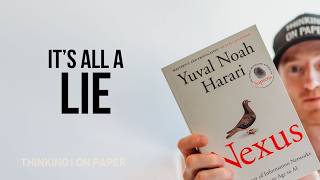
Is AI the problem, or are we? Yuval Noah Harari writes that computers aren't yet powerful enough to escape our control by themselves, and that as long as humanity stands united, we can build institutions to control AI.
Who stops clapping first? Chapter eight of Nexus opens with Solzhenitsyn's account of a Stalin-era party conference where the applause ran for eleven minutes, until a paper factory director sat down and was arrested that night.
Boris Mamlyuk and Anuj Dasgupta build smart transactions at STXN, which they describe as time travel on the blockchain: the ability to go back and fix a transaction after it has gone wrong.
Who pays for the surveillance of modern life? Yuval Noah Harari points out that we pay for the digital agents ourselves, and carry them with us wherever we go.
Has the AI takeover already begun? Yuval Noah Harari argues that computers able to pursue goals and make decisions by themselves change the fundamental structure of our information networks.
What gives religion its authority? Yuval Noah Harari argues that its most important function is to provide superhuman legitimacy for social order.
Why are stories more powerful than truth? Yuval Noah Harari argues that humans rule the world because we cooperate in large numbers, and we cooperate in large numbers because we tell stories.
Does more information make us wiser? Yuval Noah Harari opens Nexus by arguing that power isn't wisdom, and that the naive view of information gets it wrong.
Leonard Tang stress tests large language models for a living, and he says he never really believed in them in the first place.
Don Norman started the world's first cognitive science department, became vice president of advanced technology at Apple and wrote The Design of Everyday Things. Now he wants design centred on humanity rather than on individual users.
Olas Protocol founder Ciaran Murray is building an open publishing system in which the crowd, rather than an editorial board, funds writers and checks what they publish.
Todd Haselhorst is CEO and founder of Heale, a unified API for logistics, and he says the middle mile of freight is still a complete mess.