Most Human Wins
A memo written as if from the Boring Institute to the Council of Humans on Earth warns that people who compete for specific jobs will increasingly lose to machines.



In this episode · 15 chapters
The ingredients to do your job are changing and those ingredients are your former outputs of work.
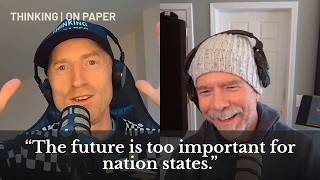
Mark and Jeremy read Packy McCormick's Not Boring memorandum on how people compete as AI commoditises skills such as writing, graphic design and coding. Its core advice is short: “Don't just move up the stack, run up the stack.”
They weigh it against the Prussian school model, Michael Porter's three generic strategies and Rockefeller's Standard Oil, and ask whether it works for people who aren't entrepreneurial. The news segment compares the Stargate project with the UK's AI opportunities action plan.
Most Human Wins, a memo by Packy McCormick of the Not Boring newsletter, argues that “people who compete for specific jobs will increasingly lose to machines” as AI commoditises skills, so value moves to what is scarce and most human. On the Thinking On Paper podcast, Mark Fielding and Jeremy Gilbertson test that advice, then cover the $500 billion Stargate plan from OpenAI, Oracle and SoftBank and the UK's AI Opportunities Action Plan.
Is AI replacing people or commoditising their skills?
The memo argues AI is commoditising specific skills, making them cheap and interchangeable, rather than replacing whole people. Mark reads the economic rule behind it: as the cost of tasks from code to design falls, “the value of their substitutes decreases and the value of their complements increases.” The memo also warns that the more machine-readable your work is, the more trouble you are in.
What does run up the stack mean in Most Human Wins?
McCormick's strategy is “Don't just move up the stack, run up the stack”: treat whatever is being commoditised as an input. He tells readers to offer what becomes scarce and precious when something once scarce becomes abundant and cheap, and the hosts discuss his example of Rockefeller's Standard Oil, which moved into refining and distribution as crude oil got cheaper.
How does Michael Porter's strategy apply to humans and AI?
The memo draws on Michael Porter's competitive strategy from the 1980s, which names three generic business strategies: cost leadership, focus and differentiation. Jeremy's reading is that AI wins on cost and focus, so humans have to compete on differentiation. The memo puts it as “Novel experiences are the human currency.”
Why does Jeremy reject perfection as a goal for AI?
Jeremy rejects the memo's line that “perfect AI will possess the Midas touch” as a goal. He compares it to quantising a beat in a digital audio workstation: “The ability to dance is not driven by perfection. It's driven by anticipation.” He argues that people who filter and guide, with taste, will become more valuable as AI floods the world with content.
How do the UK AI plan and Stargate compare on investment?
In the news segment, Mark reads that the UK's AI Opportunities Action Plan is backed by a 14 billion pound investment from tech firms, and that the $500 billion Stargate plan from OpenAI, Oracle and SoftBank starts with 100 billion. Jeremy proposes judging such investments by tokens per dollar per watt, alongside power usage effectiveness (PUE), the standard ratio of a data centre's total power to the power its servers use.
Where Mark disagrees with the memo
Mark says “my concern with this memorandum is that it's not applicable for most people.” The memo tells readers to become entrepreneurs, and he asks what that looks like “for normal folk who aren't entrepreneurial in spirit”. He expects “a lot of collateral damage” and a lot of people left behind.
Links from this episode
Questions
What is Packy McCormick's Most Human Wins memo about?
Most Human Wins, a memo by Packy McCormick of the Not Boring newsletter, argues that “people who compete for specific jobs will increasingly lose to machines” as AI commoditises skills, so value moves to what is scarce and most human.
What do Mark and Jeremy compare the Not Boring memo with?
They weigh it against the Prussian school model, Michael Porter's three generic strategies and Rockefeller's Standard Oil, and ask whether it works for people who aren't entrepreneurial.
What news does the Not Boring episode cover?
The news segment compares the Stargate project with the UK's AI opportunities action plan.
Transcript
Jeremy Gilbertson Disruptors and curious minds, welcome to another episode of Thinking on Paper, your personal vehicle to understand the intersection of culture and emerging technology, how it applies to business, how it applies to family, how it applies to relationships. That's what we are here to do. My name is Jeremy. This is Mark. And as always, we have this episode broken down into multiple segments. We have a first interview segment, which will be interesting today because we're doing something just a little different.
We have a hot button segment, which is turning out to be the fan favorite with Mark Fielding, and we have the news, and then we unpack a bunch of stuff backstage at the end. Mark, how are you? And what the heck are we talking about today? I'm very well. I'm very optimistic ahead of today's show. We're going to be unpacking Paki McCormick's Not Boring newsletter. And this was your idea.
Mark Fielding It was a great idea. And I think it came at a very pertinent time for me personally, because I am a content creator, a writer. And the last couple of years, I have noticed my clients, the number of my clients declining, my work declining as more and more people use AI and keep the work in house. I need to adapt or I need, or I will die. And so today in this newsletter, Paki McCormick kind of outlines a strategy for surviving, flourishing, thriving in a world of AI.
A secret memorandum
Mark Fielding He writes it as a secret memorandum from the Boring Institute to the Council of Humans on Earth. That's you, that's me, that's our listeners. And the idea is that it will give people who don't want to lie down, roll over, and let AI take their jobs a toolkit to fight back. We love toolkits. We love frameworks. We want easy buttons. We want answers, especially to big problems. Let's just jump right in.
Jeremy Gilbertson The reason why this was so appealing, I think, like you said, right now, a lot of people are like, man, what is going on with AI? Especially I hear it's like replacing something that I kind of do. I'm a coder, I'm a writer, I'm a graphic designer. Now people can just push a button and some cool stuff comes out. How do I maintain my participation in the economic engine? That's fueled, isn't it, by the leaders of these AI companies who every day say that critical thinking, creativity, content creation, your jobs, whether you're designing, whatever you're doing, they're at risk now.
And that makes us more fearful. That makes us more scared. That makes us question our usefulness and our ability to survive, doesn't it, and work and earn money. Absolutely. It's definitely somewhat of a frightening proposition. That's why we want to help kind of share some of these great insights that he had. The memorandum is what, about 35 pages? I mean, definitely read it. It's super valuable. But here's some nuggets to kind of set the stage. Let's start with a couple of defining terms. Let's talk about commoditization.
Complements
Jeremy Gilbertson And then we'll talk about complements. First of all, what people are concerned about right now, and rightfully so, is that AI is commoditizing certain human skills. Certain human skills like writing, like graphic designing, like coding, like marketing, like all of these other things, all of these things that humans do very well. Now machines are able to approach the threshold of doing them equal or better, at least in certain tasks, right?
Which quicker. And quicker. And quicker, exactly right. And the cost for doing said thing is coming down too, which makes it even more and more appealing. But the important thing to think about here is not AI is going to replace or commoditize humans. AI is going to commoditize and replace certain human skills. And if you live in just the window of that singular human skill, let's say, I mean, look at calculators, right?
So Karen Johnson, the brilliant mathematician who helped get, what was it? Who was the astronaut? Jeez. John Glenn. Get John Glenn back from the moon, right? She was what was called a computer. She was a computer, like literally. And she had a piece of paper. She had a chalkboard, maybe a slide rule or whatever the heck else it is, but she literally was a computer. So now, even in that movie, there's a movie out about that whole thing, talked about IBM coming in and now these computers where you fed cards and all of that stuff that was teased in very early in the essence of that story.
But are mathematicians still valuable? Hell yes. Is it easier for a mathematician to do cooler things by offloading some of the, we called it grunt work last time and doing that grunt work quicker and faster. So the way I look at it, Mark, I think the ingredients are changing. The ingredients to do your job are changing and those ingredients are your former outputs of work. That's a pretty crazy thing to think about, right?
Your input equals your output
Mark Fielding Your input equals your output. So change your input. I like that, the analogy of the mathematician. If you used a modern day, a marketing expert, somebody their job is to write emails, write tweets, write deep dives on LinkedIn, write white papers. That, if you just do that, if you just focus on that, you are going to be superseded by AI. AI is going to do it better than you. It's going to do it quicker than you and it's going to do it cheaper than you.
And your ability, you might still be able to do it, but you're going to have no value. Your value will decrease because there is a cheaper alternative to you, a replacement, a substitute, what he calls a substitute. The more machine readable and interchangeable your processes and outputs are, the more trouble you are in, he says. And so the more you rely on AI, the more you give over your tasks to it, the more in danger you are.
And so this Memorandum on Human Strategy kind of gives you a way to think about breaking out of that. And I was thinking about music as an analogy. You're a musician. I was thinking about the analogy of music and how in the 1970s Pink Floyd got boring. So you had the Sex Pistols and the Ramones.
This is this idea where the input changed the output. They built on something that came before it. And I think the point of this Memorandum was, for me, and correct me if I'm wrong, but take what AI gives and build upon it. Create something new. Just add it. If your input is books and conversation, add AI into that input to create a new output. Am I thinking along the right lines there? Yeah. The way I think about it is he talks about it.
Jeremy Gilbertson There's a thread throughout this whole paper of aiming higher, of stepping into the next higher level of abstraction, which is interesting because we've always talked about this idea of polymaths, of interdisciplinary thinking, of nexus thinking, Julio-Tino plug, ding, ding, where you don't have just your convergent mind activated, where you're specializing in one thing. You're actually able to explore multiple threads and see in between multiple things.
So that's this higher level of like, okay, what are the adjacencies between all of these things that I'm doing? And you can't think about that kind of stuff. You don't have time to think about that kind of stuff if your head's down, buried, running through a pile of data to get insight on something or to create the framework of a website. So let's look at, as an entrepreneur, all of these tools pre-AI that started coming out to help entrepreneurs.
Squarespace
Jeremy Gilbertson You had Squarespace where I didn't have to HTML code a website anymore. You had, let's see, what else? Like QuickBooks, where I didn't have to hire an accountant to send invoices and manage my AR and do financial statements. Very simply high level, right? So these are mechanical extensions of humanity, which helped entrepreneurs. And you have this big push right now. This is going to be really interesting.
You have this big push for people to, and he references this in his memo, for people to kind of be not just a, he used to quote, not just be a businessman, but be a business comma man. And I don't know if that was a Rick Rubin quote from his book, but he referenced Rick Rubin. But this idea of like, what can you do to think about making something, about creating something, about doing something instead of participating in someone else's doing of something.
That's where things could get really interesting. That's where entrepreneurship could really scale. But who knows? There's probably a whole other side of this where everything gets automated. So if everything gets automated and everything is, is money even a thing anymore? If everything gets done by something else other than humans, like does money become something that's not anything anymore?
Mark Fielding I know I'm spinning around in eight different directions. Let's pull it back. That's E&M Banks and the culture novels, which I often talk about. So he does talk about financial analogies. He says, become an entrepreneur. He says, quote, people who compete for specific jobs will increasingly lose to machines, which is what I'm going to tattoo on my children's arms, I think so that they know that in the future, because that comment really struck me.
Who loses
Mark Fielding People who compete for specific jobs will increasingly lose to machines. And I worry, okay, here's one pushing back on, become an entrepreneur. Work for yourself. I mean, perhaps an analogy for the LinkedIn, for our LinkedIn fans is, you know, personal brand building. Okay. Transcend the job. That's really, really difficult. Become an entrepreneur. Unleash your own shackles. Be free. What does that look like in reality for normal folk who aren't entrepreneurial in spirit?
Jeremy Gilbertson Are they the ones who lose? I think there might be a lean to give the advantage to someone that is more entrepreneurial minded than someone who is comfortable wanting to just specialize in one particular skill. And because that skill will eventually go away. We're taught at school, Jeremy. Say that one more time. Like we're taught in school. Yeah, to specialize, right? We talked about this all the time in the 1800s.
The Prussian school model
Jeremy Gilbertson The Prussian school model gets referenced, right? Not to say all Russians or Prussians or people from that area are robots and machines, but their model of school that basically created the same individual to be spun out to work in factories as a widget was co-opted by Western culture a long, long time ago. And I'm not going to jump on Soapbox for too, too long because there are great schools and great teachers and people who have a high level of care in educating.
There is also a model that's still a little bit broken. It's spitting out widgets where it needs to be spitting out creators. It needs to be spitting out thinkers that are able to activate ideas. And there's a segment of this too, that I thought was really interesting. As entrepreneurs, you always hear, well, yeah, great ideas are a dime a dozen. It's all about execution, right? But now with AI, he points out, and I agree with him, AI could make execution a hell of a lot easier than it used to be putting the value on the ideas, right?
Putting the value on seeing the adjacencies, the interdependencies, the things living in the smoke between two subjects where you could figure out as a human what to do with it, what to make, what he calls a novel experience, a new novel experience, but doing that with more efficient tools. Yeah. What does he say? Novel experiences are the human currency. Commoditization reduces the value of specific capabilities while simultaneously enabling the growth of new experiences.
Most human wins
Mark Fielding And this is why most human wins. Again, if you're a graphic designer, what does a new human experience look like, feel like, sound like? How do you get there? At what point does the AI beat the human at seeing the interdependencies and seeing the clouds and the shadows between subjects? And polymath AI, AGI is the ultimate polymath, is it not? And so I really like this memorandum. I think I've read a few times and really, really kind of know yourself to know how you can apply it to your existence, to your job, to your career, to what you are interested in. And that's a difficult part. Yeah. And he, and he references a lot.
Jeremy Gilbertson I mean, he's a, he's a, he's a heck of a researcher and writer and, and, and connecting old things to new things. And we talk about how anything new rooted in old is easier to understand. You know, there are a lot of older business models that he references, Michael Porter's competitive strategy written in the 1980s. It talks about these three kind of generic business strategies, right?
One is overall cost leadership. The other is focus. And the third is differentiation, right? That's it. Just one of them, right? Because he talks about the, on the cost side, you know, cost declines are, are just, are just rocking and rolling right now. And, and he says, never bet against the curve when it's going that way, which is right. And then the ability to focus on something, something is better than us at focusing on one particular thing.
And it's going to only improve, you know, with these skillsets of coding and math and, and all of that stuff. So what do we do? What is, what do we lean on? What's the third one, Mark? Differentiate ourselves, differentiate our thinking, differentiate our products, differentiate Steve Jobs. So how do we do that? Right? How do you do that? So I think there, there's an interesting callback.
What drew me in to this, the tee up that he did to this memo in his actual newsletter drew me in because he started talking about very human things that technology are these mechanical extensions of ourselves as technology, the phone, the computer, the you know, the car, the plane, all of these things are extensions of, of us as humans. And he teased the idea of like, Hey, there's a circular thing happening here where we're eventually going to bust through this, this tech cycle, this tech extension cycle back to humanity, back to what makes us human.
So I start thinking about this. And as I see technology getting crazier, people looking at their phones, people like, you know, locked in and not communicating on a human to human level. I start thinking about, Hey, there's going to be a thinking on paper cave where we have record players and books and candles and pencils and, and things a little couch to where we can have meaningful discourse to understand the meeting of us in the planet.
Mark Fielding Like, like, I don't know, did you, what do you think about that as a, as a, as a, as a predictor of things that were actually going to be less tech influenced and more human in the future? The winners, not the losers, the minority, not the majority. I don't see us turning back. We are a technological species. We are an AI species. We are going into the future, dancing hand in hand with what we've created.
And perhaps there has to be for some, a reconnection with what came before in order to surpass what exists. But on mass, I think there's going to be a lot of collateral damage. I think there's going to be a lot of losers and I think there's going to be a lot of people being lost. And is this a way, this is really, I just, if I had to, my concern with this memorandum is that it's not applicable for most people.
And so vis-a-vis there will be lots of losers. Can I, I want to, I'll tell you what, let's do hot buttons. We'll leave a bit and then we'll work on a strategy. But before hot buttons, I want to leave with a quote from the paper, which is, I think sums up what I've been speaking about.
Run up the stack
Mark Fielding Don't just move up the stack, run up the stack. As something is being commoditized, determine how to use it as an input to propel yourself up the stack. Offer what becomes scarce and precious when something once scarce and precious becomes abundant and cheap. That is what we're going to unpack after the hot buttons. Sounds great. Sounds great. Let's hit hot buttons. Fire away, Mark, what you got for me?
Well, have you got a clock? Are we doing out of the clock when I find them? Oh yes. We'll get the clock. We'll get the clock. We'll get the clock. All right. I'm ready when you are. Okay. So he talked about raging bull. We had a clock dysfunction. Fire again. Taxi driver or raging bull? Taxi driver. What's your superpower? One word. What's my superpower? Synthesis. Describe AI in one word.
Jeremy Gilbertson Offloading. Mindfulness or transcendental meditation? Mindfulness. We are one or we are infinite? Both. No? Five in five. Well done, Mark. Well done. I like your humanity touch on all of those things. So back to what he's talking about. Yeah, 100%. Most human wins. Isn't that the last line? Almost most human wins. So do you... I'm going to call BS because we're the most human there are and we're not winning.
Where's all my money? Oh my gosh. Well, it's not there yet. Timing is everything, Mark. Timing is everything. So let's point back to the thing you said right before the hot buttons, the idea of when a resource gets scarce, let's talk about the opportunity there. So tee that up again real quick and we can have a conversation. Hold on. Give me a sec. Give me a sec. Don't just move up the stack, run up the stack.
Commoditised
Mark Fielding As something is becoming commoditized, determine how to use it as an input to propel yourself up the stack. Offer what becomes scarce and precious when something once scarce and precious becomes abundant and cheap. Offer what becomes scarce and precious when something once scarce and precious becomes abundant and cheap. So what would be... So he references standard oil, right? Rockefeller and standard oil when crude oil became cheaper, right?
Jeremy Gilbertson And that was a resource that was once more precious. Price came down. Availability was more accessible. So he took that one input and went into distribution, went into refining and that sort of thing. So he took that.
But man, we're not all JD Rockefeller. So what do you think is an example of us taking something now that was once precious and using it as an ingredient? Remember, the ingredients are changing, right? So what's a new ingredient that someone could take and run with? Well, spot quiz. I hadn't heard that question before. And just as you were speaking, something popped into my mind. And it was comedy, humor.
Mark Fielding And with the homogenization of messaging, with the homogenization of social media, and maybe these are... I just followed the wrong people, but somebody's kind of turned off the funny button, haven't they, in a lot of this? And maybe comedy, humor has become scarce. And maybe that could be something you add in to your messaging. Be funnier, be more... Yeah, funny, comedy, humor. There you go.
Jeremy Gilbertson So that's a point of connection, right? With humor, it has a chance to do two things. Number one, lets people let down their guard and potentially make a connection, right? But humor can also go on the bad side. If you go more into sarcasm or that sort of thing, you get into... I'm going to put my guard up and be like, Mark's kind of the jackass by saying that, right? So humor's a little dangerous.
The human touch
Mark Fielding And it's the human touch. What did you say there, John? I just heard it again. I don't mean danger as in jumping off a high cliff without a parachute. I mean, put people's backs up. You're talking about scarce things, which are scarce. So I don't know, I've not thought about this. Okay, what about you? What comes to your mind? Anything practical? I don't know if humor is a practical thing.
Jeremy Gilbertson If you're a designer, if you're a marketeer, how do you find the scarce? What do you do differently? Man, I think it's really interesting to think about the availability of information that's out there right now, the availability of data that's out there right now, but turning that into a useful insight or something that I could take as an ingredient. So my ability to process right now, I like reading books and I enjoy the slow process of reading books, but if I wanted to do some research on something, I could accelerate my learning and research on that to generate ideas.
So there's an old adage of generating bad ideas can lead you to good ideas. And when you try to generate a bad idea, your guard's down and you don't really care. So what if you were able to parse through a giant chunk of information about a subject or about multiple subjects and then create 10 bad ideas out of that just as a fun exercise, right? So this brings us back to what makes us human is the ability to create these connections between things.
Creativity is the useful arrangement of found elements, right? Or the unique arrangement of found elements. You might see four building blocks differently than I see four building blocks, right? And my unique take on it could lead to something novel. Your unique take on it could lead to something novel. But we as humans have to be willing to do that thing. We have to be willing to uncover the Lego blocks and willing to look a little silly in mashing up different combinations of those
Mark Fielding Lego blocks. That's something that I think if we lean into, we can get up that level of abstraction or what did you say? Run to the... He calls it running up the stack, doesn't he? That abstraction of human experience. I think you touched on something there, something being scarce and precious, something that's very scarce and precious right now, as well as humor is looking silly, looking stupid, ego.
Everyone has an ego and people don't like looking silly. So maybe that's some kind of superpower you could add to the way you think and work. I want to add a little bit of the paper. I'm going to quote him again. If the cost to perform certain units of work from math problems to code, to marketing, to finance, to sales, to design, to customer support calls is decreasing, then the value of their substitutes decreases and the value of their complements increases.
Complements and extensions
Mark Fielding So complements, so something that I've been doing as a writer marketer is complementing that with speaking gigs. I complement what I do. I will add things to my skill set rather than doubling down on writing tweets, but that's not going to work, is it? So I'll add a compliment. So maybe whatever domain you're working in, add compliments, make your value increase by being better at multiple things.
Jeremy Gilbertson Compliments and extensions, right? It goes back to like, there's that book a while back, The Adjacent Possible, right? So what are you doing and what things are adjacent to that thing you're doing and how can you extend into those pieces? But man, we talked about this before, we're taught that we have to pick a path. We have to jump on that conveyor belt and kind of ride it for 30 years until we can go to the beach.
Like that's ingrained in our head and it's ingrained because we have a deep need for security in us as humans. And there's a fear of not being secure. And that is kind of manipulated by these, hey, you got to jump on this conveyor belt. You got to get a job. You got to get insurance. If you don't do that, if you play around and be entrepreneurial minded and big thinker, then you're going to be in a risky situation, right?
So I don't know if this enables entrepreneurship or it just elevates those who are willing to be entrepreneurs and leaves the rest holding the bag. It's kind of scary. I mean, I would want to figure out how we can help those people understand that they can be creative, understand that they have that capability. It just gets beaten out of us. At a very young age, Picasso said, all kids are genius until they become adults, right?
Mark Fielding So it's like, how do we rekindle that? I think that's the opportunity. How do we rekindle that? I think just turn everyone into personal brands. How do you think about this quote, the simpler the product is for anyone to make, the more important brand is. Brand exists at a higher level. And then he gives some examples, some pretty obvious examples. But is that giving us all a carte blanche to make our own personal brand? I'm actually exhausted at the idea of personal brands.
Jeremy Gilbertson The whole LinkedIn thing, become an influencer and be this invented construct of yourself instead of just clearly demonstrating the value. But that's not how you scale. You don't go from a certain- Not in the attention economy, Jeremy. Not in the attention economy. That's right. That's right. A couple of quick things before we go to the news, because there are a couple of points in the news and some analysis that you'd been doing on this whole AI thing.
What makes you dance
Jeremy Gilbertson I want to talk about, he references, actually, a quote in this paper, perfect AI will possess the Midas touch. Everything it touches will turn to perfect. I'm going to tell you, I hate perfect. I think the reason why shit is cool is because it's imperfect. I'm going to give you a musical analogy. Say I make a beat in a digital audio workstation in Logic or Pro Tools or something. I create a beat and I quantize that beat, meaning it goes to perfect segments of that beat, whether it's a quarter note, an eighth note, or 16th, perfectly segmented.
Guess what makes you dance? A delay in that beat, a push in that beat. The ability to dance is not driven by perfection. It's driven by anticipation. of what, when perfection messes up, right, that's the, that's the cool stuff. Like the, the, the bleeding of a color in a painting that makes something super interesting and novel. So it goes back to this novel and unique approach. Um, what do you think about that with perfection and like AI being able to do everything perfectly?
Mark Fielding I, I, okay. You use music. Yeah. What is perfection anyway? I don't think God saved the queen was deemed a perfect song. Was it Quentin Tarantino? Okay. Group in the nineties when Pulp Fiction, when Reservoir Dogs came out, it wasn't. Nobody had an idea of what perfection was. Who decides what perfection is anyway? No, I don't. And he used it in the paper. He uses the example of Paul Schrader, which is why we had Paul Schrader in the, in the, in the hot buttons about.
Yeah. Then if everything's perfect, then we go back to what's the differentiator. Don't you? If everything's perfect and there's a billion films, then you still have to decide which film to watch. So you have to, what's the differentiator? Is it that people like that? The imperfections, the personality, our perfection, our personalities, our imperfections, you know? So yeah, screw, screw perfection.
Jeremy Gilbertson Well, and, and also you mentioned like deciding what to watch or deciding what to listen to, right. And there's that, there's that piece of it in Kevin Kelly, who we are super excited to announce is going to be going to be on the, going to be on the show this, this April, which is, is going to be amazing. I read his book, uh, the inevitable 12 tech trends a long, long time ago. And he references this idea of filter, right? There's going to be, but even back before AI, there was more information created in a day that anyone can watch in a lifetime.
Filtering
Jeremy Gilbertson So the important aspect of filtering, right? So say AI can create all this content, can create all this stuff, right? I listen to Spotify. I listen to music on Spotify. I can, I can listen to any song I want at any time. Right. But I still go to playlists because I want like, Ooh, I like this music. What else can I, I look for filter buttons. I look for easy buttons in that regard. So this ability to be tour guides, to be filters, to be not literal tour guides, but like experience guides in any kind of discipline with some sort of taste of imperfection, um, could be really valuable down the road.
It is really valuable. It always has been really valuable and it will be increasingly more valuable than it's ever been. There you go. Let's go to the news. To the news. All right. A couple of quick things that we're going to want to touch on in the news related to some more tactical things about AI. So the first point we want to talk about is, uh, infrastructure plans behind building this capability of AI.
And also the second piece of this is a metric on evaluating the success of that infrastructure. So Mark, let's talk about the Stargate project and, you know, a group of companies that happen to have $500 billion that they're ready to deploy over the next four years in the States. And then what, what's happening over in Europe? What do you see in there? Over in England. So for new listeners, I'm English.
Mark Fielding I'm from England. Jeremy is American. And about a week ago, the UK got really, really excited about the UK AI plan. To quote the government recently unveiled an ambitious AI opportunities action plan backed by a 14 billion pound investment from leading tech firms. The plan includes establishing AI growth zones, creating new jobs and investing in infrastructure like supercomputers and data centers.
The goal is to boost economic growth, enhance public services and position the UK as a global leader in AI innovation. 14 million. And then of course, yesterday, the day before the $500 billion Stargate AI plan announced by Trump and OpenAI in working with Oracle SoftBank, the project aims to build advanced AI infrastructures across the US starting with an initial investment of 100 billion. The plan is expected to create over a hundred thousand jobs and establish the US as a leader in AI technology.
And Elon Musk has already come out and said, that's BS. They don't have any money. At least they're coordinated and collaborating, right? Just like the US to be like, oh, 14 billion sounds like a massive investment and awesome from a, from the UK perspective. And it's like, nah, we're going to do, we're going to do 500 billion. But like. I don't even think that the UK's landed on their radar and looking at the UK thing, there's nothing about web three cryptos, nothing about blockchain. There's a lot missing out of it.
Jeremy Gilbertson Reading, I think it's almost like, call to book club, we're reading Nexus, information isn't truth. Right, right, right, right. A lot of it, a lot of it is, you know, posturing and talking and that sort of thing, because, you know, I don't, I don't know how 500 billion comes together and how it's deployed over the next four years by, by some organizations. I bet we could put $500 billion to way better use than building out server racks, power distribution units, UPSs, generators, and cooling towers to make, to make AI happen.
I mean, think about the greater good of things we talked about in the last XPRIZE episode. But, so, so as we, as we think about this, as we think about this technology, like the costs are going to go down tremendously, like, so there's a scaling law that's out there, you know, as, as you know, there's Moore's law, you know, on resistors and chips. There's a scaling law that says, what is it that the size and complexity of AI models doubles every six months.
The cost of GPT
Jeremy Gilbertson And Paki's paper references the cost of GPT-4 type technology has dropped 600 times since 2023, 600 times. Like how, how does that, like, that's, that's, that's super important because it's only going to increase. I mean, 600 times cost decrease. And you're talking about $500 billion being invested to build more of these scalable types of infrastructure.
That's only going to reduce costs, only going to commoditize things more, only going to get people's, um, I don't know, not get people's attention, but it's only going to, it's only going to bring forward the importance of turning on that human light bulb again and figuring out what to point to, how to, how to get a layer up, how to use your own creativity and novel ideas and know how to create and build new things. Using this resource that used to be scarce, compute used to be scarce, right?
Compute resource used to be scarce and used to have to, Mark, if you and I were researchers and we were at a university and there was a, uh, a shared research computer, we used to have to compete for time on that computer. And I would try to, I would try to take as much time on a computer as possible so I could compute a bunch of stuff. And then that would limit your ability to use that. Now we've got more computers on our phone than that whole university had way back in the day.
Mark Fielding Right? So paradigm shift, right? We need to get a guest on if anyone's listening, who works in data centers specifically for AI, because that 600 X decrease in what a year, year and a bit, is that mostly because of GPU power efficiency and how the models are programmed, like what's driving that cut and if it is GPU, what's the impact elsewhere? What are the knock-on effects where we're not being, where we're not seeing it on a, an energy level?
Jeremy Gilbertson I want to talk to the space data center people. Uh, hopefully they'll have time for us. Uh, what was the name of that company? Lumen Orbit. Lumen Orbit. We want to talk to you. We want to unpack this stuff, um, because, well, this is a rabbit hole, but now lower earth orbit, it apparently is going to be too crowded to do anything at some point, and they're actually companies designing technology to remove trash from lower earth orbit. Anyway, I digress. Um, massive investments or massive announcements of investments are happening right and left.
How you analyse success
Jeremy Gilbertson Let's talk about how you analyze the success of said investment, right? Um, so I came across a video that was shared by Chris, uh, Moller. Is it, do you say Moller? Is that how I would say it? Yeah. Moller. He's one of our listeners. One of our collaborators, he does some great work, does some awesome work, resilient communities, all of that stuff. Um, he shared a video from Nicholas Thompson from the Atlantic that had, um, uh, Microsoft CEO on this quick little video and talking about this idea of a new metric to, um, to see how efficient we are in deploying AI infrastructure.
So there's an old metric. Let me talk about a metric speaking to data centers. It's been around for a while. That's called P U E. It's called power usage effectiveness, right? So in data centers, you have it load it's servers and compute stuff, assets, storage devices that are, uh, that have a specific power draw. And then you have the facility infrastructure on the backend of that, that supports that power being up all the time with redundancies, right?
So oftentimes you design two different systems electrically and mechanically to make sure that one system doesn't go down. So P U E has been a rating and data centers for years and years and years. And, um, now we're talking about tying it down to tokens per per dollar per watt, right? So three pieces of the component tokens is basically how, uh, information is chunked up and, and fed into models, right?
So you have, so you have the tokens and then you have the electrical power. Needed to do that processing of the tokens. And then you have the dollar cost of that electricity of the redundancy behind that electricity, like we talked about in, in P U E. So this could be a new metric for analyzing how efficient these systems are, not just from a compute standpoint, but how are we doing environmentally with this stuff as well?
Mark Fielding Well, that's a very big, big question. I think in, in the, the memorandum from Not Boring, there was a 30 cents for 2 million tokens on the new OpenAI, OpenAIO3 model. And so 2 million tokens, I think a token can be, depends how they categorize it, but like a word, a phrase, a couple of words. So 30 cents per 2 million, they talk about trillion data sets of trillions. So that's where the money goes.
Jeremy Gilbertson Yeah. Do you have a question on how do you measure success in these investments? I mean, that depends, doesn't it? I mean, how do you measure success with a complete failure of trying to get AI everywhere? There you go. One, one other metric that I was thinking about too, is this idea of, um, AI inference, right? And I, and I looked this up a little bit and it's how quickly a model applies what it has learned to new information.
That really should be like the, you know, the, the test of how well it works and how quickly it assimilates to that new information. So what I'm picturing like this dashboard, right? So you have like PUE, you have, um, you have tokens per dollars per watt, and then you have AI inference time and like all of these different things, um, because we love to create dashboards, right? Dashboards to look into, you know, the, you're the CTO and you're like, Oh, let's look at our dashboard. Let's look at our AI dashboard. Oh man. Our inference, our inferences is way down.
Jeremy, how can we increase that? Right. So anyway, we've been, we've been going on and on. That is the news. We're talking about investments. We're talking about how you evaluate how well these investments are doing. Um, we've unpacked Paki McCormick's, um, call to humanity or call back to humans and their superpowers and understanding what they are not to understand what they can become.
It's a, it's a, he references this netty netty Sanskrit, uh, term that was really interesting and a call back to me, humanity, Paki, we would love to have you on the show to talk about this stuff. We can only do it justice by reading what you wrote in, in kind of inferring it ourselves. But, uh, we'd love to have you on the show. If anyone knows Paki, get us in touch. Yeah. Netty netty.
Mark Fielding You are what you aren't subtraction take away. Um, yeah. And I think we'll leave you with one of the closing lines of the memorandum. The more human you are, the more likely you are to win good news for us humans. There you have it. Stay curious, be disruptive, keep thinking on paper.